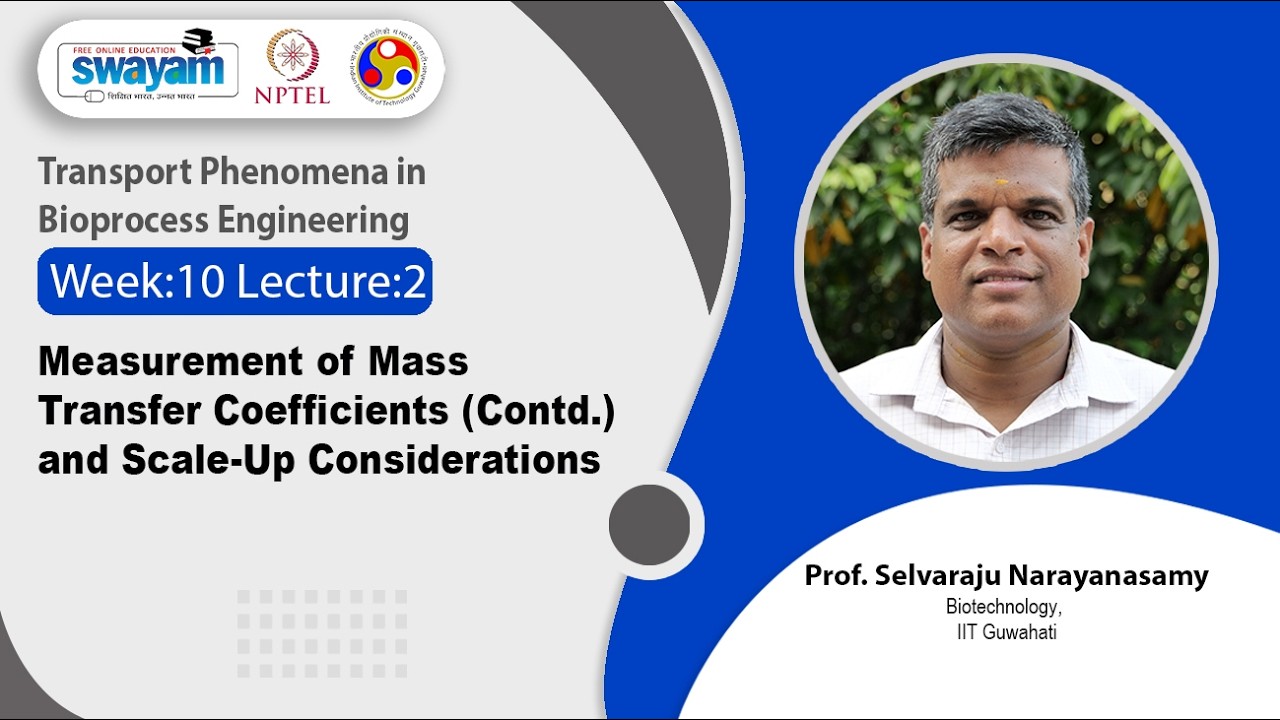
Lec 47: Measurement of Mass Transfer Coefficients (Contd.) and Scale-Up Considerations
Keywords
Summary
148 words
Critical Evaluation
Value of the Information & Strength of the Argument
The lecture provides a systematic and quantitative presentation of kLa measurement and scale-up, valuable for bioprocess engineers. The argumentation is logical: starting with the principle of oxygen balance, deriving equations, and applying them to a realistic example. Comparisons between methods are clear, highlighting trade-offs. The discussion on scale-up is pragmatic, acknowledging the complexities of maintaining performance from lab to industrial scale. The content is well-structured and builds on previous lectures, demonstrating pedagogical solidity.
Scientific Rigor, Source Quality, Title Accuracy
Scientific rigor is high: the lecture follows standard chemical engineering principles, uses consistent SI units, and clearly states assumptions. The source is an NPTEL course from IIT Guwahati, a reputable educational platform. While no external references are cited in the video, the material is fundamental and widely accepted. The title matches the content exactly. No viewer comments are provided for analysis.
149 words
Title / Content Match
Title accurately reflects the content: continuation of mass transfer coefficient measurement and scale-up considerations.
Quality & Reliability
9/10
University lecture from IIT Guwahati, part of NPTEL course; rigorous treatment, clear methodology, appropriate depth; lacks in-video external citations but relies on established chemical engineering principles.
Key Moments
Markers derived by PSI from the transcript: the creator did not define chapters.
- Introduction to oxygen balance method and its advantages
- Assumptions of oxygen balance method and applicability to lab-scale
- Worked example: calculating NA and kLa for a 10 L bioreactor
- Comparison of kLa measurement techniques and their best use cases
- Factors affecting kLa: agitation speed and power input
- Aeration rate and broth viscosity effects on kLa
- Temperature, reactor geometry, and pressure effects
- Scale-up strategies: constant kLa, P/V, tip speed, and volumetric flow
Cited Sources
- Transport Phenomena in Bioprocess Engineering - Course — Official course page with additional resources and lecture materials.
- Playlist for Transport Phenomena in Bioprocess Engineering — Full playlist of lectures for the course.
Contribution & Novelties
This lecture consolidates knowledge on kLa measurement and scale-up, emphasizing the oxygen balance method and its practical application. It clarifies the transition from lab-scale to industrial-scale, which is crucial for bioprocess design. The worked example bridges theory and practice.
Pour aller plus loin :
- Mass transfer coefficient — Fundamental definition and theory behind mass transfer coefficients.
- Bioreactor — Overview of bioreactor types and design considerations relevant to scale-up.
- Oxygen transfer — Mechanisms of oxygen transfer in fermentation systems.
78 words
Radar Profile
The scores indicate a balanced profile with high quantity and quality of information, advanced technical level, and strong reliability. The lecture is comprehensive and trustworthy, suitable for advanced students and practitioners.