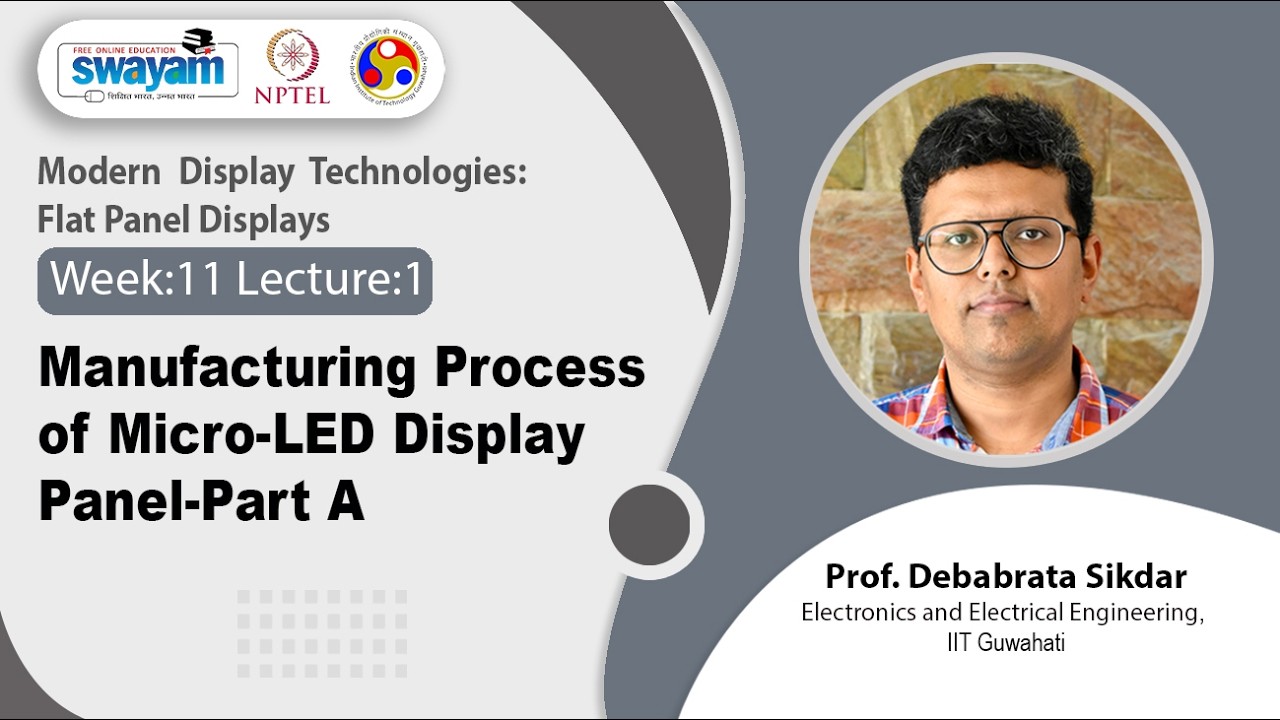
Lec 52: Manufacturing Process of Micro-LED Display Panel-Part A
Keywords
Summary
154 words
Critical Evaluation
Value of the Information & Strength of the Argument
The lecture provides substantial value by offering a detailed comparison of the two main MOCVD reactor types used in microLED production, including actual uniformity data and economic considerations. The argumentation is logical and evidence-based: it first establishes the necessity of high-yield, high-uniformity growth, then explains how each reactor design seeks to achieve this through fluid dynamics and rotation mechanisms. The presenter clearly articulates the trade-offs between the vertical and horizontal systems, using concrete examples like the ‘windward effect’ and the ‘gas foil’ solution. While the lecture is technical and assumes some familiarity with semiconductor fabrication, it successfully communicates the key engineering challenges and metrics without oversimplifying. The argumentation could be strengthened by citing specific sources, but the internal logic and data presentation render it convincing.
Scientific Rigor, Source Quality, Title Accuracy
The content is sourced from NPTEL, a nationally coordinated e-learning initiative by the Indian Institutes of Technology, ensuring academic reliability. The lecturer, Prof. Debabrata Sikdar, is a faculty member at IIT Guwahati with expertise in photonics and display technologies. No external references are cited within the lecture itself, but the information aligns with standard knowledge in LED manufacturing. The title accurately reflects the scope of the lecture, which is part of a larger course. The video has very low viewership (7 views) and no comments, so public feedback cannot be assessed.
231 words
Title / Content Match
The title precisely reflects the content, which covers the manufacturing process of micro-LED display panels, Part A.
Quality & Reliability
8/10
Lecture from NPTEL (a recognized Indian educational platform) by an IIT Guwahati professor, characterized by clear technical exposition and accurate use of terminology. The content aligns with established semiconductor manufacturing principles, though it lacks explicit citations within the video itself.
Key Moments
Markers derived by PSI from the transcript: the creator did not define chapters.
- Introduction and lecture outline: next-generation display requirements and MOCVD reactors.
- Discussion on LED applications and the evolution of mobile displays, highlighting pixel density increase.
- Comparison of inorganic microLEDs vs organic microOLEDs, emphasizing advantages and challenges.
- Introduction to MOCVD fundamentals: reactor chamber, precursors, and epitaxial growth.
- Detailed explanation of vertical rotating disc reactor (Veeco) with advantages and limitations.
- Horizontal planetary reactor (Aixtron) and its gas-foil spinning mechanism, comparison summary.
Cited Sources
- Course: Modern Display Technologies: Flat Panel Displays — Course page for the NPTEL course to which this lecture belongs, providing additional materials and context.
- Playlist: NPTEL Modern Display Technologies — YouTube playlist containing the full set of lectures from this course.
Contribution & Novelties
This lecture contributes a focused educational exposition on MOCVD reactor configurations for micro-LED manufacturing, bridging the gap between general LED epitaxy and the specific requirements of micro-LED displays. It highlights quantitative uniformity metrics (e.g., standard deviation of photoluminescence wavelength) and compares industrial reactor designs, offering practical insight for engineers and researchers. The discussion of windward effects and gas-foil rotation provides nuanced understanding beyond typical textbook descriptions.
Pour aller plus loin :
- Metalorganic vapour-phase epitaxy (MOCVD) - Wikipedia — Overview of the technique, including reactor types and applications.
- MicroLED - Wikipedia — Comprehensive information on micro-LED technology, challenges, and commercialization.
- Light-emitting diode - Wikipedia — Background on LED physics and materials, relevant to the display applications discussed.
116 words
Radar Profile
The radar profile is dominated by high technical quality, information content, and reliability, with slightly lower marks for quantity due to the focused scope. This reflects a well-structured, specialized lecture that excels in depth but may not cover the entire manufacturing process (reserved for Part B).