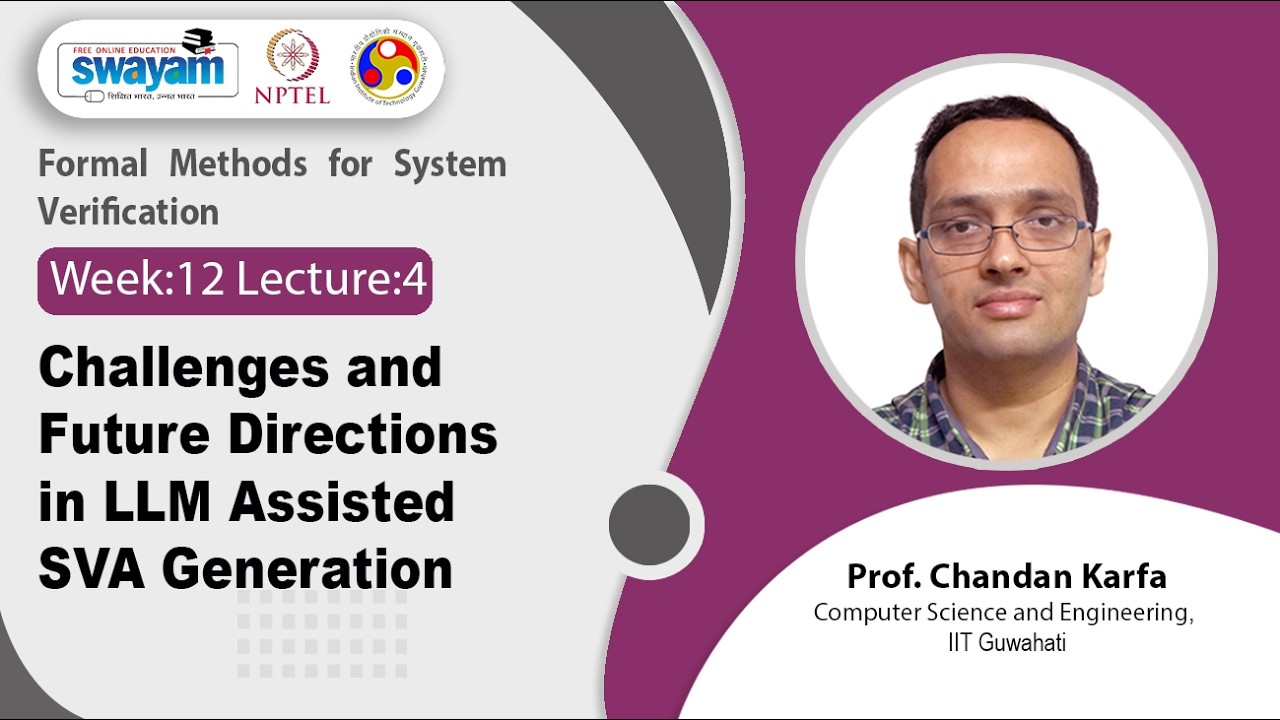
Lec 56: Challenges and Future Directions in LLM Assisted SVA Generation
Keywords
Summary
207 words
Critical Evaluation
Value of the Information & Strength of the Argument
The lecture provides substantial value by synthesizing multiple research efforts and distilling them into actionable guidelines for practitioners and researchers. The argumentation is solid, as the instructor supports each challenge with case studies (e.g., ripple carry adder, I2C) and quantitative results (e.g., assertion pass rates, coverage percentages). He convincingly argues that LLM-based generation is not yet fully reliable, but can be improved through systematic approaches such as signal mapping, knowledge graphs, and iterative rectification loops. The reasoning is clear and well-structured, though it assumes prior knowledge of formal verification concepts.
Scientific Rigor, Source Quality, Title Accuracy
The scientific rigor is high, given the lecturer’s expertise and the nature of the content, which is based on recent research in the field. However, the video itself does not provide explicit references or citations to the mentioned works (CHIAK, LagRV, SUNG, etc.), relying instead on the course context. The title is perfectly aligned with the content, accurately describing the lecture’s focus. No external sources are cited beyond the course and playlist links in the description, which limits the verifiability of the claims directly from the video.
192 words
Title / Content Match
The title exactly reflects the content: the lecture focuses on challenges and future directions in LLM-assisted SVA generation, as stated.
Quality & Reliability
8/10
The lecture is delivered by a professor from IIT Guwahati, a reputable institution, and covers well-established topics in formal verification. It provides practical guidelines based on recent research, but lacks detailed citations within the video itself, which slightly reduces the score.
Key Moments
Markers derived by PSI from the transcript: the creator did not define chapters.
- Introduction: importance of assertion-based verification and role of LLMs.
- Review of previous LLM-based assertion generation works (CHIAK, LagRV, SUNG).
- Challenge 1: Generating assertions from specification vs RTL.
- Challenge 2: Signal name consistency between generated assertions and RTL.
- Challenge 3: Ambiguity in natural language specifications and the need for knowledge graphs.
- Challenge 4: One-shot generation vs iterative rectification loops.
- Challenge 5: Falsification of coverage values due to vacuous assertions.
- Challenge 6: Handling long design specifications with limited context windows.
- Summary of guidelines and best practices for LLM-based SVA generation.
Cited Sources
- Formal Methods for System Verification (Course Homepage) — Course page for the NPTEL course of which this lecture is a part.
- Playlist for Formal Methods for System Verification — YouTube playlist containing all lectures of the course.
Concurring Sources
- Formal Methods for System Verification (Course Homepage) — Course page providing context and additional resources for the lecture series.
Contribution & Novelties
The lecture’s original contribution lies in systematically identifying six major challenges in LLM-based assertion generation and providing actionable guidelines for each. This synthesis goes beyond individual research proposals, offering a coherent framework that can guide future researchers and practitioners. The emphasis on signal mapping, vacuity checks, and long-context handling addresses practical gaps often overlooked in earlier works.
Pour aller plus loin :
- Retrieval-augmented generation — Relevant to the suggestion of using GraphRAG for handling long contexts in assertion generation.
- Knowledge graph — The lecture recommends structuring specifications as knowledge graphs to reduce ambiguity.
- Monte Carlo tree search — Used in the SUNG framework for iterative refinement of assertion sets.
109 words
Radar Profile
The profile shows high technical level (9) and strong quantitative and qualitative scores (8 each), indicating a content-dense and reliable lecture. The slightly lower fiabilité (8) reflects the lack of explicit citations within the video, though the source (NPTEL) is reputable.