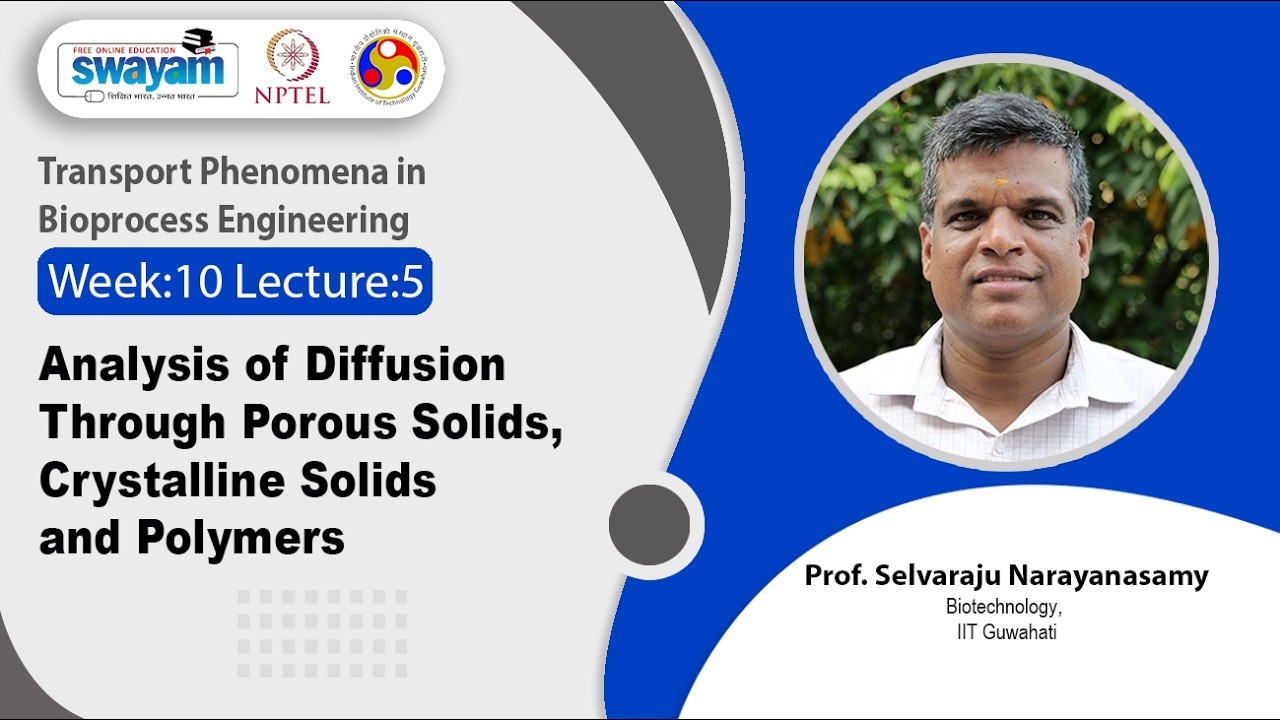
Lec 50: Analysis of diffusion through porous solids, crystalline solids and polymers
Keywords
Summary
275 words
Critical Evaluation
Value of the Information & Strength of the Argument
The lecture provides a comprehensive and well-structured explanation of diffusion in various solid materials, bridging fundamental principles with bioprocess applications. The argumentation is solid, systematically progressing from basic definitions to complex phenomena, supported by mathematical formulations (Fick’s law, Arrhenius equation) and physical reasoning. The inclusion of practical examples (e.g., immobilized cells, chromatography resins, stainless steel bioreactors) strengthens the relevance and helps illustrate abstract concepts. The lecturer distinguishes between different diffusion regimes and clearly explains controlling parameters, ensuring a thorough understanding. The content is accurate and aligns with standard chemical engineering knowledge.
Scientific Rigor, Source Quality, Title Accuracy
The scientific rigor is high, as the lecture aligns with established theories in transport phenomena. The sources are primarily the lecturer’s expertise and standard textbook knowledge, with course materials referenced via NPTEL. No external citations are explicitly provided, but the content is consistent with well-known literature. The title exactly matches the content, covering all three material types as delivered. The lecture is well-organized, with clear learning objectives and logical flow.
176 words
Title / Content Match
The title accurately reflects the content: the lecture systematically addresses diffusion in porous solids, crystalline solids, and polymers.
Quality & Reliability
8/10
Detailed and accurate coverage of diffusion phenomena in porous, crystalline, and polymeric solids, delivered by an IIT professor. Concepts are well-explained with equations and practical examples.
Key Moments
Markers derived by PSI from the transcript: the creator did not define chapters.
- Introduction to porous solids, two-phase nature, and importance in bioprocess engineering.
- Classification of pores: micropores (<2 nm), mesopores (2-50 nm), macropores (>50 nm) with examples.
- Discussion of molecular diffusion and Knudsen diffusion, and the Knudsen number criterion.
- Explanation of porosity and tortuosity, and their combined effect on effective diffusivity.
- Applications to immobilized cells, internal mass transfer limitations, and design trade-offs.
- Introduction to crystalline solids, defects, and the vacancy hopping mechanism.
- Diffusion coefficient temperature dependence (Arrhenius) and grain boundary diffusion.
- Stainless steel in bioreactors and chromium carbide precipitation effects.
- Freeze-drying and crystal growth in bioprocess equipment.
- Diffusion in polymers: free volume theory and factors affecting polymer diffusivity.
Cited Sources
- NPTEL Course: Transport Phenomena in Bioprocess Engineering — Course webpage for the lecture series, providing access to materials and resources.
- Playlist: Transport Phenomena in Bioprocess Engineering — YouTube playlist containing all lectures from this course.
Contribution & Novelties
This lecture provides a systematic and integrated overview of diffusion phenomena in three distinct classes of solids, specifically tailored to bioprocess engineering applications. It synthesizes classical theories with practical considerations, such as design trade-offs in porous supports and the impact of thermal history on equipment integrity. This integrative perspective is valuable for students and practitioners alike, as it bridges fundamental transport phenomena with bioprocess design.
Pour aller plus loin :
- Fick’s laws of diffusion — Foundational laws governing molecular diffusion, central to the lecture’s mathematical formulations.
- Knudsen diffusion — Key mechanism in porous solids when pore size is comparable to the mean free path, discussed via the Knudsen number.
- Porosity — Defines void fraction in solids, a critical parameter in effective diffusivity calculations.
- Tortuosity — Describes the winding path length in porous media, influencing diffusion rates.
- Vacancy defect — Essential for atomic diffusion in crystalline solids, as detailed in the lecture.
151 words
Radar Profile
The radar profile shows high scores across all dimensions, particularly in technical level (9), reflecting the lecture's advanced mathematical content and detailed physical explanations. Quantité and qualité of information are also strong (8 each), indicating comprehensive coverage of the subject. The fiabilité (8) underscores the credibility of the source and the soundness of the presented theory.