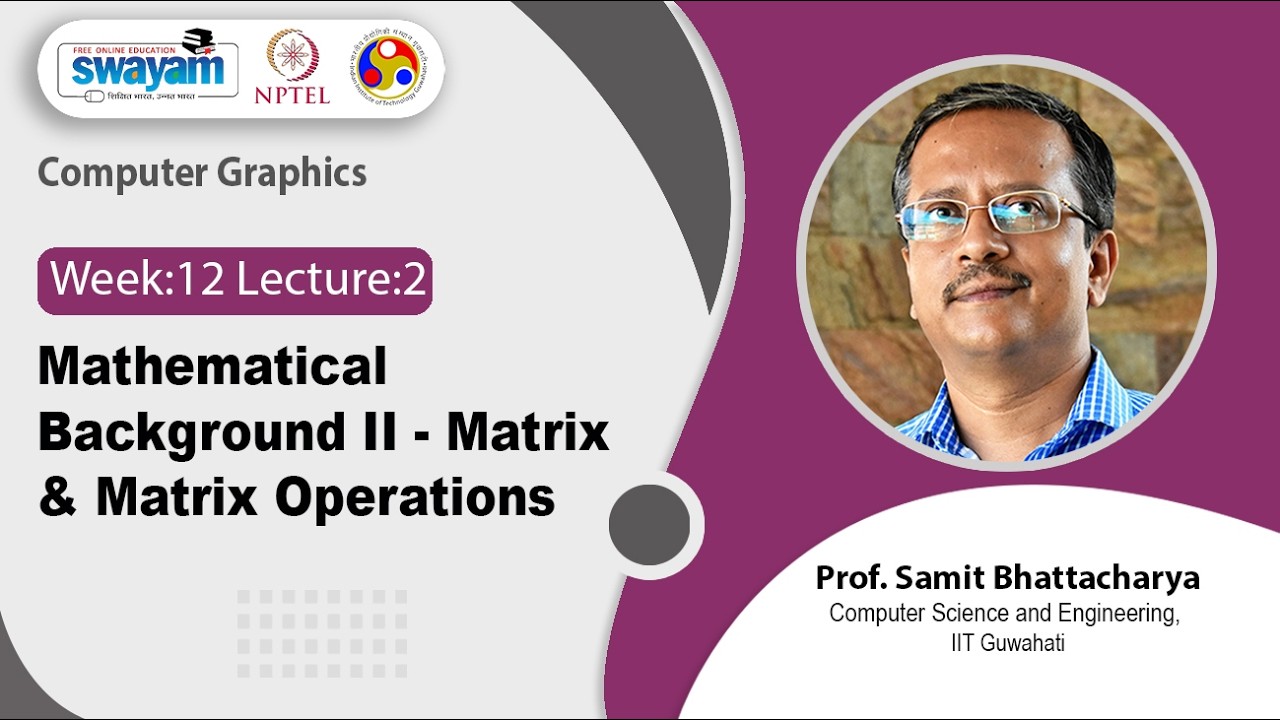
Lec 48: Mathematical Background II - Matrix & Matrix Operations
Keywords
Summary
218 words
Critical Evaluation
Value of the Information & Strength of the Argument
The lecture provides a clear and systematic exposition of matrix operations essential for computer graphics. The instructor builds concepts progressively, from basic definitions to complex operations, always connecting them to specific graphics applications such as transformations and view-based calculations. Arguments are well-structured, with examples that illustrate each operation and its pitfalls (e.g., non-commutativity, transpose reversal). The emphasis on why and where matrices are used in the pipeline adds practical value, helping students appreciate the relevance of linear algebra. The explanations are mathematically sound, and the reasoning is logical and easy to follow.
Scientific Rigor, Source Quality, Title Accuracy
The content is scientifically rigorous, adhering to standard linear algebra principles. The instructor explicitly references his own book (Computer Graphics, Appendix A) as a source for further study, though no direct link is provided in the description. The only external source given is the official NPTEL course page, which validates the authenticity of the course. The title accurately describes the lecture’s scope. No public comments were provided to analyze trends, so no inference can be made about audience reception.
186 words
Title / Content Match
The title accurately reflects the content: a lecture on matrix and matrix operations as part of a mathematical background series for computer graphics.
Quality & Reliability
8/10
The lecture is delivered by a professor from IIT Guwahati as part of an official NPTEL course, ensuring high academic rigor. The content is standard linear algebra applied to computer graphics, presented with clarity and correct mathematical formalism. There are no controversial claims, and the explanations align with established textbook material.
Key Moments
Markers derived by PSI from the transcript: the creator did not define chapters.
- Recap of previous lecture on coordinate systems, vectors, and dot/cross products; introduction to matrices as the next topic.
- Definition of a matrix, its dimensions, notation for elements (M_ij), and representation of vectors as special matrices.
- Explanation of scalar multiplication and matrix addition, with examples showing element-wise operations and shape preservation.
- Matrix multiplication: condition on inner dimensions, calculation rule (dot product of rows and columns), and a worked 2x3 times 3x2 example.
- Properties of matrix multiplication: non-commutativity, distributivity over addition, and the transpose reversal rule (AB)^T = B^T A^T.
- Determinant: definition for 2x2 matrices, recursive expansion for higher orders, and geometric meaning related to volume scaling.
- Matrix inverse: existence condition (non-zero determinant), element-level formula, and applications in undo transformations and solving equations.
- Summary of key points and preview of next lecture on lines and plane equations, with reference to the instructor's book.
Cited Sources
- NPTEL Course: Computer Graphics — Official course page for the Computer Graphics course (NPTEL), providing access to lectures and materials.
Contribution & Novelties
The lecture reinforces fundamental matrix operations while explicitly linking each to computer graphics applications, such as transformation composition and viewing pipelines. It clarifies common pitfalls like the non-commutativity of multiplication and the transpose reversal rule, which are critical for correct implementation in graphics code. The emphasis on determinant’s role in singularity and volume scaling provides intuitive understanding beyond mere computation.
Pour aller plus loin :
- Matrix (mathematics) — Comprehensive overview of matrices, their history, and diverse applications.
- Matrix multiplication — Detailed explanation of matrix multiplication, including algorithms and complexity.
- Transpose — Properties and applications of the transpose operation in linear algebra.
- Determinant — In-depth discussion of determinants, including geometric interpretations and computational methods.
- Invertible matrix — Conditions for invertibility and methods for computing inverses.
124 words
Radar Profile
The radar profile shows high scores in 'qualite_information' and 'fiabilite_globale', reflecting the lecture's accuracy and trustworthiness. 'quantite_information' is moderate due to the focused scope on matrices, and 'niveau_technique' is intermediate as it assumes basic algebra knowledge. The overall shape suggests a reliable educational resource for foundational linear algebra in graphics.