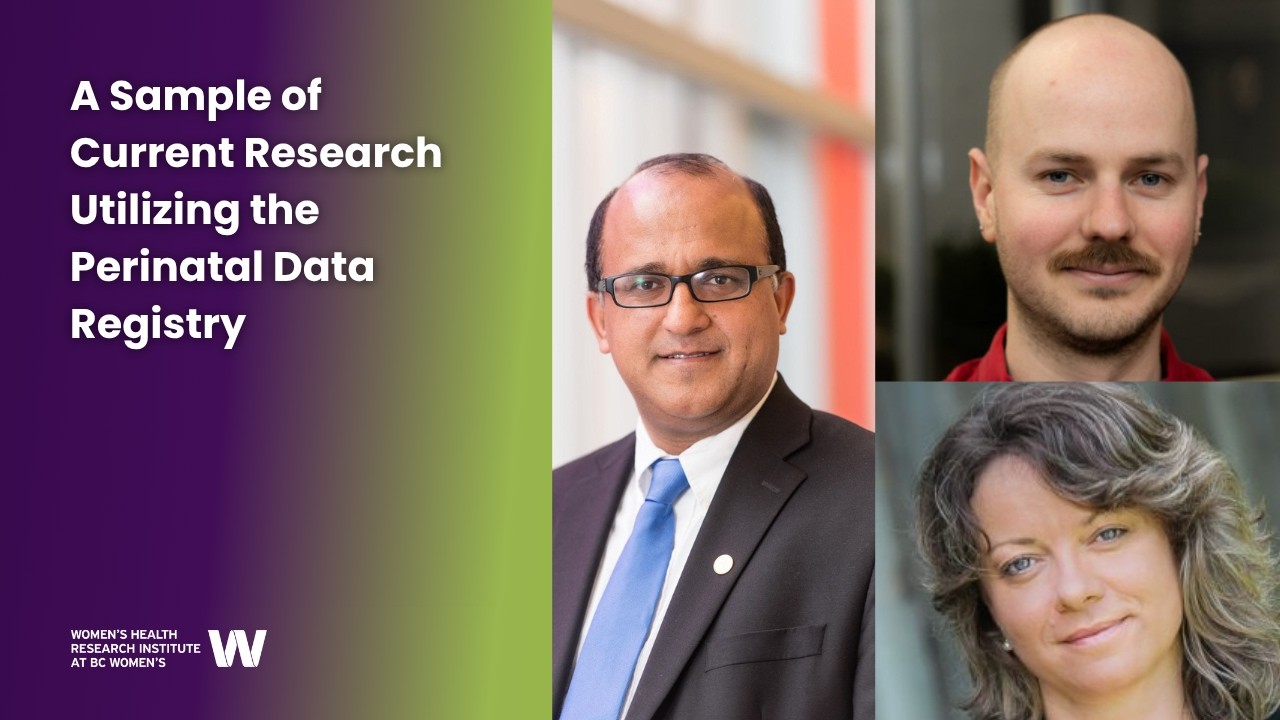
A Sample of Current Research Utilizing the BC Perinatal Data Registry
Keywords
Summary
216 words
Critical Evaluation
Value of the Information & Strength of the Argument
The presentations provide valuable population-based insights that fill gaps in the literature. For recurrent pregnancy loss, the study uses a large, unselected cohort to demonstrate that primary RPL does not delay the interval to the second live birth, offering reassurance for family planning, while also uncovering persistent risks of pregnancy complications. The argumentation is methodologically sound: clear definitions, rigorous exclusion criteria, and appropriate statistical adjustments. For term PROM, the research addresses a poorly studied area with robust registry data, aiming to establish contemporary prevalence and risks. Both talks underscore the strength of the BCPDR for high-quality observational research.
Scientific Rigor, Source Quality, Title Accuracy
The scientific rigor is high: the BCPDR is a well-maintained, validated registry, and both studies received ethical approval. The recurrent pregnancy loss study was published in Human Reproduction, a reputable peer-reviewed journal. The speakers reference major clinical guidelines (ESHRE, SOGC, ASRM) and the 2016 Statistics Canada census, supporting their definitions and interpretations. The title accurately represents the content, as multiple research projects are showcased. No commercial bias is apparent.
182 words
Title / Content Match
The title accurately reflects the content: the webinar presents current research projects (recurrent pregnancy loss and term PROM) using the BC Perinatal Data Registry.
Quality & Reliability
8/10
The presentation details robust methodology using a validated registry capturing ~99% of provincial births, cites peer-reviewed publications, and follows ethical approvals. No obvious biases detected.
Key Moments
Markers derived by PSI from the transcript: the creator did not define chapters.
- Introduction to the BC Perinatal Data Registry and its access process
- Dr. Bedaiwy presents recurrent pregnancy loss study objectives and methods
- Results: interval to second live birth and complications across groups
- Cumulative rates of second live birth and conclusions
- Dr. Lisonkova presents term PROM study design and data source
Cited Sources
- BC Perinatal Data Registry — Primary dataset used for both studies; captures ~99% of provincial births
- Human Reproduction (publication on recurrent pregnancy loss) — Peer-reviewed publication of the recurrent pregnancy loss study
- ESHRE Guideline on Recurrent Pregnancy Loss — Cited as a major guideline influencing the definition of recurrent pregnancy loss
- ASRM Guideline (2026) — Mentioned as recent guideline incorporating all recognized losses in RPL definition
- Statistics Canada 2016 Census — Used for fertility rate context in British Columbia
Concurring Sources
- ESHRE Guideline on Recurrent Pregnancy Loss — Aligns with the study's definition of RPL and inclusion of non-visualized losses
Contribution & Novelties
The webinar highlights novel population-based findings: primary RPL does not delay second live birth, contrary to common assumption, and term PROM has been understudied despite its frequency. The use of the BCPDR enables adjustments for multiple confounders, improving causal inference. These insights can inform patient counseling and clinical guidelines.
Pour aller plus loin :
- Recurrent miscarriage (Wikipedia) — Provides background on definitions and epidemiology.
- Prelabor rupture of membranes (Wikipedia) — Overview of the condition treated in the second talk.
- BC Perinatal Data Registry (Perinatal Services BC) — Official site with detailed data access information.
94 words
Radar Profile
The video scores very high on information quantity and technical depth, reflecting a specialized academic audience. It is slightly lower on accessibility and broad appeal, but remains highly credible.