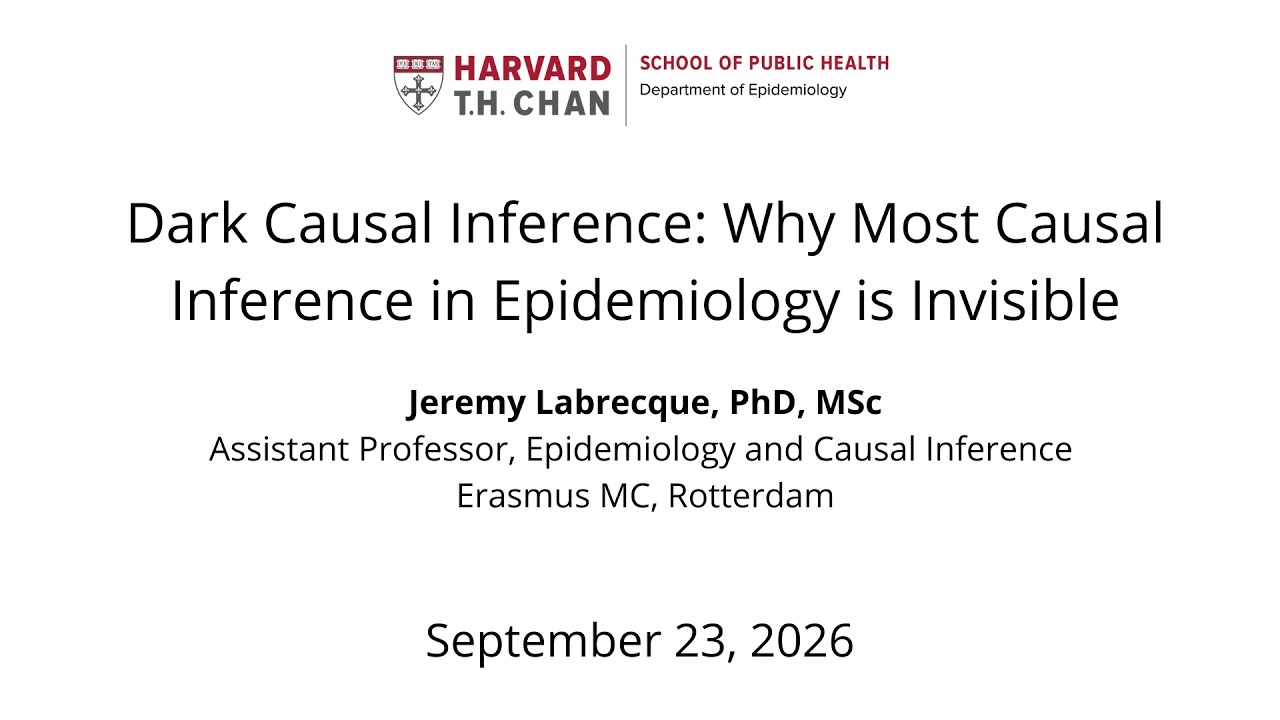
Jeremy Labrecque Seminar, September 23, 2026
Keywords
Summary
184 words
Critical Evaluation
Value of the Information & Strength of the Argument
The talk offers a valuable conceptual contribution by framing the lack of transparency in causal inference as ‘dark causal inference’, which resonates with calls for reform. The argumentation is well-structured: he starts with a clear definition, supports it with concrete examples (guidelines, specific papers), and quantifies the problem using recent meta-scientific studies. He anticipates counterarguments (e.g., why stronger causal language might be justified) and addresses them. However, some points rely on his personal interpretations, such as the rejection of ‘association’ in research questions, which is presented as logically necessary but may be debated. Overall, the reasoning is compelling and backed by credible evidence, but reflects a specific methodological stance.
Scientific Rigor, Source Quality, Title Accuracy
The speaker demonstrates scientific rigor by grounding his claims in multiple peer-reviewed studies, including those he co-authored (e.g., the BMJ paper on causal language). He cites specific stats with sources, such as Haber et al. (2022) and Eisenberg-Guyot et al., and transparently distinguishes between his own opinions and established findings. The video title is generic, but the content aligns with the announced topic. No public comments were provided for analysis, so no trends can be assessed.
200 words
Title / Content Match
The video title is generic (seminar recording), but the content matches the announced talk on 'dark causal inference' as described in the introduction.
Quality & Reliability
8/10
The speaker is a recognized expert in causal inference with extensive publications. The talk references numerous peer-reviewed studies and presents coherent arguments, though it reflects a personal viewpoint on methodological reform.
Key Moments
Markers derived by PSI from the transcript: the creator did not define chapters.
- Introduction by Albert Hofman and speaker introduction.
- Introduction of 'dark causal inference' analogy to dark matter.
- Example from guidelines study: 25% of statements used stronger causal language than cited literature.
- Example from an article on severe maternal morbidity and epilepsy illustrating unclear causal question.
- Discussion of meta-science studies: Haber et al. (60% action recommendations), Kezios (13% clear causal questions), Eisenberg-Guyot (54%).
- Assumption reporting failures: ICU review and Mendelian randomization studies under-report key assumptions.
- Call for clear research questions as the first step to improve causal inference.
- Discussion of the problem with using 'association' in research questions, referencing his BMJ paper.
- Concluding advocacy for transparent causal reasoning in all epidemiological articles.
Cited Sources
- Epidemiology Degree Program Overview — Link provided in the video description.
- General anesthesia during critical periods of fetal heart development may increase the risk of congenital heart defects (International Journal of Epidemiology) — Cited as an example of a causal conclusion requiring causal evidence.
- Study on severe maternal morbidity and epilepsy — Example of dark causal inference with an unclear causal question.
- Haber et al. (2022) on action recommendations in epidemiology journals — Cited for the statistic that ~60% of papers contain action recommendations.
- Kezios et al. on variable selection and causal questions — Cited for finding that only 13% had a clear causal question.
- Eisenberg-Guyot et al. review of G-methods — Cited for 54% clear causal questions and assumption reporting.
- Labrecque and Kezios: How and when to use causal and associational language (BMJ) — Paper written by the speaker on the topic.
Contribution & Novelties
The talk introduces the original metaphor of ‘dark causal inference’ to draw attention to the opacity of causal reasoning in epidemiological publications. It synthesizes recent meta-scientific evidence and proposes concrete steps for reform, such as mandating explicit research questions and assumption justifications. The emphasis on making the entire causal reasoning process visible is a novel framing that could influence editorial policies.
Pour aller plus loin :
- Causal inference (Wikipedia) — Foundational concept central to the talk.
- Directed acyclic graph (DAG) — Tool used to express causal assumptions.
- Mendelian randomization (Wikipedia) — Method discussed in the context of assumption checking.
99 words
Radar Profile
The profile shows high scores across all dimensions, indicating a well-balanced talk that provides substantial information, technical depth, and reliable content. The lowest score is 'fiabilite_globale' at 8, still high, reflecting the speaker's expert but opinionated viewpoint.