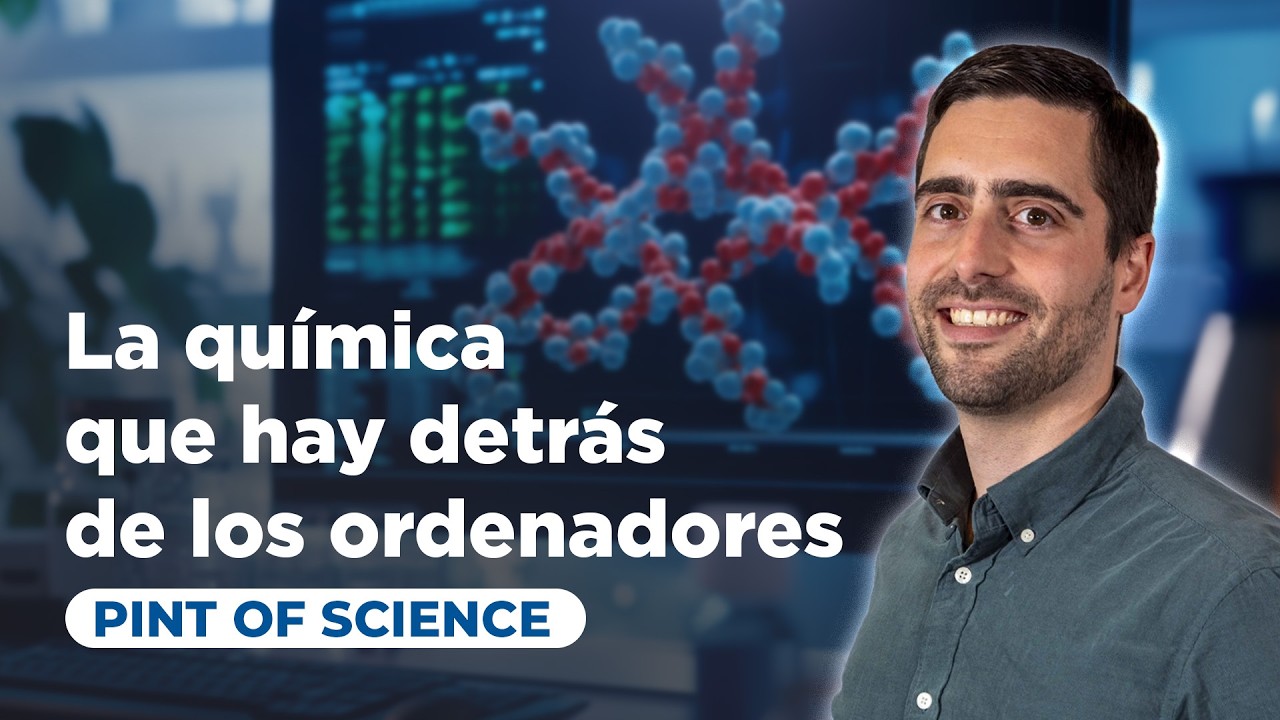
La química que hay detrás de los ordenadores | Alberto Gutiérrez Vega
The chemistry behind computers | Alberto Gutiérrez Vega
Keywords
Summary
185 words
Critical Evaluation
Value of the Information & Strength of the Argument
The talk provides a valuable introduction to computational chemistry, a discipline often overlooked by the general public. The speaker effectively demonstrates the practical relevance of computer simulations in addressing real-world environmental and energy problems. The argumentation is clear and logically structured: starting from fundamental concepts (atoms, molecules, models) and then presenting concrete examples where simulation adds value. The narrative is persuasive, emphasizing the cost and time savings of computational approaches while acknowledging that simulation complements rather than replaces experimental work. However, the talk lacks depth in explaining the actual mathematical or computational methodologies, limiting its value for technically inclined viewers. Overall, the information is accurate and well-presented, with a strong emphasis on the benefits of computational chemistry.
Scientific Rigor, Source Quality, Title Accuracy
The scientific rigor is adequate for a general audience talk. The speaker is a qualified researcher, and the concepts presented (atoms, molecules, modelling, CO2 greenhouse effect, PFAS persistence) are well-established. No specific studies are cited, but the examples are drawn from the speaker’s own research and general knowledge. The title is perfectly matched to the content, as the talk consistently focuses on the chemistry behind computers. The description and tags align with the content. However, the lack of direct references in the video itself makes it difficult to verify specific claims about the projects mentioned. The only external source provided in the description is a blog link, which may offer further information. Overall, the talk is reliable but would benefit from citing specific literature or case studies for enhanced transparency.
262 words
Title / Content Match
The title perfectly matches the content: the talk explains how chemistry is linked to computers through computational simulation, exactly as the title promises.
Quality & Reliability
7/10
The speaker is a PhD researcher in computational chemistry, presenting well-established concepts. The talk is clear and accurate but does not cite specific studies, relying on general knowledge. It provides a reliable overview for a general audience without detailed technical depth.
Key Moments
Markers derived by PSI from the transcript: the creator did not define chapters.
- Introduction: the speaker presents himself and his research group, emphasizing the team behind the work.
- The question 'What is the relationship between chemistry and computers?' and the idea that computers can simulate materials.
- Explanation of computational chemistry: atoms, molecules, models, and predicting properties via physical laws.
- First application: capturing CO2 with simulations of porous materials.
- Second application: capturing PFAS (forever chemicals) from water using simulated adsorbent materials.
- Third application: improving lithium-ion batteries by simulating adhesion between components.
- Overview of other EU and national projects employing computational simulation.
- Conclusion: a computer can be a laboratory; next time you use one, think of it as a chemistry tool.
Cited Sources
- UBU Investiga blog — The channel's official blog for research and science communication at the University of Burgos.
Contribution & Novelties
This talk contributes to the general public’s understanding of computational chemistry, a field that is often unknown despite its role in developing modern technologies. It uniquely connects everyday devices with chemical simulation, using accessible examples like capturing CO2 and PFAS and improving batteries. The speaker stresses the dual benefit of saving time and money, making the case for computational approaches as a smart first step. The talk is original in its pedagogical simplicity, but for a deeper dive, the following resources are recommended.
Pour aller plus loin :
- Computational chemistry — Wikipedia overview of the discipline, its methods, and applications.
- Molecular dynamics — A simulation technique used to study the motion of atoms and molecules.
- Density functional theory — A quantum mechanical method widely used in computational chemistry to predict material properties.
- Per- and polyfluoroalkyl substances — Wikipedia entry on PFAS, explaining their properties and environmental concerns.
- Lithium-ion battery — Background on battery technology, including its components and challenges.
159 words
Radar Profile
The radar profile shows a balanced but moderately low technical level, with reliability and quality scoring highest. Quantity and technical depth are moderate, reflecting a general audience. The talk is trustworthy but not highly technical or dense, suitable for an introductory overview.