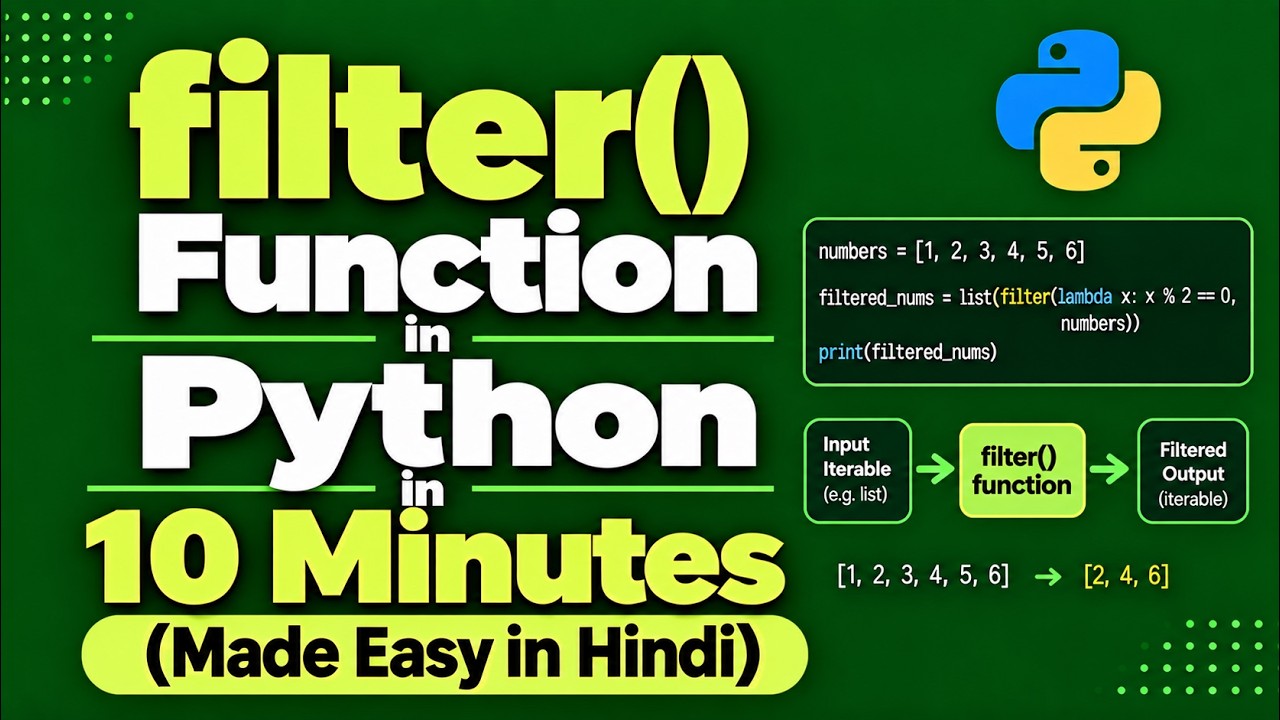
filter Function in Python : Syntax and applications with many examples
Keywords
Summary
134 words
Critical Evaluation
Value of the Information & Strength of the Argument
The video provides solid value by illustrating filter() in multiple contexts: with named functions, lambda expressions, and as a comparison to loops and list comprehensions. The argumentation is clear and logical, building from basic syntax to practical applications. Each example is run and the output displayed, reinforcing understanding. The comparison with an explicit loop and list comprehension helps contextualize when filter() is appropriate, though the instructor does not deeply discuss performance trade-offs or the alternative from Python’s itertools module.
Scientific Rigor, Source Quality, Title Accuracy
The explanation is accurate and consistent with Python documentation. No external sources are cited, relying solely on the instructor’s demonstration. The title matches the content precisely, as the entire video is dedicated to the filter function. The instructional quality is good for beginners, but lacks depth on edge cases and advanced use. The absence of citations is acceptable for a basic tutorial, though it limits external verification.
161 words
Title / Content Match
The title accurately reflects the content: a thorough tutorial on the filter function with numerous examples.
Quality & Reliability
8/10
Clear pedagogical explanation of Python's filter() with multiple examples, accurately covering its operation and return of an iterator. No external sources cited, but the content is correct and reproducible.
Key Moments
Markers derived by PSI from the transcript: the creator did not define chapters.
- Introduction to filter() and its purpose in data science
- Syntax explanation: filter(function, iterable)
- Example 1: Using custom function is_even to filter even numbers from a list
- Example 2: Using lambda to filter positive numbers from range(-5, 5)
- Example 3: Filtering even numbers from a list using lambda
- Equivalent for-loop implementation to filter positive numbers
- Equivalent list comprehension approach
Contribution & Novelties
The video provides a clear, beginner-friendly walkthrough of Python’s filter() function with multiple practical examples, emphasizing the need to cast the returned iterator to a list. Its originality lies in the comparative examples with loops and list comprehensions, helping viewers understand when to use each approach.
Pour aller plus loin :
- Python filter() documentation — Official reference for filter().
- Python list comprehensions — Alternative method for filtering and transforming data.
- Python lambda expressions — Reference for anonymous functions used in many filter() examples.
83 words
Radar Profile
The profile shows high scores for quantity and quality of information, moderate technical level, and high reliability, indicating a solid educational tutorial for beginners. The lower technical level reflects the elementary nature of the content.