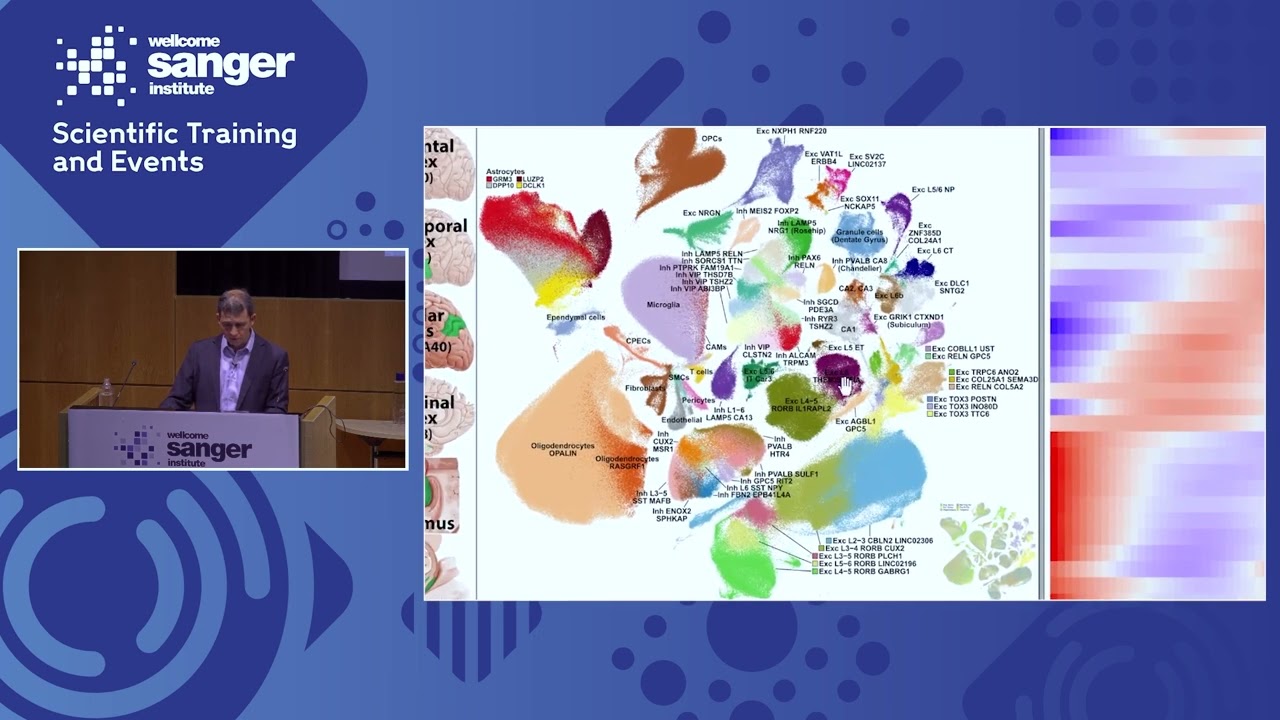
Genomics of Brain Disorders 2026 | Keynote by Manolis Kellis, MIT, USA
Keywords
Summary
182 words
Critical Evaluation
Value of the Information & Strength of the Argument
The talk delivers high-value information by synthesizing a decade of research into a coherent narrative that connects genetic variants to cellular mechanisms and therapeutic hypotheses. The argumentation is strong: each claim is supported by specific experimental evidence, such as the FTO locus example where a single letter change was shown to flip thermogenesis sevenfold and affect weight gain in mice, or the APOE4 example where cyclodextrin restored cholesterol transport and cognition. The speaker carefully distinguishes correlation from causation and emphasizes the importance of perturbation experiments. The discussion of single-cell atlases is grounded in concrete numbers (e.g., 2.4 million cells, 430 donors) and identifies both consistent hallmarks and heterogeneity across individuals. The argument for foundation models is presented as a paradigm shift, with the rationale that multimodal representations can capture complex biological concepts. The talk also acknowledges limitations, such as the binary phenotype problem and uninterpretable findings, which strengthens its credibility. Overall, the argumentation is rigorous, evidence-based, and forward-looking.
Scientific Rigor, Source Quality, Title Accuracy
The scientific rigor is exemplary: the speaker cites specific published studies (e.g., Science 2022 on schizophrenia, epigenomics roadmap 2015) and large consortium efforts. The data are from peer-reviewed sources and have been replicated in independent cohorts. The use of multiple modalities (single-cell RNA, ATAC, imaging) and cross-species comparisons adds robustness. The title accurately reflects the content, as the talk covers genomics, single-cell circuitry, foundation models, and therapeutic translation for brain disorders. No comments were provided, so no audience trend analysis is included.
255 words
Title / Content Match
The title accurately reflects the content: a keynote on genomics of brain disorders covering single-cell circuitry, foundation models, and brain-matched organoids for precision therapeutics. The talk delivers on these themes with detailed examples.
Quality & Reliability
9/10
Keynote by a leading MIT computational biologist at a Sanger Institute conference; content is grounded in published, peer-reviewed work (Science, Nature, etc.) and large-scale consortium data. Claims are mechanistic and supported by experimental validation in human cultures and mouse models. No sensationalism or unsupported assertions; limitations are acknowledged (e.g., heterogeneity, uninterpretable findings).
Key Moments
Markers derived by PSI from the transcript: the creator did not define chapters.
- Introduction and overview of the talk: from genetics to circuitry, targets, and therapeutics, plus foundation models for biology.
- Historical context: from microscopes to molecular basis of Alzheimer's; the complexity of single-cell data (20,000 dimensions).
- Three paradigm shifts: massive data, causality via genetics, and co-reasoning with AI foundation models.
- Example 1: FTO locus in obesity; single nucleotide change affects thermogenesis and weight regulation in mice.
- Example 2: APOE4 in Alzheimer's; cholesterol transport defect in oligodendrocytes impairs myelination; cyclodextrin restores cognition in mice.
- Example 3: Cancer immunotherapy; epigenomic differences between responders and non-responders lead to combination therapy with 100% response in mice.
- Single-cell atlases of brain disorders: Alzheimer's (2.4M cells, 430 donors), ALS/FTD, schizophrenia, bipolar; early vs late changes and sex differences.
- Astrocyte modules and cognitive resilience; choline metabolism pathway protective; specific inhibitory neuron subtypes vulnerable.
- Epigenomic erosion in late Alzheimer's; microglia activation trajectory and genetic risk enrichment; vascular cells enriched in Alzheimer's.
- Evolutionary analysis using deep learning to predict epigenomic states across mammals and hominins; changes in developing brain.
- Puzzling finding: control individuals with schizophrenia-like transcriptional signatures and vice versa, challenging binary phenotypes.
Contribution & Novelties
The talk provides a comprehensive synthesis of how single-cell genomics, genetics, and AI foundation models are converging to transform brain disorder research. It highlights novel findings such as the role of astrocyte modules in cognitive resilience, the epigenomic erosion in late Alzheimer’s, and the evolutionary insights from deep learning predictions of epigenomic states across hominins. The discussion of heterogeneity and the binary phenotype problem is particularly original, showing that some controls exhibit disease-like signatures and vice versa, which has implications for diagnosis and therapeutic targeting. The integration of multi-omic data at scale and the vision for co-reasoning with AI models represent a forward-looking perspective.
Pour aller plus loin :
- Single-cell RNA sequencing — Overview of the technology and its applications in neuroscience.
- Alzheimer’s disease — Background on genetics, pathology, and current therapeutic approaches.
- Foundation models in biology — General concept of foundation models and their adaptation to biological data.
- APOE4 and cholesterol metabolism in Alzheimer’s — Key mechanism discussed; see reviews on APOE and lipid transport.
- Microglia in neurodegeneration — Role of microglia in Alzheimer’s and other brain disorders.
179 words
Radar Profile
The radar profile shows very high scores across all dimensions: information quantity, quality, technical level, and overall reliability. This reflects a dense, expert-level keynote that balances breadth and depth, with rigorous evidence and clear mechanistic explanations. The only slight dip is in quantity due to the talk's focus on selected highlights rather than exhaustive coverage.