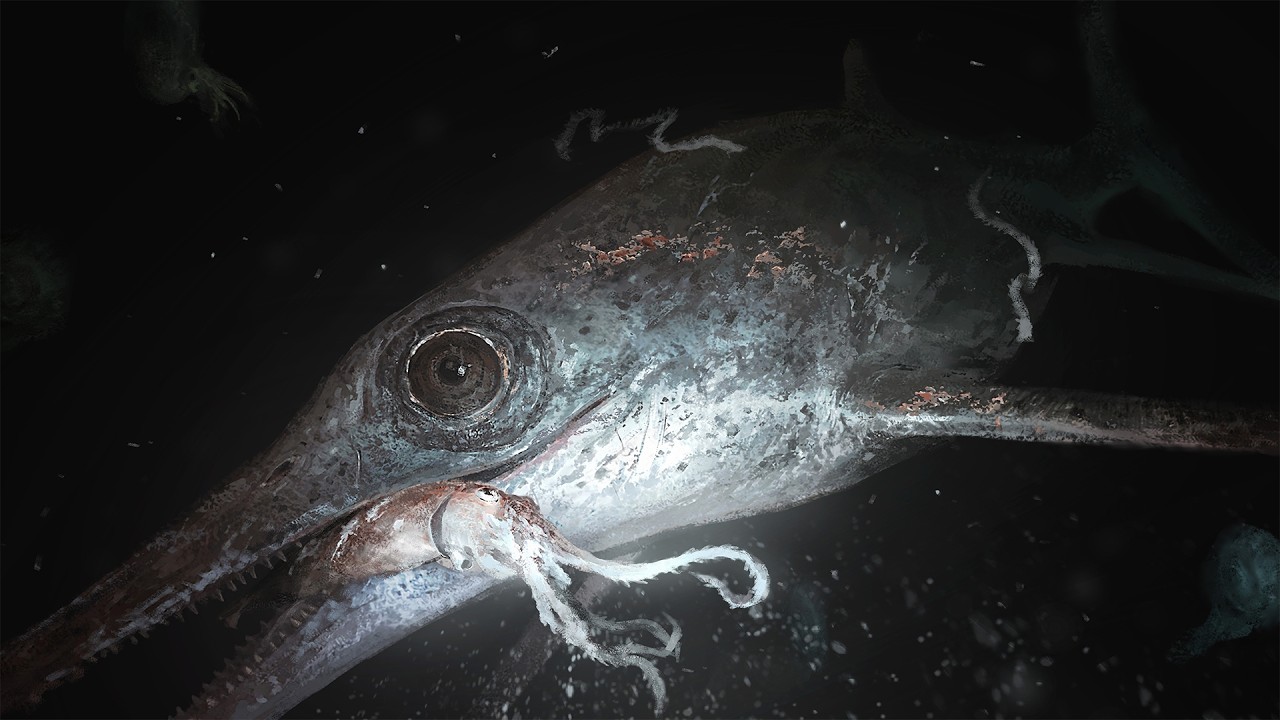
Why The Early Jurassic Oceans Were So Deadly
Keywords
Summary
141 words
Critical Evaluation
Value of the Information & Strength of the Argument
The video provides substantial educational value by integrating hands-on fossil hunting with expert explanations. The argumentation is well-supported: the team uses direct observation, museum specimens, and recent scientific research (e.g., the 2023 study on Temnodontosaurus chondroderms) to build a coherent picture of the animal’s ecology and behavior. The reasoning is sound, with appropriate caveats about uncertainty in species identification and extrapolation from limited specimens. The presence of a professional paleontologist (Dr. Roy Smith) adds credibility to the information presented.
Scientific Rigor, Source Quality, Title Accuracy
The scientific rigor is commendable; the video cites specific fossils, museum displays, and expert opinions, grounding claims in tangible evidence. Sources named include the Lyme Regis Museum, South Coast Fossils guide Joe Thompson, and the recent paper on Temnodontosaurus fin structures. The title accurately reflects the focus on Temnodontosaurus as a deadly predator, but the video is more about the search and the animal’s adaptations than a broader analysis of all Early Jurassic ocean dangers. Overall, the title is a slight overgeneralization but not misleading.
179 words
Title / Content Match
The title focuses on the deadliness of Early Jurassic oceans, and the video does discuss Temnodontosaurus as a deadly apex predator, though much of the content is about fossil hunting experiences.
Quality & Reliability
8/10
The video features expert commentary from a pterosaur specialist and cites recent research on Temnodontosaurus adaptations, while presenting fossil findings with appropriate caveats.
Key Moments
Markers derived by PSI from the transcript: the creator did not define chapters.
- Introduction of the BoneHeads crew and their mission to find Temnodontosaurus fossils.
- Hamza discovers a large Temnodontosaurus tooth at Monmouth Beach; team examines it.
- Visit to Lyme Regis Museum to examine a Temnodontosaurus platyodon skull.
- Discussion of the recent research on 'chondroderms' and silent swimming adaptation in Temnodontosaurus.
- Dr. Roy Smith explains Dimorphodon pterosaur fossils at the museum.
- Return to the beach; encounter a fresh landslide at Monmouth cliff, highlighting dangers.
- Day three ends with no Temnodontosaurus finds; team decides to go to Weymouth.
- Meeting Joe Thompson at Weymouth to search Kimmeridge Clay for pliosaur teeth.
Cited Sources
- South Coast Fossils - Fossil Walks — Guided fossil hunting tours in Dorset mentioned in the video.
- Feather and Fang Studio on Etsy — Merchandise and design links mentioned in the description.
- Rudolf Hima Art Portfolio — Thumbnail artist's portfolio.
- TNT Design — Logo designer's website.
Contribution & Novelties
The video stands out for its blend of fieldwork and scientific explanation, offering viewers an authentic look at how paleontologists search for and interpret fossils. It brings attention to recent research on Temnodontosaurus’ hypothesized silent swimming adaptions, making cutting-edge science accessible. The inclusion of multiple expert perspectives and behind-the-scenes access adds depth.
Pour aller plus loin :
- Temnodontosaurus on Wikipedia — Overview of the genus and species.
- Ichthyosaur on Wikipedia — Context on the broader group of marine reptiles.
- Jurassic Coast on Wikipedia — Geological significance of the site featured in the video.
93 words
Radar Profile
The scores are high across the board, indicating a well-balanced video with strong information content, technical depth, and reliability. The slight dip in 'niveau_technique' reflects the accessible tone, while the quality and fiabilité scores are robust thanks to expert input and clear sourcing.
💬 très positif - Sur les 30 commentaires analysés, l'enthousiasme est dominant, avec de nombreux éloges sur le retour de la série, l'animation d'introduction et la compétence des intervenants, sans aucune critique notable.