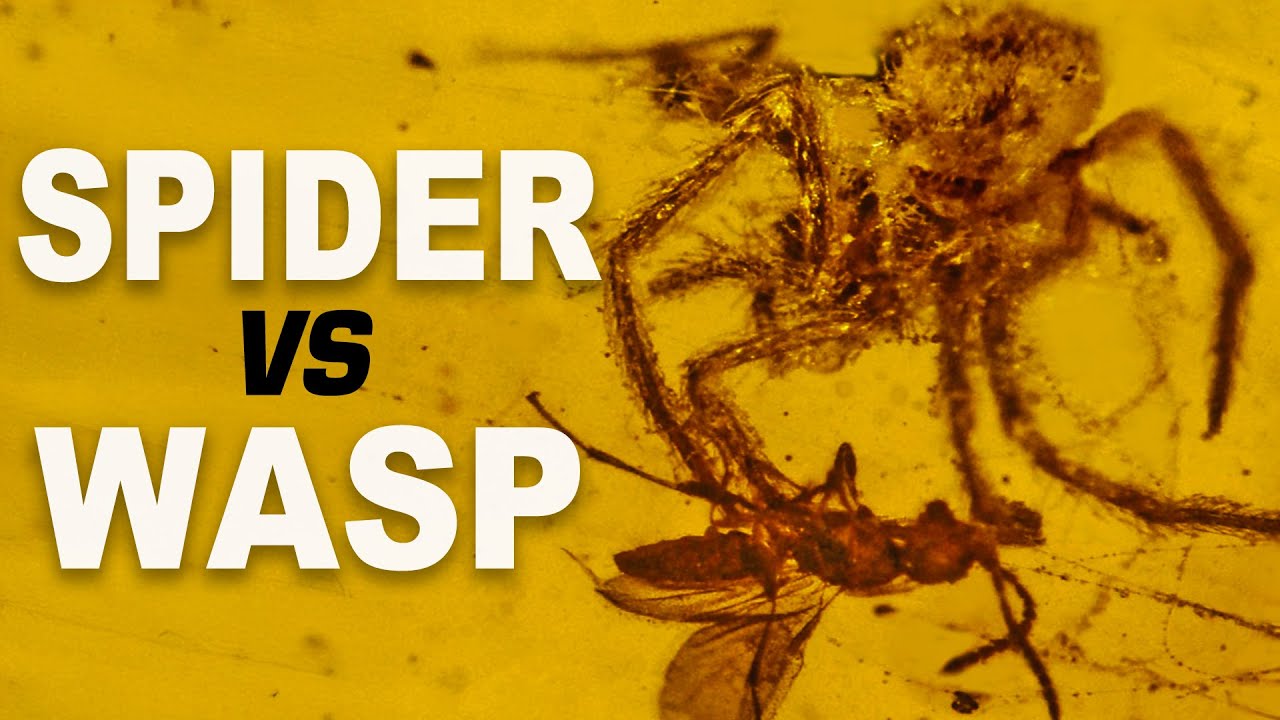
An Ancient Spider Attack Frozen in Amber
Keywords
Summary
134 words
Critical Evaluation
Value of the Information & Strength of the Argument
The video provides valuable insights into paleontology and the behaviors of ancient arachnids and insects. It presents the evidence from the fossil with clear logical reasoning, explaining how the amber’s contents reveal sociality, web structure, and predation dynamics. The argumentation is solid, based on the cited scientific literature, and the narrative effectively connects the fossil to broader evolutionary and ecological concepts.
Scientific Rigor, Source Quality, Title Accuracy
The video demonstrates high scientific rigor by referencing multiple peer-reviewed articles and news outlets. The sources are relevant and directly support the claims made about the fossil. The title accurately reflects the content, focusing on the spider attack, which is a central theme. The video does not overstate findings and provides a balanced view of the significance of the discovery.
136 words
Title / Content Match
The title perfectly reflects the content, which focuses on a fossilized spider attack preserved in amber.
Quality & Reliability
8/10
The video is well-researched, citing multiple scientific papers and reputable news sources. The information is accurate and clearly presented, making it a reliable science communication piece.
Key Moments
Markers derived by PSI from the transcript: the creator did not define chapters.
- Introduction to amber and Jurassic Park, setting up the significance of amber fossils.
- Description of the fossil found in Myanmar, its age, and the Hukawng Valley mine.
- Identification of the new spider species Geratonephila burmanica based on preserved details.
- Evidence of social behavior in spiders, with two males sharing a web, suggesting long-standing sociality.
- Examination of the web strands with sticky droplets and trapped aerial plankton, indicating webs were not regularly rebuilt.
- The wasp victim is identified as a new species in the superfamily Platygastroidea, named Cascoscelio incassus.
- Discussion of parasitoid wasps and their egg-laying habits, with the spider attack seen as 'payback'.
- The net-winged insect (Neuroptera) and its spider-boarding larvae, illustrating an ancient predator-prey relationship.
Cited Sources
- Scienceshot: 100-Million-Year-Old Spider Attack Caught in Amber — News article about the fossil discovery.
- 100-Million-Year-Old Spider Attack Caught in Amber — Sci-News article detailing the amber fossil.
- Fossil of ancient spider attack only one of its type ever discovered — Oregon State University press release about the fossil.
- Springer Article on Spider Attack in Amber — Research paper describing the fossil and its significance.
- JSTOR Article on Related Studies — Academic paper possibly on Nephilidae or amber fossils.
- Zoological Letters Article on Spider Sociality — Paper discussing social behavior in spiders.
- Wiley Article on Spider or Wasp Taxonomy — Systematic entomology study relevant to the species.
- Annual Review of Entomology - Relevant Chapter — Review article on insect or spider biology.
- ScienceDirect Topic: Platygasteridae — Background information on the wasp family.
- Nature Scientific Reports Article — Recent scientific paper possibly on related fossils or behaviors.
External References
Contribution & Novelties
The video provides an accessible and engaging overview of a remarkable fossil find, explaining its scientific significance in clear terms. It highlights the discovery of a new species and the earliest evidence of social behavior in golden orb-weaver spiders. The original contribution lies in synthesizing multiple lines of evidence from the amber to reconstruct ancient ecological interactions.
Pour aller plus loin :
- Spider sociality — Discusses the evolution of social behavior in spiders, relevant to the video’s claims about ancient sociality.
- Amber — Provides background on amber formation and its fossil preservation properties, essential to understanding the video’s subject.
- Parasitoid wasp — Explains the biology of parasitoid wasps, which is central to the wasp’s role in the fossil.
- Golden orb-weaver spider — Information on the family Nephilidae and their modern behaviors, supporting the video’s interpretations.
135 words
Radar Profile
The radar scores indicate a well-balanced video with high quality of information and reliability, while the technical level is moderate, suitable for a broad audience. The quantity of information is good but not exhaustive, and the overall reliability is strong due to proper sourcing.