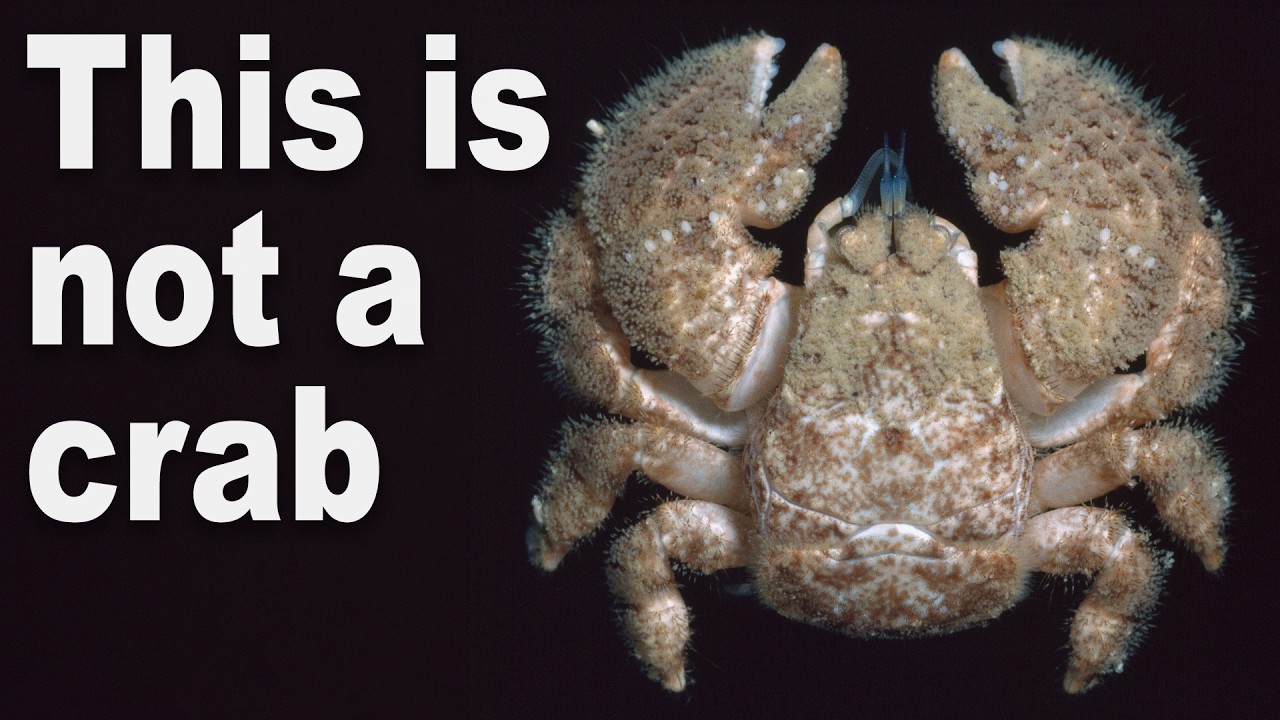
Every Time Things Have Evolved Into Crabs
Keywords
Summary
173 words
Critical Evaluation
Value of the Information & Strength of the Argument
The video provides substantial value by systematically compiling and explaining a wide range of examples of carcinization, from well-known to obscure. The argumentation is solid, grounded in evolutionary principles and supported by molecular and fossil evidence. The presenter clearly distinguishes between true crab-like features and convergent similarities, offering a nuanced scientific perspective. He also addresses controversies, such as the hermit crab ancestry of king crabs, showing how molecular data resolved the debate. The inclusion of recent discoveries (e.g., Parapagurus rex) adds freshness. The presentation style is engaging and accessible without sacrificing accuracy.
Scientific Rigor, Source Quality, Title Accuracy
The video demonstrates high scientific rigor. It references a linked Google Docs document containing sources, which underscores its commitment to transparency. The presenter cites specific scientific literature (e.g., description of Callichimaera perplexa, studies on carcinization) and explains complex concepts accurately. The title is perfectly aligned with the content, as the video indeed covers every known example of carcinization mentioned in scientific literature. The structure follows a logical progression from true crabs to partial and hypothetical cases, which enhances its credibility. Overall, the video is scientifically sound and the title accurately reflects the comprehensive scope of the content.
204 words
Title / Content Match
The title accurately reflects the content, which comprehensively reviews examples of carcinization across various lineages.
Quality & Reliability
8/10
The video is well-researched, referencing diverse scientific sources (likely listed in the linked document). The presenter is an experienced science communicator and the content aligns with current evolutionary biology understanding.
Chapters
- Intro
- Convergent Evolution POSTERS!
- What is a crab?
- The 'true' crabs - Brachyura
- Porcelain crabs - Porcellanidae
- Hairy stone crabs - Lomisidae
- King crabs - Lithodidae
- Coconut crab - Coenobitidae
- Patagurus rex
- Squat lobsters
- Mole crabs - Hippoidea
- Horseshoe crabs - Xiphosura
- Crab spiders - Thomisidae
- Slipper lobster
- Fish lice and whale lice
- Crab lice
- Cyclidans
- Other examples of possible carcinisation
- Could humans ever evolve into crabs?
- Outro
Cited Sources
- Sources and references for this video (Google Docs) — Listed as 'Sources' in the video description, this document presumably contains the full list of references used in the video.
- Ben G Thomas subreddit — Community channel for discussion and additional context, though not a direct scientific source.
Contribution & Novelties
This video stands out as a comprehensive review of carcinization, synthesizing scattered information into a single narrative. It clarifies the definition of a true crab and systematically evaluates multiple lineages, including recent discoveries like Parapagurus rex. The discussion extends beyond crustaceans to other arthropods and even non-arthropods, offering a broader perspective on convergent evolution. It also addresses the concept of stabilomorphy for horseshoe crabs and touches on exotic topics like crab lice conservation. The video adds value by presenting current scientific understanding in an accessible format, prompting viewers to consider the mechanisms of evolutionary convergence.
Pour aller plus loin :
- Carcinisation - Wikipedia — Overview of the phenomenon and examples.
- Convergent evolution - Wikipedia — General concept exemplified by carcinization.
- Brachyura (true crabs) - Wikipedia — Evolutionary history and classification of true crabs.
- Anomura - Wikipedia — The diverse anomuran group, including many carcinized lineages.
145 words
Radar Profile
The radar profile is well-balanced, with high scores in quantity, quality, technique, and reliability, indicating a thoroughly researched and clearly presented scientific video.
💬 Positif. Sur les 30 commentaires analysés, le ton est largement enthousiaste et humoristique, avec des références à des mèmes et des appréciations sur la qualité de la recherche et la manière dont les artistes ont été crédités.