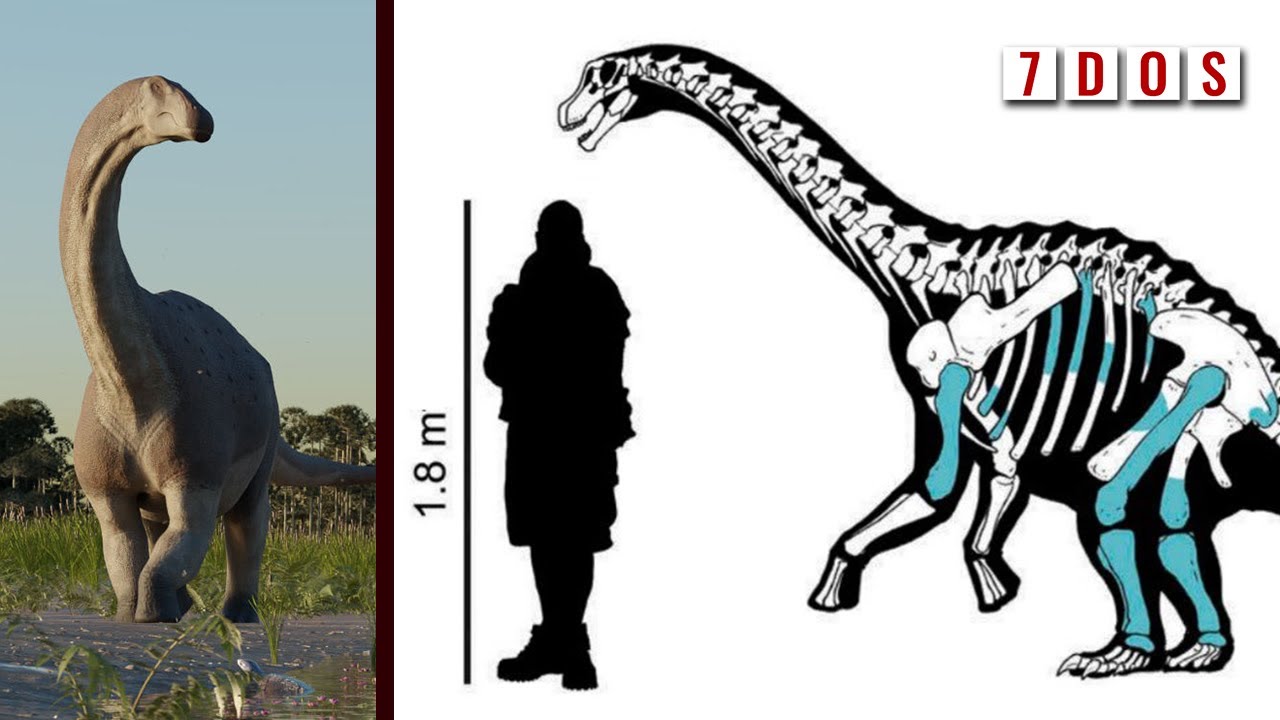
A New Species of Dwarf Titanosaur Has Been Discovered | 7 Days of Science
Keywords
Summary
164 words
Critical Evaluation
Value of the Information & Strength of the Argument
The video delivers valuable, up-to-date summaries of multiple scientific papers, providing context and explaining the significance of each discovery. The argumentation is sound: for each study, the presenters outline the methods, key findings, and implications, often referring to the original publications. The coverage of the GRB study, the nitroplast discovery, and the titanosaur description is detailed and accurately reflects the source articles. The orca rescue update is presented with empathetic but factual reporting. The arguments are well-structured, and the hosts clearly explain complex concepts in an accessible yet precise manner.
Scientific Rigor, Source Quality, Title Accuracy
The video demonstrates high scientific rigour by referencing numerous primary and secondary sources, with links provided in the description. Each news item is supported by at least one peer-reviewed article or reputable news outlet, such as Nature, Science, and the BBC. The titanosaur discovery is sourced from a paper in Historical Biology, and the synapsid and sabre-toothed cat studies from the Anatomical Record. The title accurately reflects the main headline of the week, although the video is broader in scope. The presenter’s occasional stumble over the species name (Titanomachya gimenezi) does not detract from the overall accuracy. There is no evidence of misleading information; the presentation is balanced and appropriately cautious about uncertainties.
218 words
Title / Content Match
The title accurately highlights the titanosaur discovery, which is a major segment, though the video also covers several other scientific news items.
Quality & Reliability
8/10
The video cites numerous peer-reviewed articles and reputable news sources, and presents findings fairly accurately. However, some topics are summarized briefly, and the distinction between primary and secondary sources is not always explicit.
Key Moments
Markers derived by PSI from the transcript: the creator did not define chapters.
- Introduction and title sequence
- Study on the brightest gamma-ray burst and r-process nucleosynthesis
- Dietary fibre and hypertension study
- Discovery of a new subatomic particle
- First nitrogen-fixing organelle (nitroplast) found in algae
- Update on the stranded orca calf 'Brave Little Hunter'
- New dwarf titanosaur Titanomachya gimenezi described
- Neurosensory diversity in non-mammaliaform synapsids
- Biomechanics of sabre-toothed cat skulls
Cited Sources
- Brightest GRB analysed — Nature Astronomy paper on the GRB analysis
- BBC news on GRB — BBC news article summarizing the GRB discovery
- Dietary fibre and hypertension — Hypertension journal article on dietary fibre and blood pressure
- New subatomic particle — Physical Review Letters paper on the new particle
- First algae that can fix nitrogen — Science paper on the nitrogen-fixing organelle
- Orca calf update — CTV News article on the orca rescue effort
- New small titanosaur — Historical Biology paper describing Titanomachya gimenezi
- Early synapsid neurosensory diversity — Anatomical Record study on synapsid adaptations
- Differences in bites of sabre-toothed cats — Anatomical Record study on sabre-toothed cat biomechanics
Concurring Sources
- Nature News on nitroplast — News article supporting the nitrogen-fixing algae discovery
- Sci.News on dietary fibre — Sci.News summary of the hypertension study
- Physics APS on new particle — Physics news summarizing the subatomic particle discovery
External References
Contribution & Novelties
The video synthesizes recent scientific discoveries with clear explanations, offering an accessible overview of current research. The inclusion of multiple fields (astronomy, health, particle physics, marine biology, paleontology) provides a broad perspective. The nitroplast discovery is highlighted as a breakthrough that could revolutionize agriculture. The titanosaur findings challenge previous assumptions about sauropod size and geographic distribution.
Pour aller plus loin :
- Gamma-ray bursts and r-process nucleosynthesis — Overview of the astrophysical process for heavy elements.
- Titanosauria — Wikipedia article on the clade of sauropod dinosaurs.
- Endosymbiotic theory — Explanation of how organelles like mitochondria and nitroplasts arise.
- Finite element analysis in biomechanics — Method used to study skull mechanics.
- Non-mammaliaform synapsids — Background on early ancestors of mammals.
118 words
Radar Profile
The radar profile shows high scores across all dimensions, indicating a well-rounded and reliable science communication video. The strengths lie in the quality and reliability of information, with slightly lower scores for quantity and technical depth due to the brevity of each news segment.
💬 Très positif. Sur les 30 commentaires analysés, les spectateurs expriment un enthousiasme marqué pour la présence de Doug en chair et en os (plutôt que son habituel découpage en carton), accompagné d'humour et de félicitations pour la qualité de l'information scientifique présentée.