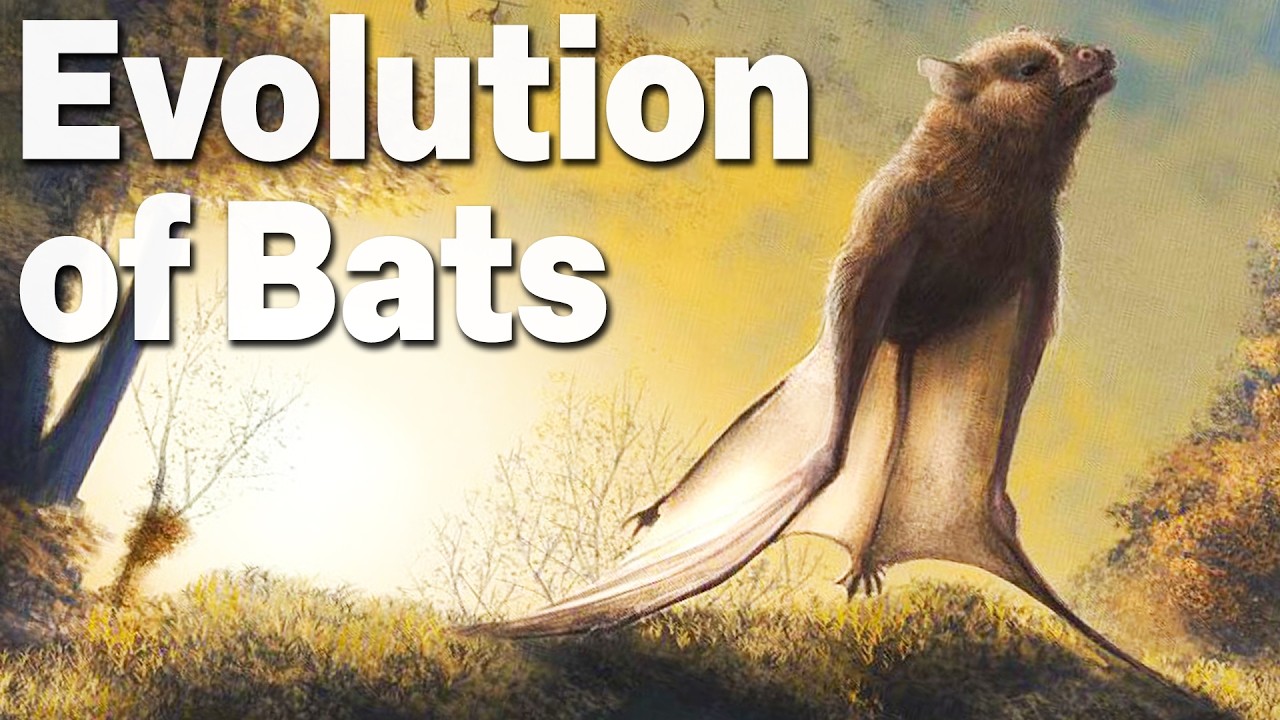
The Truth of Bat Evolution
Keywords
Summary
181 words
Critical Evaluation
Value of the Information & Strength of the Argument
The video provides substantial value by synthesizing the latest paleontological and genetic evidence on bat origins, including very recent 2023 and 2024 studies. The argumentation is well-structured, moving from fossil evidence to classification debates, and clearly presents competing hypotheses (e.g., whether echolocation is ancestral or convergent). The presenter carefully distinguishes between established facts and speculations, such as the hypothetical flightless ancestor. The inclusion of multiple expert perspectives and explicit referencing of peer-reviewed papers strengthens the credibility. The reasoning is logical, with each section building on previous information, and the tone remains objective throughout.
Scientific Rigor, Source Quality, Title Accuracy
The video demonstrates high scientific rigor: it cites over twenty primary research articles and reviews, many from top journals (Nature, Science, Current Biology). The presenter accurately conveys the uncertainty and ongoing debates, such as the echolocation controversy and the 1980s ‘megabats-primates’ hypothesis. The title ‘The Truth of Bat Evolution’ is fitting, as the video seeks to present the current consensus while acknowledging gaps. The content aligns well with the title, and the inclusion of specific fossil sites and species names adds precision. No major biases or misinformation were detected.
197 words
Title / Content Match
The title accurately reflects the content, which comprehensively covers the current understanding of bat evolution.
Quality & Reliability
9/10
The video relies on numerous peer-reviewed sources, presents current scientific consensus, and includes nuanced discussions of debates. The presenter cites specific studies and explains methodological limitations.
Chapters
Cited Sources
- https://doi.org/10.1016/j.cub.2013.09.014 — Cited in description as a source on bat evolution
- https://journals.biologists.com/jeb/article/207/25/4361/15115/Echolocation-signal-structure-in-the — Cited in description as a source on echolocation signal structure
- https://journals.plos.org/plosone/article?id=10.1371/journal.pone.0283505 — Cited in description as a source on Icaronycteris gunnelli
- https://link.springer.com/article/10.1007/BF02989856 — Cited in description as a source on early bats
- https://link.springer.com/article/10.1007/s10914-024-09705-8 — Cited in description as a source on bat phylogeny
- https://onlinelibrary.wiley.com/doi/10.1111/mam.12211 — Cited in description as a source on bat evolution
- https://royalsocietypublishing.org/doi/10.1098/rsbl.2021.0185 — Cited in description as a source on bat origins
- https://scholar.google.com/scholar?q=Early+Eocene+bats+%28Mammalia%2C+Chiroptera%29+and+other+vertebrates+in+freshwater+limestones+of+the+Willwood+Formation%2C+Clark%E2%80%99s+Fork+Basin%2C+Wyoming+Gingerich+1987 — Cited in description as a source on early Eocene bats
- https://scienceblogs.com/tetrapodzoology/2009/07/13/we-flightless-primates — Cited in description as a source on the megabats-primates hypothesis
- https://ucmp.berkeley.edu/vertebrates/flight/converge.html — Cited in description as a source on flight convergence
- https://www.cell.com/current-biology/fulltext/S0960-9822(14)01425-0?_returnURL=https%3A%2F%2Flinkinghub.elsevier.com%2Fretrieve%2Fpii%2FS0960982214014250%3Fshowall%3Dtrue — Cited in description as a source on bat phylogeny
- https://www.cell.com/current-biology/fulltext/S0960-9822(23)01289-7?_returnURL=https%3A%2F%2Flinkinghub.elsevier.com%2Fretrieve%2Fpii%2FS0960982223012897%3Fshowall%3Dtrue — Cited in description as a source on bat evolution
- https://www.nature.com/articles/d41586-023-03223-y — Cited in description as a news article on bat fossil
- https://www.nature.com/articles/nature06549 — Cited in description as a source on Onychonycteris
- https://www.nature.com/articles/nature09219 — Cited in description as a source on bat origins
- https://www.nature.com/articles/srep27726 — Cited in description as a source on bat evolution
- https://www.ncbi.nlm.nih.gov/pmc/articles/PMC122208/ — Cited in description as a source on bat evolution
- https://www.ncbi.nlm.nih.gov/pmc/articles/PMC3038382/ — Cited in description as a source on bat classification
- https://www.ncbi.nlm.nih.gov/pmc/articles/PMC4611652/ — Cited in description as a source on bat evolution
- https://www.pnas.org/doi/full/10.1073/pnas.111551998 — Cited in description as a source on bat phylogeny
Concurring Sources
- https://journals.plos.org/plosone/article?id=10.1371/journal.pone.0283505 — Supports the description of Icaronycteris gunnelli as a complete early bat
- https://www.nature.com/articles/nature06549 — Supports the discussion of Onychonycteris and early flight evolution
- https://www.nature.com/articles/nature09219 — Supports the molecular clock estimates for bat origins
Contribution & Novelties
This video excels by integrating the most recent research (up to 2024) in a clear narrative, making accessible the latest findings on bat evolution. It uniquely highlights the 2024 comprehensive study that reclassified many Eocene bats as stem lineages, and the discovery of Icaronycteris gunnelli and Vielasia, which are not yet well-known to the general public. The clear explanation of stem vs crown groups and the nuanced handling of echolocation debates provide a thorough update for enthusiasts.
Pour aller plus loin :
- Evolution of bats (Wikipedia) — A broad overview covering fossil evidence and classification.
- Animal echolocation (Wikipedia) — Detailed discussion of echolocation mechanisms, including in bats.
- Messel pit (Wikipedia) — Key fossil site described in the video, with rich bat fossils.
- Yinpterochiroptera (Wikipedia) — Modern bat classification group discussed in the video.
133 words
Radar Profile
The radar profile shows high scores across all dimensions, indicating a well-balanced and thorough presentation. The slight dip in technical level suggests the video is accessible to a general audience while maintaining solid scientific depth. The overall reliability and information quality are excellent, making it a trustworthy resource.
💬 Sur les 30 commentaires analysés, le climat est très positif : la majorité exprime de l'intérêt pour le sujet, certains partagent des expériences personnelles avec des chauves-souris et d'autres apportent des précisions scientifiques complémentaires, témoignant d'une audience engagée et experte.