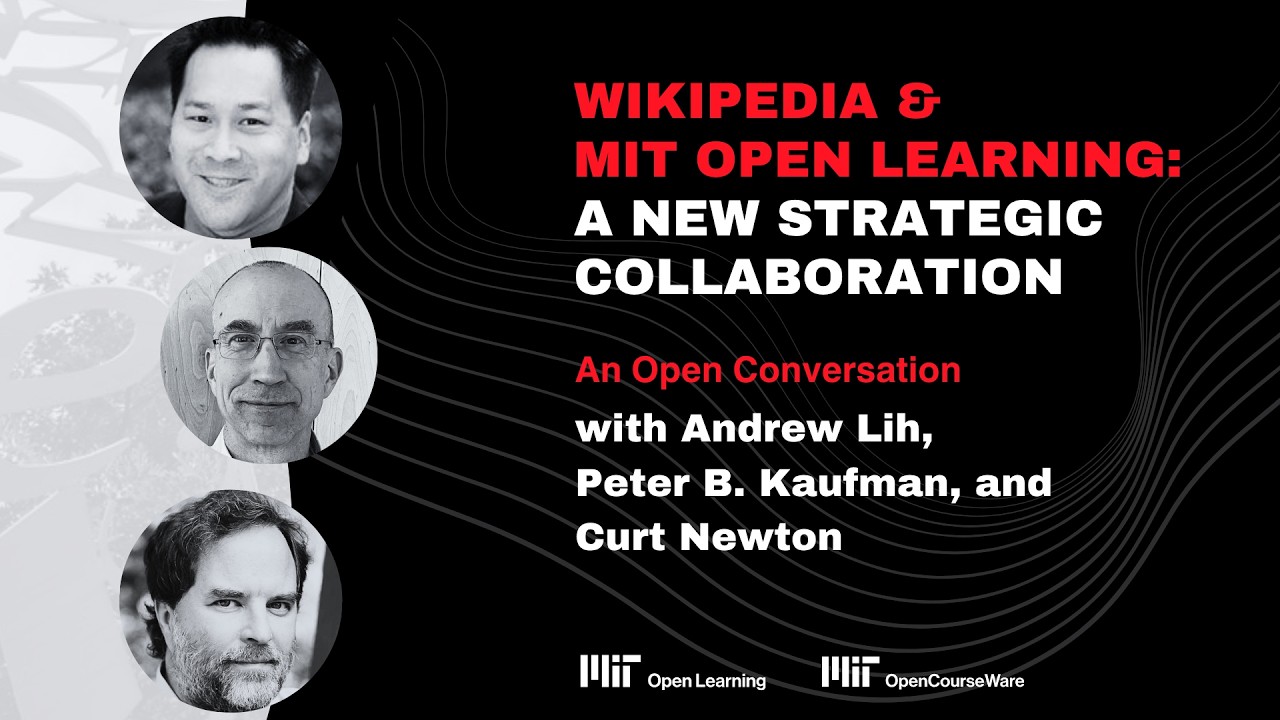
Wikipedia & MIT Open Learning: A New Strategic Collaboration
Keywords
Summary
198 words
Critical Evaluation
Value of the Information & Strength of the Argument
The value of the information lies in the concrete examples of how institutional collaboration can enhance Wikipedia’s content and the thoughtful exploration of AI’s role in facilitating that process. The argumentation is coherent and relies on the speakers’ direct experience with the Smithsonian, the Met, and other institutions. The panel makes a compelling case for the importance of open educational resources in maintaining trustworthy knowledge in the digital age. However, the discussion stays at a fairly high level, lacking deep technical details or critical examination of potential challenges, such as bias in AI matching or community acceptance.
Scientific Rigor, Source Quality, Title Accuracy
The rigor is moderate; while the speakers are credible experts, they do not cite specific studies or data during the conversation. The quality of sources is implied through their institutional affiliations, and the description provides links to related projects. The title accurately reflects the content, as it is a direct announcement and discussion of the collaboration. There are no comments provided for analysis, so public reaction is not assessed.
181 words
Title / Content Match
The title accurately reflects the content: a conversation about the new collaboration between Wikipedia and MIT Open Learning.
Quality & Reliability
7/10
The discussion is led by experts with credible backgrounds in open knowledge and education. However, it is a conversational panel without formal citations or peer-reviewed evidence, making it informative but not highly rigorous.
Key Moments
Markers derived by PSI from the transcript: the creator did not define chapters.
- Andrew Lih explains the shared lineage between Wikipedia and MIT OpenCourseWare, both started in 2001.
- Discussion of using Wikipedia's warning tags and citation needed labels to identify gaps in content.
- Curt Newton explains the use of AI tools like vector search and cosine similarity for matchmaking between Wikipedia needs and OCW materials.
- Examples of successful contributions: improved solid rocket booster diagrams and comprehensive building construction coverage.
- Discussion on the potential of video and audio enrichment for Wikipedia, referencing 8,000 videos in OCW.
- Panelists discuss the importance of open knowledge in an era of paywalls and information polarization, quoting 'truth is paywalled but lies are free'.
- Call to action for viewers to contribute to Wikipedia and support open knowledge initiatives.
Cited Sources
- Wikipedia — The main reference site discussed as the target of the collaboration.
- MIT OpenCourseWare — Source of educational materials being contributed to Wikipedia.
- Current Affairs (quote: 'truth is paywalled but lies are free') — Magazine referenced for the quote about paywalled truth.
- WikiMania 2026 — Mentioned as the annual Wikipedia conference where the collaboration was presented.
- Smithsonian Open Access — Referenced as Andrew Lih's previous initiative that released digital assets.
Concurring Sources
- Wikimedia Foundation — Supporting Wikipedia's mission and collaboration with educational institutions.
- MIT Open Learning — The broader department that oversees OpenCourseWare and this collaboration.
Contribution & Novelties
The conversation highlights the novel application of AI-powered semantic search to match institutional resources with Wikipedia’s content gaps, a practice that is still emerging in the open knowledge community. The discussion also underscores the strategic value of institutional partnerships in preserving public knowledge infrastructure.
Pour aller plus loin :
- Wikipedia:Verifiability policy — Relevant for understanding the reliability standards that guide content contributions.
- Vector search — Wikipedia article on vector databases, which explains the underlying technology used for matchmaking.
- Creative Commons — The license framework that enables legal sharing of OCW materials with Wikipedia.
- MIT OpenCourseWare — The platform itself, offering free course materials worldwide.
104 words
Radar Profile
The radar profile shows moderate to high scores across most dimensions, with the weakest area being technical depth. This reflects the conversational nature of the panel, which provides a good overview but lacks rigorous technical or scientific detail.