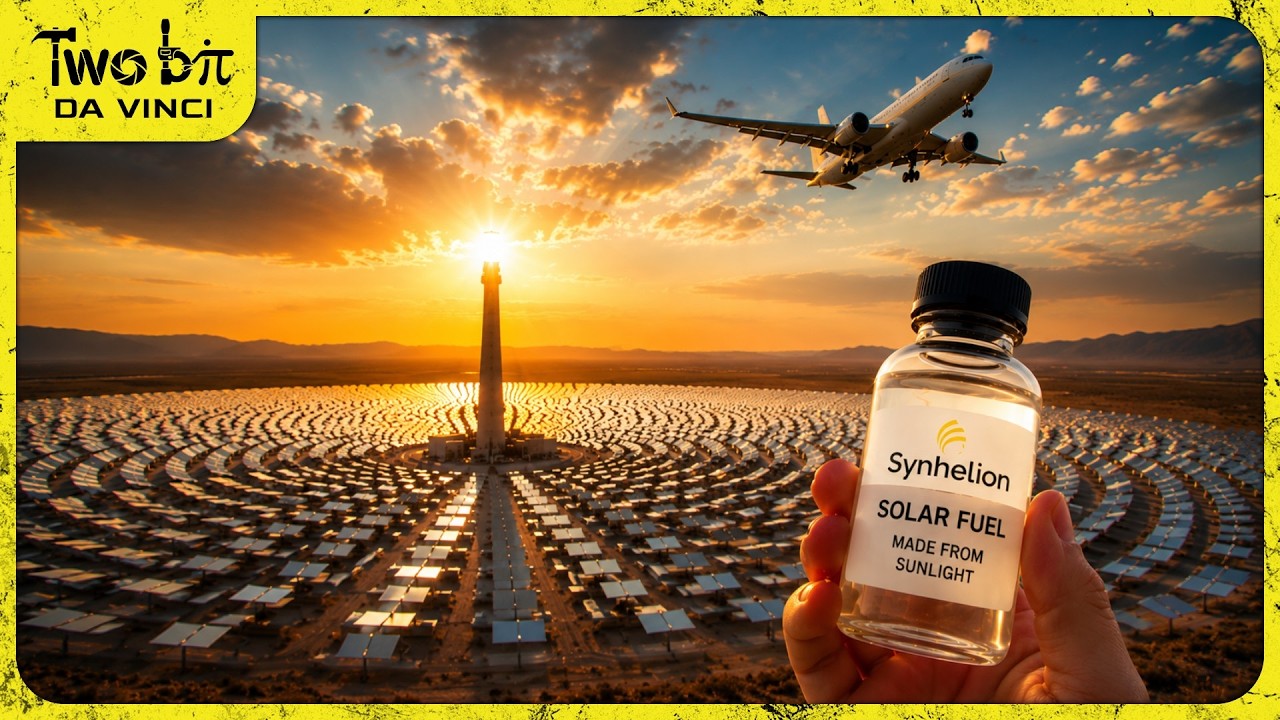
Why Batteries Will NEVER Replace Jet Fuel
Title history
- Why Batteries Will NEVER Replace Jet Fuel — observed on 20261101-0128 UTC (YouTube)
Keywords
Summary
156 words
Critical Evaluation
Value of the Information & Strength of the Argument
The video provides high informational value by clearly explaining the technical and economic hurdles of synthetic aviation fuel. It uses concrete numbers (energy densities, costs, efficiency) and first-hand interviews with engineers to support its arguments. The narrative is well-structured, leading from the fundamental problem to a proposed solution and its real-world implementation. The argument that no single perfect source is needed—using available renewable electricity, biogas, and waste—is compelling and practical. The emphasis on focusing on core competencies and leveraging existing infrastructure strengthens the case. However, the video does not deeply address the thermodynamic limits or lifecycle emissions of the process, and some simplifications (e.g., omitting the necessity of aromatics in jet fuel) were later corrected by commenters. Overall, the argumentation is solid and data-driven, though it could be more critical of scalability challenges.
Scientific Rigor, Source Quality, Title Accuracy
The scientific rigor is high: the host visited an actual operational plant, interviewed engineers, and accessed technical details like the 78% conversion efficiency and 1 MWh thermal storage. The sources used are primarily on-site testimony and company-provided data, which are credible but not peer-reviewed. The video references the RefuelEU directive correctly and cites Fischer-Tropsch chemistry as a century-old process. Potential bias exists as the video is sponsored by a robot vacuum company, but this is kept separate and does not affect the content. The title is accurate and not clickbait; it sets the thesis that batteries are inadequate, which is thoroughly substantiated. The absence of external scientific citations is a minor weakness, but the primary-source exposure adds authenticity. Overall, the video maintains a high level of rigor for a science communication format.
280 words
Title / Content Match
Title accurately reflects the core argument that batteries cannot replace jet fuel for long-haul aviation, pivoting to synthetic fuel as the pragmatic solution. Well-aligned with content.
Quality & Reliability
9/10
High-quality technical content with on-site visit to Synhelion, detailed explanations of chemistry, engineering, and regulation. Minor expert corrections in comments (e.g., aromatics necessity) but overall scientifically solid.
Key Moments
Markers derived by PSI from the transcript: the creator did not define chapters.
- Introduction: battery energy density vs jet fuel, 40x gap and weight issue.
- Explanation of Fischer-Tropsch synthesis: building kerosene from CO2 and H2O.
- Visit to Synhelion: showing the electric heater that can run on any renewable electricity.
- Ceramic brick thermal storage: 1 MWh at 1200°C, 90% efficiency, 10x cheaper than batteries.
- Discussion of solar tower being optional; focus on chemistry and reaction, not heat source.
- RefuelEU mandate: 2% SAF in 2025, 20% by 2035, 70% by 2050 with 35% synthetic e-fuel sub-mandate.
- Contrails and non-CO2 climate impact; synthetic fuel reduces soot and contrail formation.
Cited Sources
- Synhelion – Solar Fuel Company — Company visited; source of technical specifications and plant details.
- Fischer–Tropsch process – Wikipedia — Explanation of the chemical synthesis used to create jet fuel.
- RefuelEU Aviation – European Commission — EU regulation mandating sustainable aviation fuel blending.
- Ineratec – Power-to-Liquids — Partner providing Fischer-Tropsch unit for synthetic fuel production.
Concurring Sources
- IATA – Sustainable Aviation Fuel Fact Sheet — Corroborates the viability of SAF and market growth projections.
- International Council on Clean Transportation – SAF Overview — Provides data on SAF production costs and scalability consistent with the video.
Dissenting Sources
- Technical comment on aromatics in jet fuel — A commenter noted that aromatic hydrocarbons are needed for jet fuel properties like seal swelling and cold flow, implying synthetic fuel may need blending with conventional kerosene, a nuance not fully addressed in the video.
External References
Contribution & Novelties
This video’s original contribution is its reframing of synthetic fuel production: instead of requiring a perfect combination of solar towers, carbon capture, and green hydrogen, it emphasizes using already-available waste biogas, curtailed renewable electricity, and existing industrial processes. The first-hand demonstration that the solar tower is optional and that a simple resistive heater can suffice challenges common assumptions. The coverage of RefuelEU and the economic gap highlights the market opportunity. A notable insight is the alternative use of heat pumps (e.g., from Atmos Zero) to reduce electricity consumption for high-temperature steam.
Pour aller plus loin :
- Fischer-Tropsch synthesis — Core chemical process for making synfuels; details on catalysts and reaction mechanisms.
- Direct air capture — Context for carbon sourcing; the video discusses its cost impracticality for now.
- RefuelEU aviation regulation — Official EU policy framework driving SAF demand.
- Atmos Zero (heat pump technology) — Mentioned as a potential energy input innovation for high-temperature industrial heat.
155 words
Radar Profile
The radar profile shows high scores in quantitative and qualitative information, with a strong technical depth and good reliability. The relatively lower 'fiabilite_globale' (8) compared to other scores reflects minor inaccuracies or simplifications that were corrected by expert comments, but overall the content is robust.
💬 Positif. Sur les 30 commentaires analysés, la majorité exprime un accord enthousiaste et des remerciements pour la couverture détaillée de Synhelion. Plusieurs experts apportent des corrections techniques, mais le ton général reste constructif et encourageant.