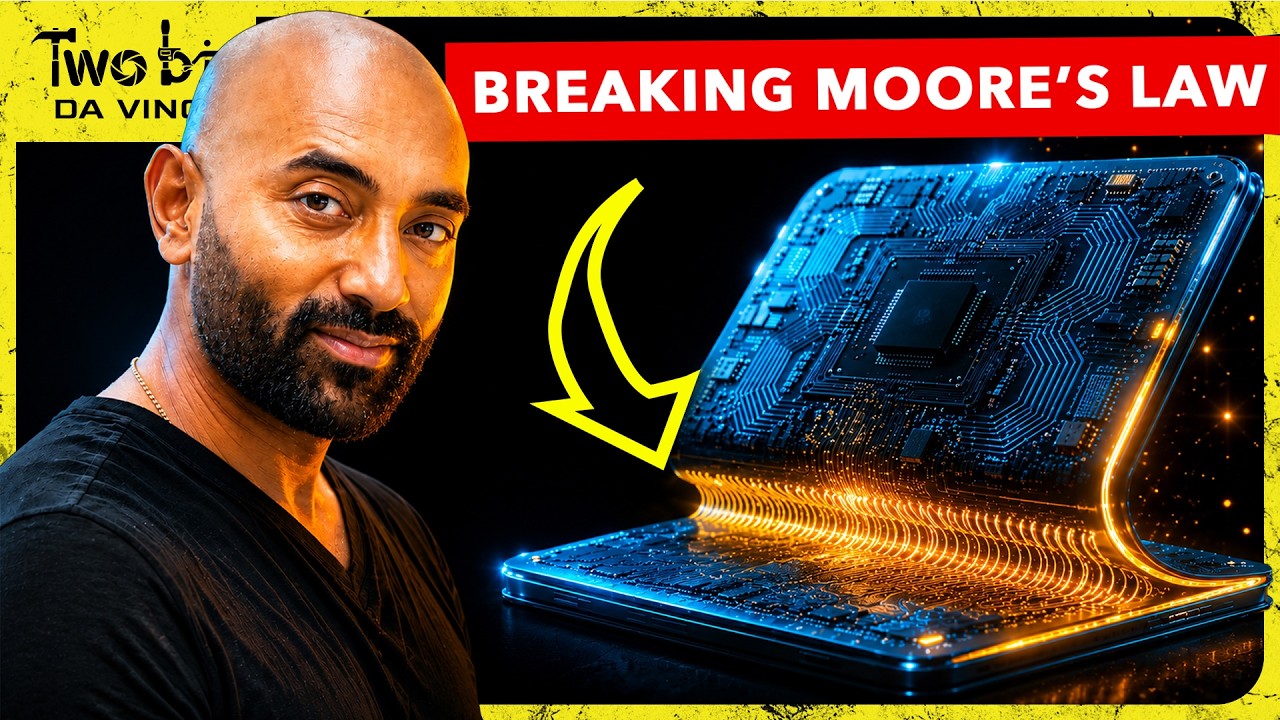
Huawei Just Broke the Rules of Moore's Law!
Title history
- Huawei Just Broke the Rules of Moore's Law! — observed on 20261101-0118 UTC (YouTube)
Keywords
Summary
154 words
Critical Evaluation
Value of the Information & Strength of the Argument
The video offers substantial value by making a highly technical topic accessible to a general audience. It effectively argues that wire delay is the fundamental bottleneck and that folding logic to shorten distances can reap enormous bandwidth and energy efficiency gains. The argumentation is solid, backed by concrete numbers (e.g., connections rising from 12,000 to 1,000,000, 53% more transistors, 41% energy efficiency) and clear analogies. However, some claims like the ‘100x leap’ are presented without deep caveats, and the video is inherently promotional for Huawei, so independent verification is missing. Still, the explanation is coherent and logically structured, making a strong case for the significance of the innovation.
Scientific Rigor, Source Quality, Title Accuracy
The scientific rigor is moderate: the video relies on official Huawei materials and mentions an IEEE event, which lends credibility, but it does not cite independent academic papers or offer critical counterpoints. The quality of the sources is acceptable for a popular science video, but the lack of external validation limits its rigor. The title accurately reflects the content, and the video does not overpromise beyond what is presented, though it frames the breakthrough in a positive light. The description provides a relevant official link, which is used, and no fabricated sources are introduced.
217 words
Title / Content Match
The title accurately reflects the content: the video discusses how Huawei's folding approach challenges the conventional scaling of Moore's Law.
Quality & Reliability
8/10
The video clearly explains a complex new technology with accurate technical details, referencing an official Huawei announcement and an IEEE event. It is well-produced but has a promotional tone and does not critically assess potential limitations beyond thermal issues.
Key Moments
Markers derived by PSI from the transcript: the creator did not define chapters.
Cited Sources
- Huawei News: IEEE ISCAS τ-Scaling — Official Huawei press release on the τ-Scaling framework presented at an IEEE symposium.
External References
Contribution & Novelties
This video provides a comprehensive and accessible explanation of Huawei’s logic folding and tau scaling, breaking down complex engineering concepts into digestible analogies. It goes beyond surface-level reporting by discussing the physical principles (RC time constant), the fabrication process (TSVs, copper bonding), and the broader implications for AI efficiency. The original contribution lies in its clear synthesis and the framing of folding as a new scaling dimension, potentially redefining how we approach post-Moore computing.
Pour aller plus loin :
- Moore’s Law — Foundation concept explained.
- Three-dimensional integrated circuit — Overview of 3D stacking technology.
- Through-silicon via — Key component enabling vertical connections.
- RC time constant — The fundamental physics behind wire delay.
- Dennard scaling — Historical scaling rule that broke down, motivating new approaches.
124 words
Radar Profile
The radar profile shows high scores in quantity and quality of information, with moderate technical depth and good reliability. This suggests a well-structured educational video that balances detail with accessibility, though it may rely heavily on a single source and thus could benefit from more independent validation.
💬 positive — Sur les 30 commentaires analysés, la majorité salue la clarté et la qualité de l'explication, avec quelques questions légitimes sur la gestion thermique et des corrections techniques mineures sur la lithographie EUV, reflétant un public engagé et plutôt satisfait.