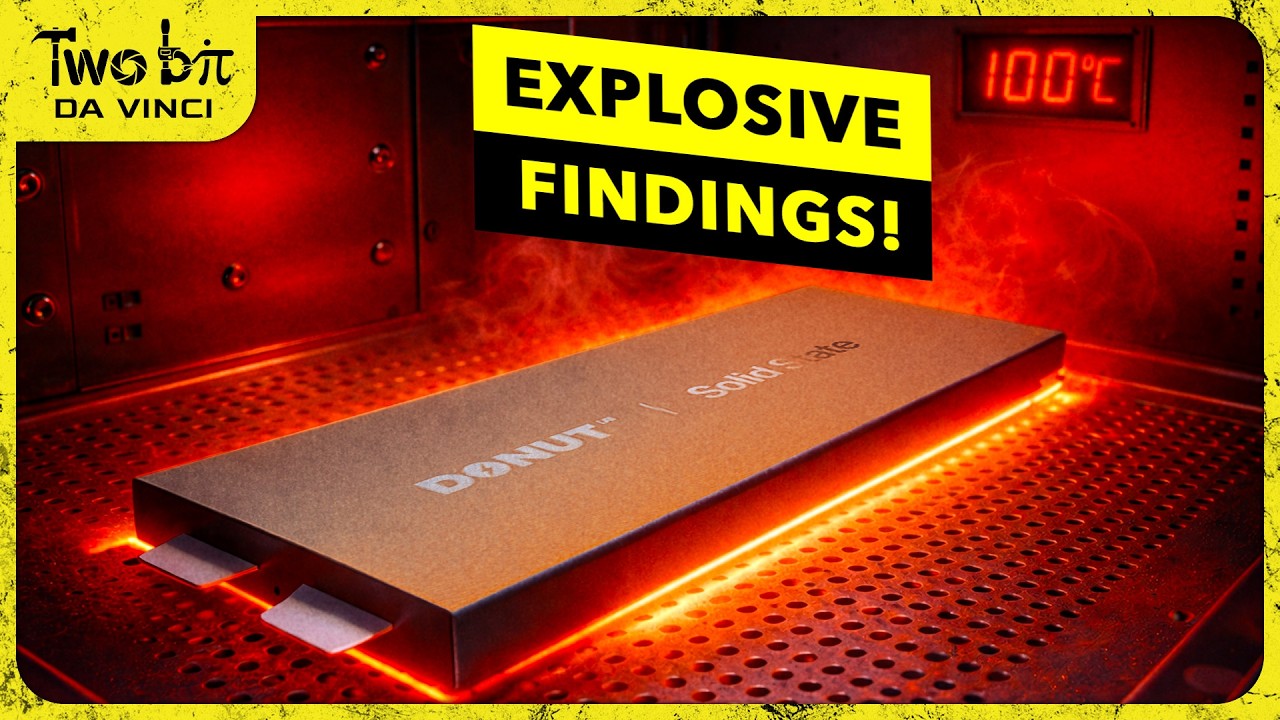
Donut Lab's Test 2 - I Didn't Expect This!
Title history
- Donut Lab's Test 2 - I Didn't Expect This! — observed on 20261101-0139 UTC (YouTube)
Keywords
Summary
190 words
Critical Evaluation
Value of the Information & Strength of the Argument
The video provides significant value by going beyond surface-level reporting. It systematically compares the test data against a wide range of commercial batteries and published research, extracting diagnostic metrics such as Coulombic efficiency and internal resistance changes. The argumentation is solid: the presenter builds a case step-by-step, first showing why the cell behaves unlike any commercial lithium-ion battery, then investigating sodium-ion chemistries that could explain the observed voltage and thermal characteristics. The reasoning is transparent, with the presenter explicitly stating when evidence is circumstantial or merely suggestive. The video also acknowledges counterarguments and missing data, which strengthens its credibility. Overall, the analysis is well-structured, evidence-based, and intellectually honest.
Scientific Rigor, Source Quality, Title Accuracy
The scientific rigor is high: the presenter relies on raw test reports from VTT, a reputable independent research center, and references published papers and commercial product specifications. The sources are clearly identified, and the presenter distinguishes between verified facts and hypotheses. The title is appropriate and attention-grabbing without being misleading, as the unexpected capacity gain at high temperature is indeed surprising. The presentation of data is meticulous, including calculations not found in the original report. However, the lack of direct access to the actual cell or its weight means the core claim of 400 Wh/kg remains unverified. The video does not overstate conclusions and explicitly invites critical feedback, which is a hallmark of rigorous science communication.
239 words
Title / Content Match
The title accurately reflects the surprising result: the cell gained capacity at high temperatures, contrary to expectations for conventional batteries.
Quality & Reliability
8/10
The analysis is meticulous, grounded in raw test data from an independent lab (VTT), and transparent about uncertainties. The presenter cross-references published research and commercial datasheets, while clearly separating facts from hypotheses. The reasoning is logical and avoids overclaiming, though the lack of direct access to the actual cell leaves room for speculation.
Chapters
Cited Sources
- VTT Test Report for Donut Lab (Test 2) — Primary data source for the battery test results, including high-temperature discharge profiles and capacity measurements.
- Two Bit da Vinci Newsletter (Full Data Spreadsheet) — Provides access to the complete dataset extracted from the VTT report, as promised in the video.
External References
Contribution & Novelties
The video’s original contribution lies in its independent re-analysis of VTT data, specifically the calculation of Coulombic efficiency and internal resistance trends, and its systematic comparison of the discharge curve against known sodium-ion cathode families. The presenter proposes a plausible sodium-ion layered-oxide architecture that fits all observed anomalies, while candidly acknowledging the enormous energy density gap compared to existing sodium-ion cells. This advances the public discourse by offering a concrete, testable hypothesis that others can pursue.
Pour aller plus loin :
- Solid-state battery — Overview of the technology class, relevant to understanding the claims.
- Sodium-ion battery — Background on the proposed alternative chemistry and its energy density limits.
- Thermal runaway — Explains why conventional batteries fail at high temperatures, a key context for the video’s argument.
126 words
Radar Profile
The radar profile shows consistently high scores across all four axes (quantity, quality, technical level, reliability), indicating a well-rounded and comprehensive analysis. The video is both information-dense and technically precise, while maintaining cautious and transparent reliability. The only slight weakness might be the inherent reliance on third-party test conditions, but this is not reflected in the scores, which are all at 8 out of 10.
💬 Orientation: positif. Sur les 30 commentaires analysés, la majorité exprime de l'enthousiasme pour les avancées de Donut Lab et apprécie l'analyse rigoureuse de la chaîne, tout en restant prudents sur les vérifications à venir.