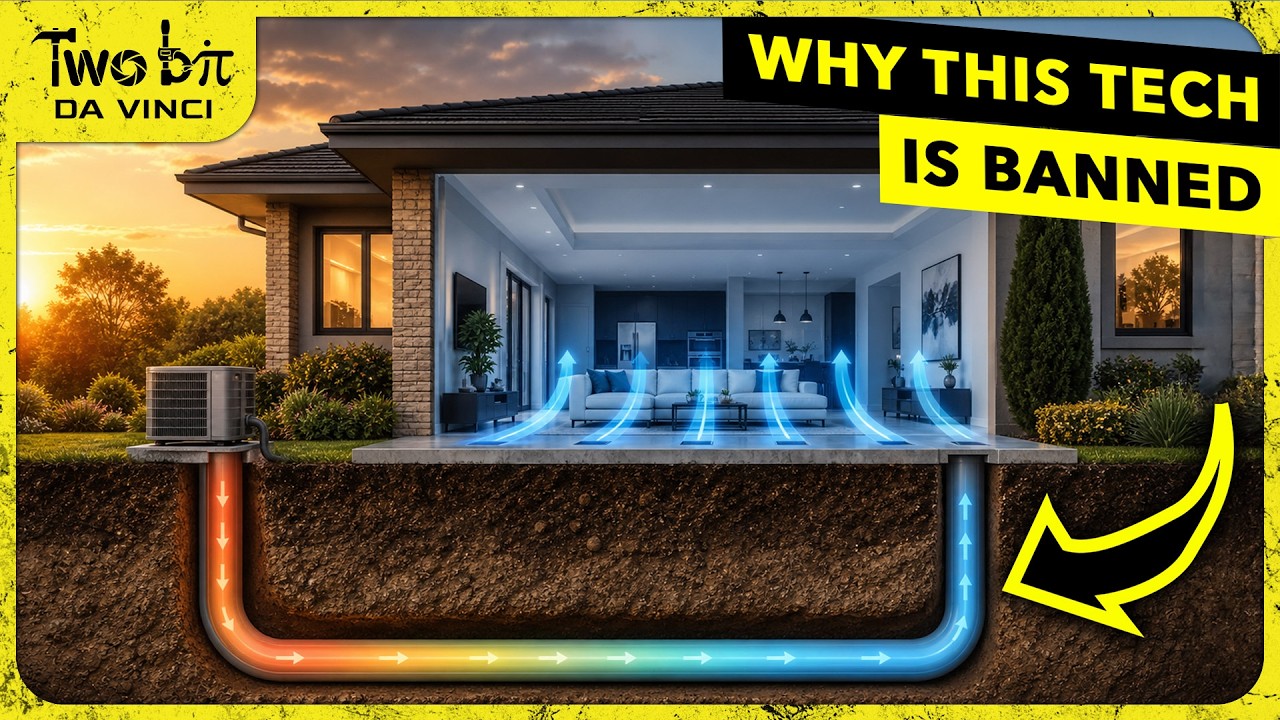
The Viral DIY Cooling Hack That Nearly Killed a Family
Title history
- The Viral DIY Cooling Hack That Nearly Killed a Family — observed on 20261101-0123 UTC (YouTube)
Keywords
Summary
246 words
Critical Evaluation
Value of the Information & Strength of the Argument
The video provides substantial value by systematically dismantling misinformation and offering verifiable evidence. It is well-structured, moving from the viral claim to the science, to system types, to code and lobbying fact-checks, to real-world examples, and to economic barriers. The argumentation is strong because it relies on primary sources: the actual building code sections, federal lobbying disclosures, peer-reviewed incidents (KU Leuven study), and documented projects. The host acknowledges nuances, such as climate suitability of air tubes, and presents both pros and cons. He clearly distinguishes between bad DIY practices and professional systems. The inclusion of cost data and payback periods adds practical value. However, the presence of a sponsor segment and the host’s personal interest introduce potential bias, though he attempts to remain balanced by acknowledging the sponsor and disclosing his own project plans.
Scientific Rigor, Source Quality, Title Accuracy
The scientific rigor is high for a YouTube video. The host cites specific documents and events: ORNL 1981 research, KU Leuven 2007 investigation, the actual text of IRC M1601.1.2, Open Secrets lobbying data, and real projects (Whisper Valley, Framingham, Dandelion). He explicitly corrects the viral video’s errors with exact figures. However, the description does not include direct links to these sources; the only links are to sponsor, partner services, and channel community pages. This limits the ability for viewers to verify claims independently, though the cited documents are identifiable. The video’s title is catchy and matches the content’s focus on a dangerous DIY hack, though it does not fully capture the broader exploration of geothermal technology. The title-contenu adequacy is good; the title highlights the sensational warning while the video fulfills that and more. Overall, the source rigor is above average for the platform, but the lack of inline references in the description is a minor weakness.
306 words
Title / Content Match
The title is engaging and accurately reflects the core warning about a dangerous DIY cooling hack, while the content also broadens into a comprehensive review of geothermal technology.
Quality & Reliability
8/10
Thorough fact-checking using primary sources (building codes, lobbying disclosures, case studies) with clear and balanced presentation, though personal opinion and sponsorship presence slightly temper absolute objectivity.
Chapters
- The Viral "Geothermal Is Banned" Video
- Earth as a Giant Thermal Battery
- The 4 Real Ground Source Systems
- Anker Solix F3800 Plus
- Debunking the Building Code & Lobbying Myths
- The Belgium Mold Disaster — Why Air Tubes Are Dangerous
- Why Isn't Every Home Geothermal?
- Whisper Valley & America's Hidden Geothermal Boom
- Congress Just Killed the Tax Credit
- My Install Plan & Final Thoughts
Cited Sources
- DeleteMe - Privacy protection — Partner service mentioned in description for online privacy.
- Two Bit da Vinci Discord — Community discussion platform for viewers.
- EnergySage for Solar — Partner resource for solar panel quotes.
- Support the Show - Membership — Channel membership support page.
- Newsletter subscription — Signup for channel newsletter.
- Podcast page — Two Bit da Vinci podcast episodes.
- Tesla referral link — Referral link for Tesla products.
External References
Contribution & Novelties
This video contributes a rigorous, evidence-based corrective to widely circulated misinformation about geothermal energy. It provides exact figures (e.g., water’s heat capacity advantage, lobbying amounts) and highlights real-world examples that counter the ‘banned’ narrative, while also warning about genuine risks (mold in humid climates). The host’s personal journey adds authenticity, and the discussion of the tax credit cancellation provides timely information.
Pour aller plus loin :
- Ground source heat pump — Comprehensive overview of technology and history.
- Earth-air heat exchanger — Details on air-based systems and their risks.
- Heat pump — General principles and types of heat pumps.
98 words
Radar Profile
The radar profile shows high scores in all dimensions, with the strongest areas being information quantity and reliability, while technical depth is slightly lower due to accessibility. The video is both informative and trustworthy, with a balanced emphasis on scientific facts and practical advice.
💬 Positif — Sur les 30 commentaires analysés, la plupart sont élogieux et informatifs, exprimant gratitude pour la clarification et partageant des expériences personnelles avec la géothermie, bien que certains soulèvent des points techniques ou des préoccupations sur les coûts.