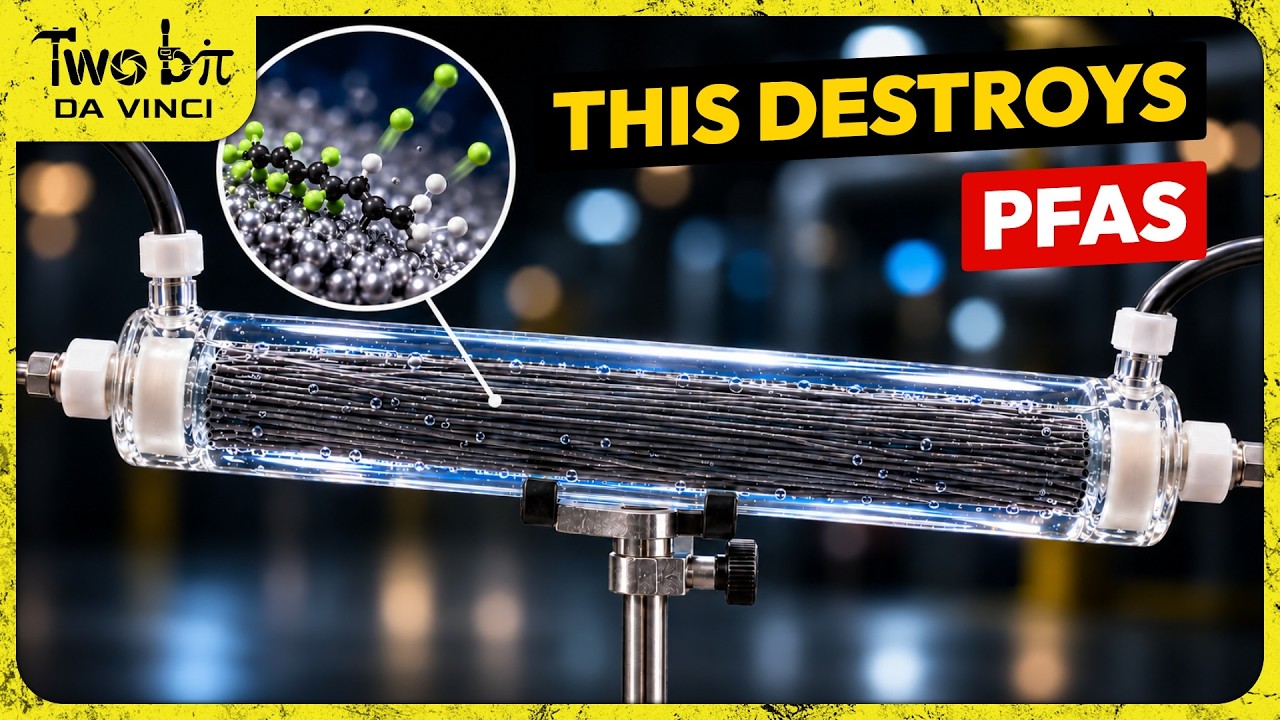
New Tech Destroys 97% of PFAS & Forever Chemicals!
Title history
- New Tech Destroys 97% of PFAS & Forever Chemicals! — observed on 20261031-2303 UTC (YouTube)
Keywords
Summary
168 words
Critical Evaluation
Value of the Information & Strength of the Argument
The video offers substantial value by breaking down a complex scientific paper into accessible explanations, providing quantitative details (removal percentages, palladium costs, reactor dimensions) and clearly distinguishing between removal and destruction. The argumentation is strong: it frames the problem (PFAS persistence, waste disposal), evaluates existing methods, presents the new membrane’s mechanism, and systematically addresses limitations (cost, pH, scaling, membrane stability). It also places the research in the regulatory context, enhancing its practical relevance. The narrator’s reasoning is clear and logical, supporting the claim that this is a promising step, though acknowledging remaining hurdles.
Scientific Rigor, Source Quality, Title Accuracy
The video demonstrates scientific rigor by citing a specific peer-reviewed study, providing exact figures, and openly discussing uncertainties (e.g., palladium loss, incomplete defluorination). It references credible agencies like the EPA and CDC, and explains why current methods are inadequate. However, the title overstates the result by implying full destruction, when the video carefully reports partial defluorination. The description contains few direct scientific sources beyond the study itself, but the video appears to faithfully represent the paper’s findings. Overall, the content is well-founded and the tone is appropriately nuanced.
196 words
Title / Content Match
The title claims 97% destruction, but the video reports 96% removal and 83% defluorination, so slightly overstated.
Quality & Reliability
8/10
The video provides a detailed, well-structured explanation of a specific scientific study, including quantitative data and limitations, while avoiding major inaccuracies.
Chapters
Cited Sources
- DeleteMe – Protect Yourself Online — Sponsor link in description for online privacy protection service.
- EnergySage – Going Solar — Referral link for solar energy quotes.
- Channel membership — Support the show via membership.
- Newsletter — Channel newsletter signup.
- Discord — Community Discord server.
- Podcast — Podcast channel.
- Tesla referral — Referral link for Tesla purchase.
External References
Contribution & Novelties
The video translates a cutting-edge scientific paper into an engaging narrative, emphasizing the distinction between removal and destruction, which is often overlooked. It also provides a transparent cost analysis of palladium usage, addressing a key barrier. The explanation of the membrane’s two hydrogen mechanisms adds depth. This could help the public and regulators appreciate both the promise and the challenges of PFAS remediation.
Pour aller plus loin :
- Per- and polyfluoroalkyl substances (PFAS) — Overview of PFAS and their environmental impact.
- Supercritical water oxidation — An existing destructive technology discussed in the video.
- Carbon–fluorine bond — The chemical bond that makes PFAS persistent.
- EPA PFAS page — Regulatory information from the EPA.
112 words
Radar Profile
The radar profile shows high scores in information quantity and technical level, while reliability and quality are slightly lower due to the title's overstatement. The overall judgement reflects a well-researched but slightly sensationalized presentation.
💬 Based on the 30 comments analysed, the mood is positive and hopeful about the new technology, though several viewers stress the need for corporate accountability and question the cost-effectiveness.