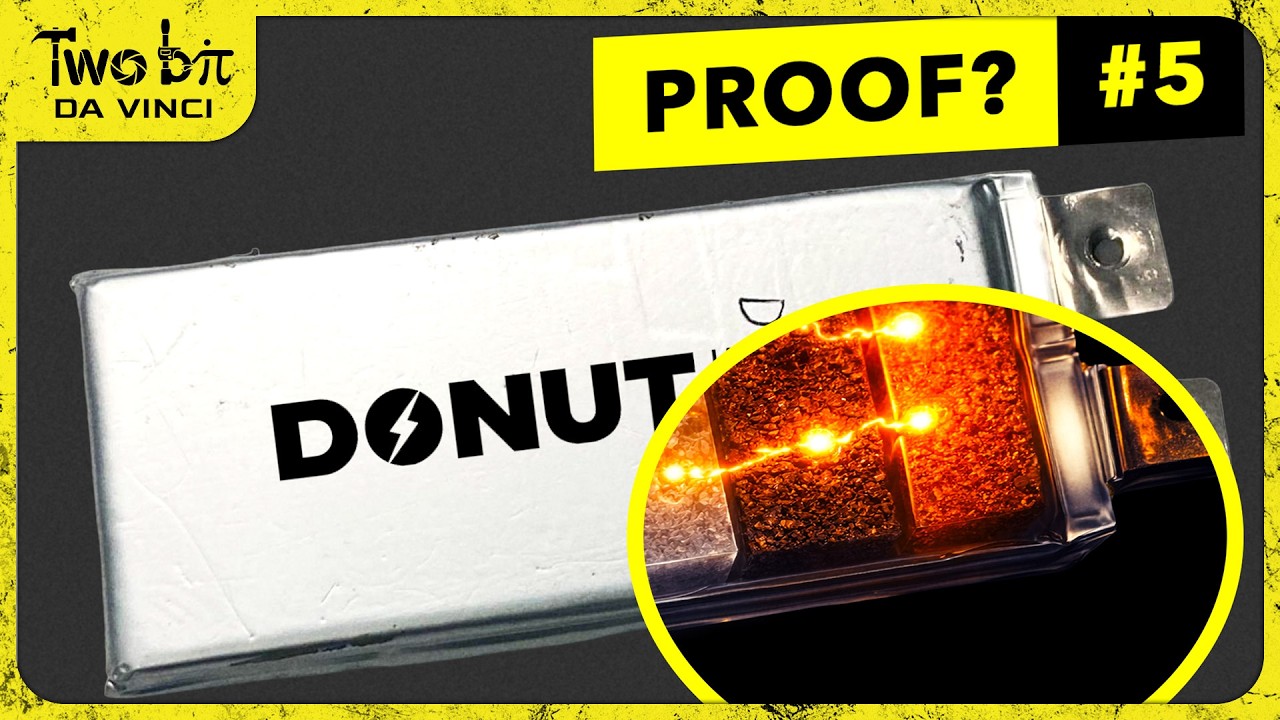
Donut Lab Battery Test 5 - FINALLY Proof?
Title history
- Donut Lab Battery Test 5 - FINALLY Proof? — observed on 20261101-0133 UTC (YouTube)
Keywords
Summary
158 words
Critical Evaluation
Value of the Information & Strength of the Argument
The value lies in a rigorous, data-driven breakdown of a public test report, providing a clear explanation of why the failure modes point to solid-state behavior. The argumentation is structured and logical, using published chemistry principles (e.g., sodium carbonate volume changes, lithium hydroxide formation) and referencing prior research (ACS Energy Letters, Lee et al. 2024). While some deductions are speculative (e.g., the identity of the anode), the presenter transparently distinguishes between evidence and inference, making the argument credible despite missing data.
Scientific Rigor, Source Quality, Title Accuracy
The video relies on the VTT report (not linked but described) and general scientific references, but no primary academic URLs are provided in the description. The quality of the reasoning is high, with clear causality and chemistry citations. The title matches the content well: it frames the test as potentially providing proof, and the video delivers circumstantial evidence while acknowledging limitations. Comment analysis is also provided, but no independent verification of the claims is offered.
171 words
Title / Content Match
The title asks whether this is finally conclusive proof; the video provides strong circumstantial evidence for a solid-state cell but stops short of claiming absolute proof, making the title appropriately framed.
Quality & Reliability
7/10
The analysis is based on a VTT test report and established chemistry principles, but the video itself is speculative in identifying the exact cell chemistry. It cites no direct academic URLs, relying on general knowledge and a sponsor segment.
Chapters
- Donut Lab's Most Revealing Test Yet
- The Overlooked Data Point — Full Capacity After Air Exposure
- VTT Pushes to 5C — The Capacity Drop
- The Pouch Failed, Not the Battery
- Is the 17% Swelling Just Gas?
- Four Mechanisms Behind the 17% Expansion
- Lithium vs Sodium — The Volume Clue
- Hidden in the Data — Coulombic Efficiency & Cycle 56
- What We Still Don't Know
- Comment Analysis — The Mood is Shifting
External References
Contribution & Novelties
The video contributes a nuanced interpretation of the Donut Lab test, notably the argument that the 17% swelling is due to solid expansion rather than gas, and the use of columbic efficiency to infer internal interface behavior. It also highlights the safety aspect of graceful degradation.
Pour aller plus loin :
- Solid-state battery — Background on solid-state electrolyte properties and challenges.
- NASICON — A sodium-ion conducting ceramic electrolyte relevant to the discussion of air-stable electrolytes.
- Coulombic efficiency — Definition and importance in battery diagnostics.
- Contact loss in solid-state batteries — Research on mechanical degradation mechanisms.
95 words
Radar Profile
The radar profile shows high scores for technical depth and information quantity, with slightly lower reliability due to reliance on indirect evidence. The quality of information is strong, but the overall confidence is tempered by the lack of access to original data and the speculative nature of some conclusions.
💬 Sur les 30 commentaires analysés, l'orientation est positive, avec une majorité d'appréciations pour la qualité de l'analyse et la pédagogie. Toutefois, on note une frustration croissante chez certains internautes concernant la lenteur de la diffusion des données par Donut Lab, sans toutefois de commentaires violents.