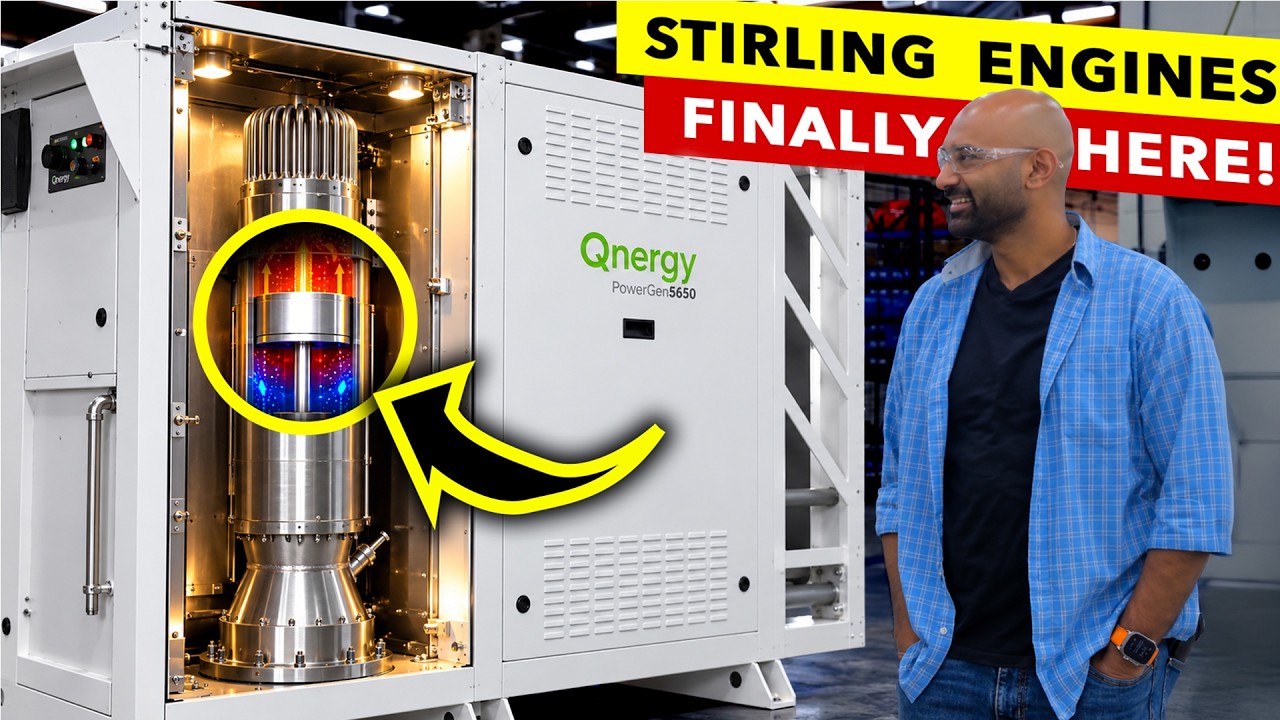
The Company that FINALLY Figured out the Stirling Engine
Title history
- The Company that FINALLY Figured out the Stirling Engine — observed on 20261031-2315 UTC (YouTube)
Keywords
Summary
153 words
Critical Evaluation
Value of the Information & Strength of the Argument
The video provides substantial technical depth on Stirling engine principles and engineering challenges, such as scaling limitations and the need for power electronics to control free-piston amplitude. It argues convincingly that Qnergy’s success stems from targeting niche markets where traditional engines fail—like handling dirty fuels and providing ultra-reliable remote power—rather than competing directly with internal combustion engines. The argumentation is well-structured, balancing positive aspects with acknowledged drawbacks, and includes concrete data (99.998% methane destruction, 70,000-80,000 hour lifespan) to support claims. The inclusion of real-world field footage and engineer testimonials enhances credibility, making the video valuable for both enthusiasts and professionals.
Scientific Rigor, Source Quality, Title Accuracy
The video demonstrates good scientific rigor by explaining the physics of Stirling engines and referencing independent evaluations, such as the Canadian government’s third-party testing. However, it does not provide direct links to these studies in the description, relying instead on promotional and support links. The title is appropriate and not misleading, as it focuses on Qnergy’s breakthrough. The video also acknowledges limitations, such as low efficiency (~12%) and high costs, avoiding overhype. Overall, while the sourcing could be more transparent, the content is credible and well-presented.
201 words
Title / Content Match
The title accurately reflects the content: the video explains how Qnergy has finally found commercial viability for Stirling engines in niche markets.
Quality & Reliability
8/10
The video is well-researched, includes interviews with company engineers, shows factory tours, and references third-party testing (Alliance Technical Group, Canadian government). However, some claims lack direct citations, and the sponsor segment does not affect content reliability.
Chapters
Concurring Sources
- Stirling engine on Wikipedia — General reference on Stirling engine principles, confirming the operational description of the video.
- Free-piston engine on Wikipedia — Explains the free-piston design and its advantages, aligning with Qnergy's approach.
External References
Contribution & Novelties
The video offers original insights into how a 200-year-old technology can be commercialized by redefining use cases rather than competing on efficiency. It highlights Qnergy’s engineering innovations, such as clearance seals and flexure bearings, and demonstrates practical applications like landfill gas abatement. This serves as a case study in cleantech business models.
Pour aller plus loin :
- Stirling engine on Wikipedia — Provides a comprehensive overview of the technology and its history.
- Free-piston engine — Explains the free-piston concept used in the QB80.
- EPA Landfill Methane Outreach Program — Information on landfill gas utilization and methane abatement, directly relevant to the video’s application.
103 words
Radar Profile
The radar profile indicates high quantity of information and a good technical level, but a slightly lower reliability score due to lack of transparent source links. The balance between technical depth and practical application is notable.
💬 On the 30 comments analyzed, the sentiment is predominantly positive, with viewers appreciating the technical depth and the exploration of niche applications. A few comments offer corrections (e.g., on operating hours) or express skepticism about the infomercial-like presentation, but overall reception is enthusiastic.