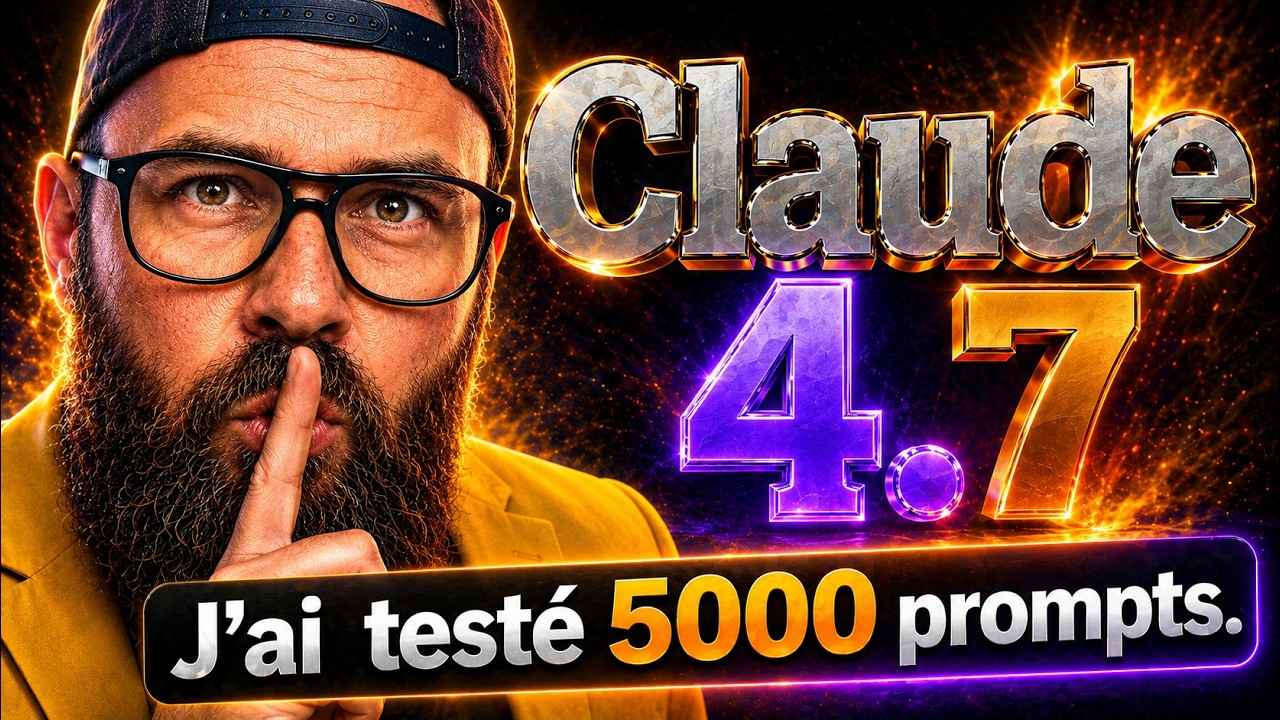
J'ai testé tous les prompts Claude : voici le meilleur !
I Tested All the Claude Prompts: Here is the Best One!
Keywords
Summary
133 words
Critical Evaluation
Value of the Information & Strength of the Argument
The video provides practical insights into prompt engineering, highlighting real issues like context pollution and the importance of structure. The argumentation is built on personal tests and references to Apple’s study, which supports the claim that models lack true reasoning. However, the evidence is presented anecdotally without controlled experiments, and the conclusions are often generalized. The value lies in the practical advice, but the lack of systematic testing weakens the strength of the argumentation.
Scientific Rigor, Source Quality, Title Accuracy
The video cites the OpenAI cookbook and Apple’s study, but does not provide direct links to these sources in the description. The description contains promotional links to the creator’s own platforms and a discounted tool, which reduces credibility. The title overpromises by claiming to test ‘all’ prompts, whereas only a few are examined. The overall scientific rigor is low, with opinions presented as facts and no peer-reviewed references.
157 words
Title / Content Match
The title is catchy but somewhat exaggerated; the video tests a few prompts, not all, and the 'best' is not clearly defined.
Quality & Reliability
4/10
The video presents subjective tests and opinions without rigorous methodology, relies on anecdotal evidence, and promotes the author's own training products. It lacks verifiable scientific references and makes broad claims about model behavior.
Key Moments
Markers derived by PSI from the transcript: the creator did not define chapters.
- Introduction: the question of writing good prompts for AI agents.
- Discussion of influencer prompts and their contradictions.
- Testing a ChatGPT prompt from OpenAI's cookbook; ChatGPT fails to understand the structure.
- Testing the same prompt with Claude; Claude correctly interprets the decision hierarchy.
- Explanation of agentic systems, parent/sub-agent architecture, and context management.
- Advice on structuring prompts with XML and Markdown, and verifying understanding via decision trees.
Cited Sources
- Parlons IA Dailymotion channel — Creator's alternative channel
- Parlons IA Medium blog — Creator's articles and resources
- Parle IA training platform — Creator's paid courses and services
- Parlons IA podcast — Creator's podcast on Spotify
- SEO Agent IA tool — Promotional tool link with discount code
Contribution & Novelties
The video contributes practical insights into structuring prompts for large language models, emphasizing the importance of decision trees and the limitations of simple role-playing prompts. Its original angle is the comparison between ChatGPT and Claude on the same task, showcasing differences in instruction comprehension. However, the claims are not substantiated by peer-reviewed research.
Pour aller plus loin :
- Prompt engineering — Overview of prompt design principles.
- Transformer (machine learning model) — Technical background on attention mechanisms.
- Large language model — Context on model capabilities and limitations.
86 words
Radar Profile
The scores show a moderate quantity of information but lower quality and reliability, indicating a technically-oriented but not scientifically rigorous presentation. The high level of technical detail contrasts with weaker fact-checking and source transparency.