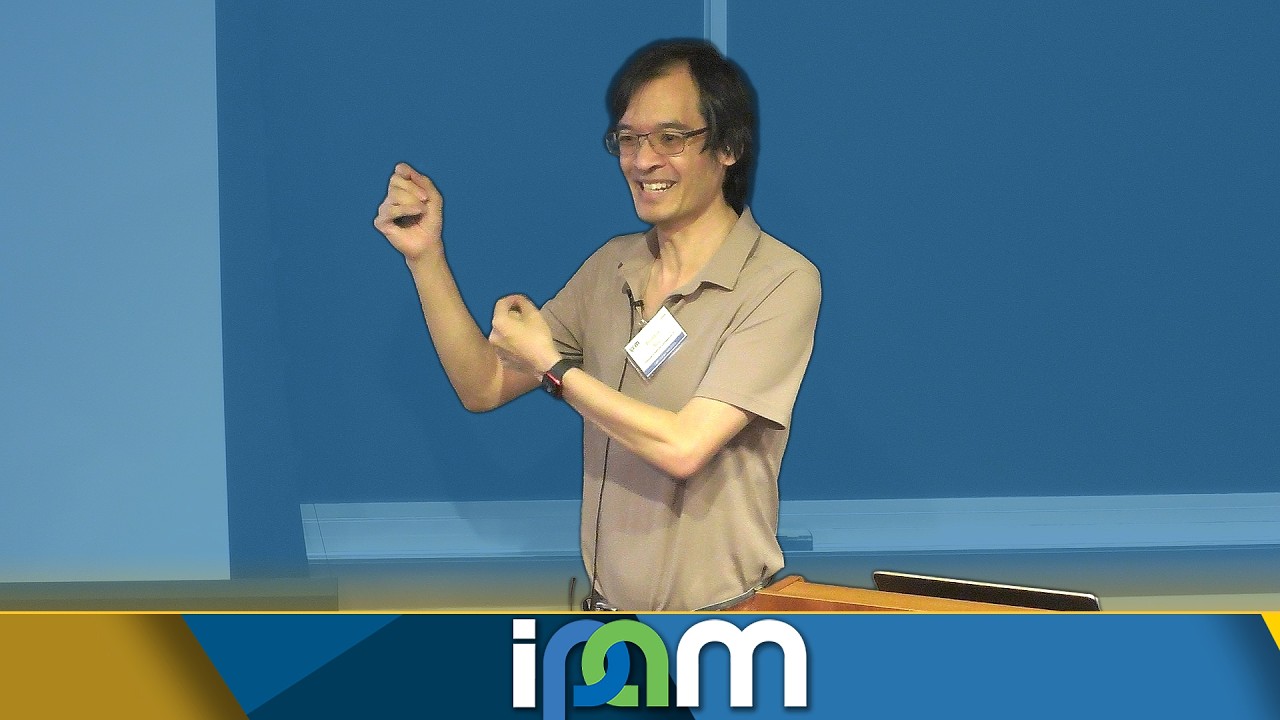
Terence Tao - The integrated explicit analytic number theory network - IPAM at UCLA
Keywords
Summary
197 words
Critical Evaluation
Value of the Information & Strength of the Argument
The talk provides substantial value by explaining a concrete, ambitious effort to formalize a entire subfield of mathematics and integrate it with modern AI tools. The argumentation is coherent, with a logical progression from the need for explicit bounds, to the difficulty of checking these results, to the proposal of using formal verification and AI. Tao also honestly discusses the shortcomings and unexpected difficulties encountered, which enhances credibility. He supports his points with a concrete example (the highly abundant number problem solved via crowdsourcing and explicit estimates) and clearly articulates the potential benefits of a dynamic, queryable network.
Scientific Rigor, Source Quality, Title Accuracy
The talk is rigorous in its technical content, though it deliberately avoids deep proofs, focusing on conceptual and organizational aspects. The sources are based on Tao’s own work and the collaborative project, referencing MathOverflow and Mathlib, and the link to the workshop page is provided. The title accurately describes the talk; the content matches the promise. There is no discrepancy between title and content. The talk does not cite external literature extensively, but it is embedded in the context of formalization efforts in mathematics.
197 words
Title / Content Match
The title accurately reflects the content: Terence Tao discusses the integrated explicit analytic number theory network project.
Quality & Reliability
8/10
The talk is given by a leading mathematician, presents a novel project in formalization, and clearly outlines both successes and challenges, but is a status report without full peer review.
Key Moments
Markers derived by PSI from the transcript: the creator did not define chapters.
- Introduction of the project and the vision of a 'living spreadsheet' for the literature.
- Explanation of explicit analytic number theory and the importance of explicit constants.
- Example of highly abundant numbers and the crowdsourced proof on MathOverflow.
- Description of the pipeline of results, from zeta function bounds to applications.
- Start of the formalization project using Lean and the initial classical approach.
- Problems with autoformalization, inefficient proofs, and the codebase becoming unmaintainable.
- New node-based network architecture inspired by the Lean comparator paradigm.
Cited Sources
- IPAM Workshop: PDEs, Verification, Mathematics, and Algorithms in the Age of AI — Workshop homepage where the talk was recorded.
Contribution & Novelties
The talk introduces a novel framework for organizing and formalizing a body of mathematical literature as an interconnected network, leveraging the Lean proof assistant and autoformalization. The key innovation is the concept of a ’living spreadsheet’ that can automatically update theorems when input bounds change, and the revised node-based architecture that treats papers, calculations, and conjectures as units. This is a promising approach to infrastructure in mathematics, potentially enabling more efficient verification and adaptation to new results.
Pour aller plus loin :
- Lean (proof assistant) — The formal verification system used in the project.
- Analytic number theory — The field of mathematics addressed.
- Goldbach’s weak conjecture — An example of a result requiring explicit bounds, mentioned in the talk.
119 words
Radar Profile
The radar shows very high scores in technical depth and quality of information, with slightly lower but still strong scores in quantity and reliability. This indicates a technically dense and credible presentation, though limited in breadth and still in early stages of verification.