Ian Le - Cluster Algebras and Legendrian Knots - IPAM at UCLA
Keywords
Summary
186 words
Critical Evaluation
Value of the Information & Strength of the Argument
The talk provides a rigorous and insightful exposition of a highly nontrivial mathematical topic. It succeeds in conveying the conceptual framework: starting from moduli spaces of local systems, it demonstrates how cluster structures emerge naturally and are controlled by Legendrian knot theory. The argumentation is coherent: the speaker builds step-by-step, clarifying definitions, providing concrete computations, and responding to audience questions. The inclusion of explicit examples (e.g., SL(4) on a triangle) makes abstract ideas concrete. The value is high for a mathematically mature audience: it offers a fresh perspective linking seemingly distant areas. The logical flow is solid, though some parts (e.g., the tetrahedron picture and mutation) are sketched rather than fully derived, relying on the audience’s prior knowledge.
Scientific Rigor, Source Quality, Title Accuracy
Scientific rigor is high: the talk is based on established work in cluster algebras, character varieties, and contact geometry, and the speaker is an active researcher. Definitions are precise, and technical conditions (e.g., genericity of flags) are discussed. The quality of sources is implicit in the content; no explicit citations are given in the talk, but the IPAM workshop page (linked in the description) serves as a reference for the tutorials. The title accurately matches the content: the talk indeed investigates how Legendrian knots yield cluster structures on moduli spaces. Comments on the video are not available, so no public feedback can be assessed.
237 words
Title / Content Match
The title accurately reflects the content: the talk explains how cluster algebras arise from Legendrian knots and Lagrangian fillings, precisely matching the announced theme.
Quality & Reliability
8/10
Talk by an expert in the field, based on well-established theories and with concrete examples; the material is technically sound and presented in a rigorous manner. Minor caveats: some statements are heuristic and the talk is an extended tutorial rather than a formal proof, but overall highly reliable.
Key Moments
Markers derived by PSI from the transcript: the creator did not define chapters.
- Introduction and review of previous talks; setup of surface S with boundary markings and group G.
- Definition of character variety (A-moduli space) and parallel X-moduli; explanation of reduction to U or B.
- Discussion of marked points and boundary conditions; emphasises that adjacent flags must be generic.
- Concrete example: SL(4) on a triangle, writing cluster variables as determinants; quiver diagram appears.
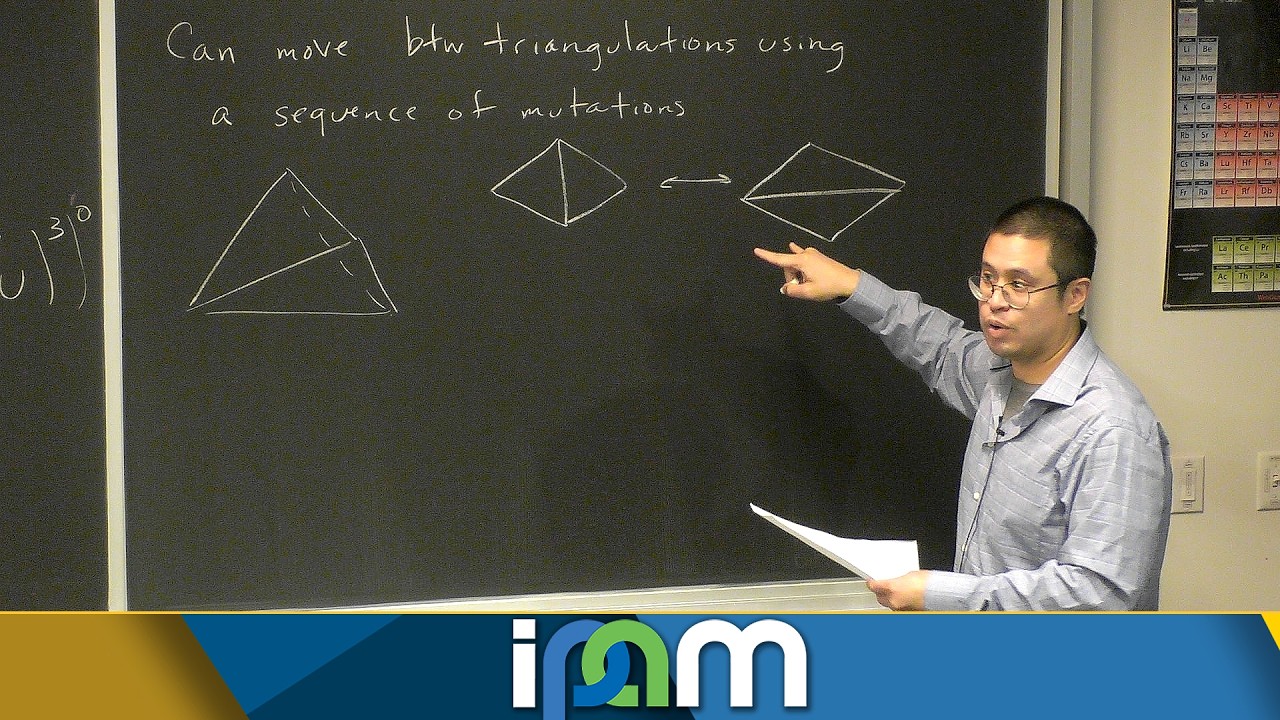
- Mutation through a tetrahedron to change triangulations; mention of many unexplored clusters beyond triangulations.
- Idea that cluster structure is a shadow of 3-manifold rigidity; audience question about tessellations.
- Construction of torus charts from cluster variables; injection into character variety and well-definedness.
- Discussion of relative positions of flags via Weyl group; examples for SL(3).
Cited Sources
- IPAM Workshop: Quantum topology, character varieties and low-dimensional geometry Tutorials — Official page for the tutorial series where this talk was recorded; provides schedule and context.
Contribution & Novelties
The talk presents an original perspective on cluster algebras by linking them explicitly to Legendrian knots and their Lagrangian fillings. It demonstrates how moduli spaces of local systems on surfaces naturally carry cluster structures that can be constructed via contact geometry. The emphasis on examples (SL(4) on a triangle) and the discussion of relative flag positions clarifies the underlying combinatorics. The speaker also hints at many unexplored cluster structures beyond those coming from triangulations, suggesting a rich area for future research.
Pour aller plus loin :
- Cluster algebra — Foundational concept; the talk builds upon cluster structures on moduli spaces.
- Legendrian knot — Central object in contact geometry; the talk uses Legendrian weaves to explain cluster patterns.
- Character variety — Moduli space of local systems; the starting point of the talk.
- Lagrangian filling — Related concept in symplectic geometry; provides the link to Legendrian knots.
145 words
Radar Profile
The radar profile shows high scores in quantitative and technical aspects, reflecting a dense, expert-level tutorial. Quality and reliability are strong, though the informal nature and reliance on prior knowledge may reduce accessibility for a general audience.