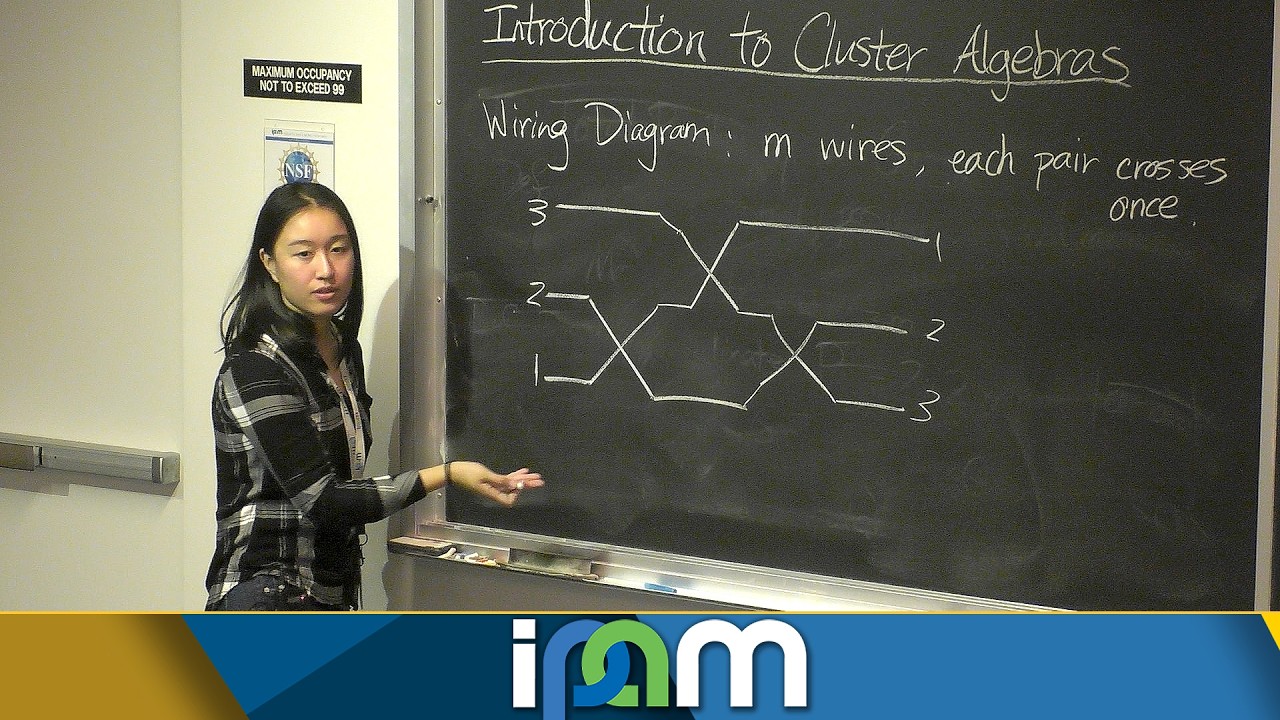
Ariana Chin - Introduction to Cluster Algebras - IPAM at UCLA
Keywords
Summary
152 words
Critical Evaluation
Value of the Information & Strength of the Argument
The lecture is of high educational value, building up from concrete motivating examples to abstract definitions without losing clarity. The argumentation is logically solid: the speaker first establishes the need for efficient positivity checks, then constructs the quiver encoding of triangulations, proves that edge flips correspond to quiver mutation, and finally invokes the Laurent phenomenon to justify the sufficiency of the initial cluster. This step-by-step approach makes the theory tangible. The inclusion of audience questions enriches the discussion by clarifying ambiguous points (e.g., the removal of two-cycles, the effect of rescaling rows, and the distinction between mutable and frozen variables). The talk successfully bridges algebraic combinatorics with other areas such as number theory and physics, although these connections are presented more as teasers than fully developed applications.
Scientific Rigor, Source Quality, Title Accuracy
The scientific rigor is exemplary: the mathematical arguments are precise, and the speaker cites the foundational work of Fomin and Zelevinsky by name. The description provides a link to the IPAM workshop page, which contains the official abstract and related materials, lending credibility. The title is fully aligned with the content—this is indeed an introductory lecture on cluster algebras. The lecture is part of a structured tutorial series at IPAM, an institution known for high-quality scientific events. No external sources beyond the workshop link are explicitly cited, but the internal logic and reliance on established theorems (e.g., Laurent phenomenon, Cartan-Killing classification) demonstrate a strong command of the subject. The title does not overpromise; it accurately describes the educational scope.
261 words
Title / Content Match
The title accurately reflects the content: a comprehensive introduction to cluster algebras, with motivations and examples.
Quality & Reliability
9/10
The lecture is delivered by a researcher at a recognized institution (IPAM/UCLA), presents mathematically correct definitions and theorems (e.g., Laurent phenomenon, classification by Dynkin diagrams), and includes rigorous step-by-step derivations. The content is consistent with the published literature on cluster algebras.
Key Moments
Markers derived by PSI from the transcript: the creator did not define chapters.
- Introduction and motivating question: checking total positivity in Grassmannian Gr(2,n) via Plücker coordinates.
- Definition of quivers, mutation, and the exchange relation; introduction of frozen variables.
- Definition of cluster algebra and statement of the Laurent phenomenon; connection to Grassmannian via triangulations.
- Explanation of finite-type classification and correspondence with Dynkin diagrams; mention of matrix generalizations for double arrows.
- Applications in number theory (SOS sequence) and physics (Y-systems), plus potential connections to SL(n) and contact manifolds.
Cited Sources
- IPAM Workshop: Quantum topology, character varieties and low-dimensional geometry Tutorials — Official workshop page providing the abstract and schedule; referenced in the video description as the event where this lecture was recorded.
Concurring Sources
- IPAM Workshop: Quantum topology, character varieties and low-dimensional geometry Tutorials — The workshop page corroborates the content and setting of the talk, providing additional schedule and resources.
Contribution & Novelties
This talk offers a clear, self-contained introduction to cluster algebras that is particularly strong in its pedagogical flow: it motivates the definitions through the problem of total positivity in Grassmannians, a historical origin of the theory. The speaker adds original insight by explicitly verifying that the exchange relation for Plücker coordinates matches quiver mutation, thereby illustrating the underlying mechanism in a concrete example. The mention of the SOS sequence and physics applications, albeit brief, highlights the cross-disciplinary reach of cluster algebras.
Pour aller plus loin :
- Cluster algebra (Wikipedia) — Comprehensive overview of the theory, including historical context and key results.
- Grassmannian (Wikipedia) — Background on the space where Plücker coordinates live, central to the talk’s first motivation.
- Quiver (mathematics) (Wikipedia) — Formal definition of quivers, the combinatorial objects used to encode cluster algebras.
- Laurent phenomenon — Special case of the property stated for cluster variables, with links to related mathematical concepts.
152 words
Radar Profile
The profile shows a well-balanced lecture: high scores in information quality and reliability, slightly lower in quantity due to the introductory nature, and a strong technical level (8/10) reflecting the advanced mathematical content. The overall pattern suggests a rigorous yet accessible tutorial.