The Tiny Twist That Turns a Pencil Into a Superconductor
Keywords
Summary
181 words
Critical Evaluation
Value of the Information & Strength of the Argument
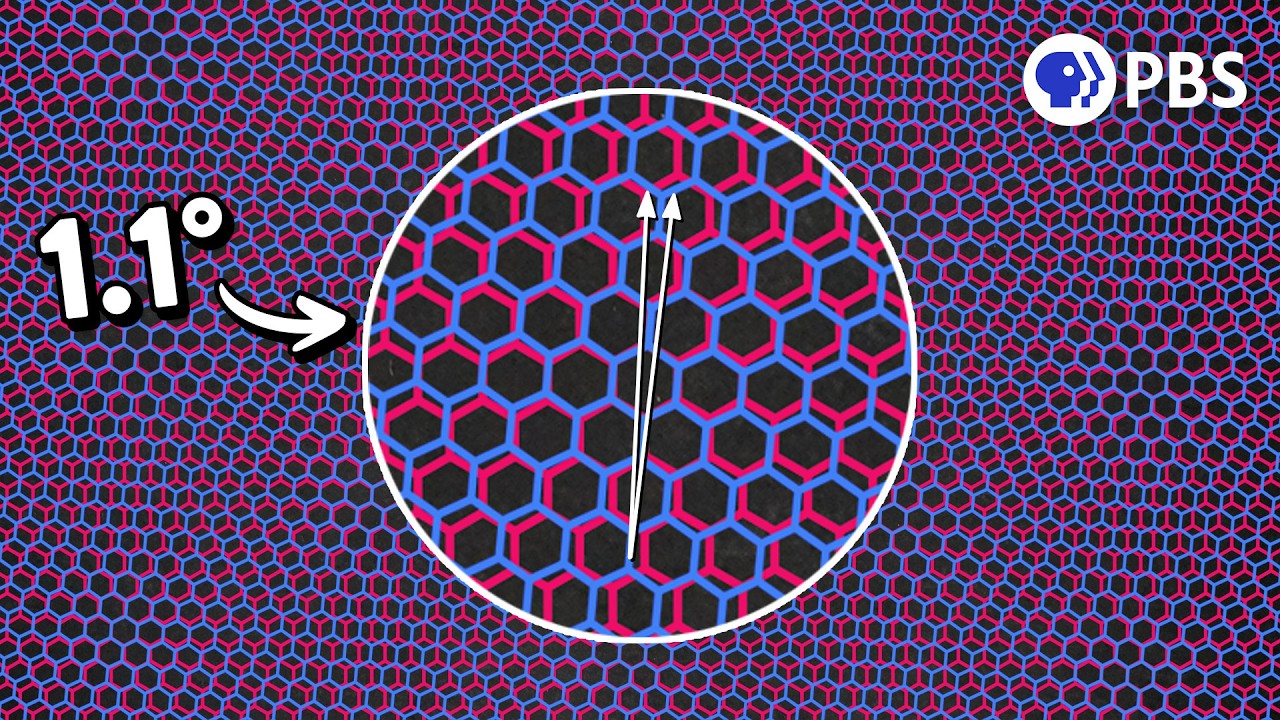
The video provides substantial educational value by demystifying a cutting-edge physics topic. Its argumentation is solid: it builds from the familiar moiré effect to the specific magic angle of 1.1°, explaining electron tunneling and interference, and then links these to experimental observations and the surprising 2018 discovery of superconductivity. The logic is clear, and the inclusion of expert commentary from Allan MacDonald adds authority. The parking-garage analogy effectively conveys why moiré materials are so tunable, and the discussion of high-temperature superconductivity acknowledges unresolved questions, which is scientifically honest. The video does not oversimplify but rather respects the audience’s intelligence while keeping explanations engaging.
Scientific Rigor, Source Quality, Title Accuracy
The scientific rigor is high: the video correctly attributes the 2011 prediction to MacDonald and colleagues, references the experimental fabrication methods, and discusses superconductivity in twisted graphene, which was first reported by Cao et al. in 2018 (though not explicitly named). The sources cited in the description (5050science.com and itsokaytobesmart.com) are project pages rather than primary literature, but the content itself is consistent with established research. The title is accurately matched to the content; the twist is indeed central, and the pencil-to-superconductor hook is both eye-catching and scientifically valid. No comments were provided, so public reception could not be assessed.
218 words
Title / Content Match
The title accurately captures the video's core idea—the tiny twist that transforms ordinary carbon into a superconductor—and is catchy without being misleading.
Quality & Reliability
8/10
The video is produced by a reputable science channel and features interviews with prominent physicists (Allan MacDonald, Kenneth). It explains complex concepts clearly, references scientific predictions and experiments, and is consistent with established knowledge about twisted bilayer graphene and superconductivity.
Key Moments
Markers derived by PSI from the transcript: the creator did not define chapters.
- Introduction of the moiré effect with visual examples
- Explanation of 2D materials and graphene's extraordinary properties
- Allan MacDonald discusses the 2011 prediction of the magic angle
- Demonstration of picking up and twisting a monolayer in the lab
- Parking garage analogy for electron states and moiré superatoms
- Discovery of superconductivity in twisted graphene and its implications
- Discussion of high-temperature superconductivity and future applications like quantum computers
- Conclusion comparing moiré materials to alchemy and closing remarks
Cited Sources
- 5050 Science: Science Across America — Mentioned as the series website for the 50x50 project.
- It's Okay To Be Smart — Be Smart channel's official website for additional content and outreach.
External References
Contribution & Novelties
The video’s novel contribution lies in making the concept of twisted bilayer graphene and its emergent electronic properties accessible to a wide audience through vivid analogies and expert interviews. It synthesizes the current state of research, from theoretical predictions to experimental realization, and highlights unresolved questions, particularly about high-temperature superconductivity. This helps demystify a frontier field and stimulates interest in condensed matter physics.
Pour aller plus loin :
- Twisted bilayer graphene — A comprehensive overview of the material and its magic-angle phenomenon, including the 2018 discovery of superconductivity.
- Moiré pattern — The general physical phenomenon behind the moiré effects described in the video, with applications beyond physics.
- Superconductivity — An introduction to the phenomenon of zero resistance and the fundamental mysteries that remain.
- High-temperature superconductivity — Relevant because the video discusses how twisted graphene might help explain these materials.
139 words
Radar Profile
The radar profile shows high scores across all dimensions, with particular strength in quality of information and reliability. The video balances comprehensive content with technical depth, indicating a well-constructed educational piece that is both informative and trustworthy.