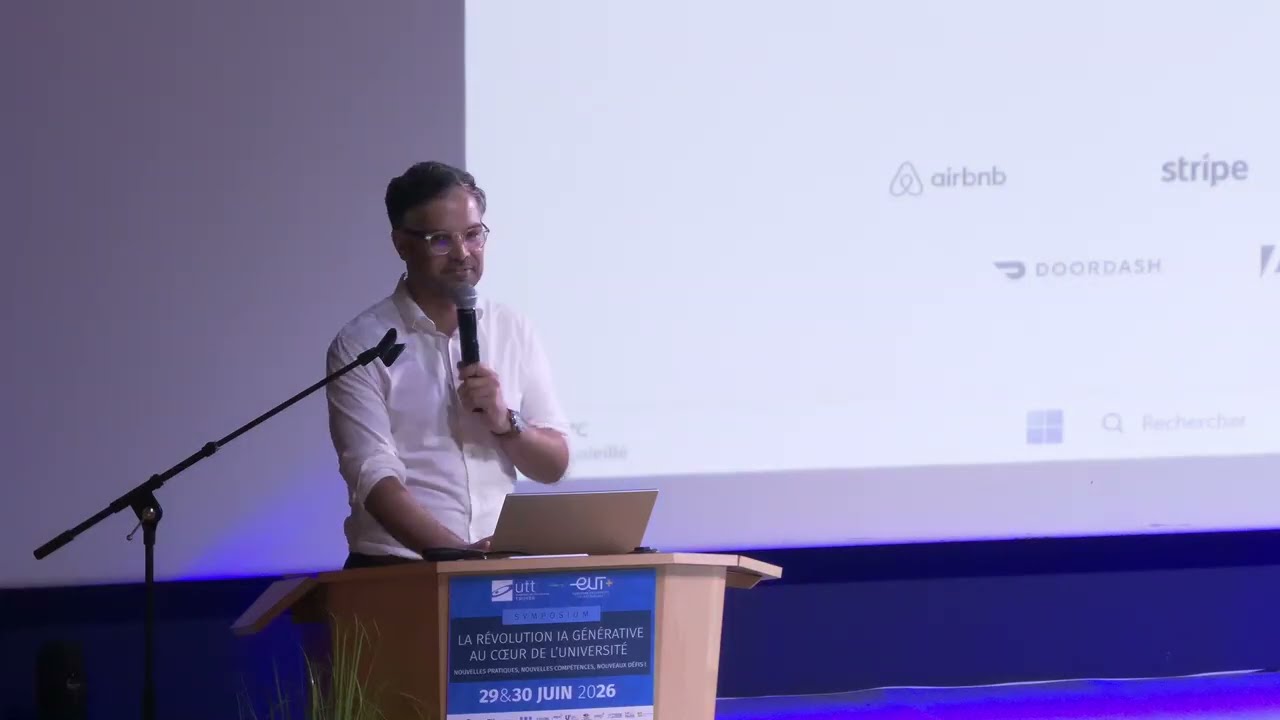
Révolution IA générative au cœur de l’université de Technologie de Troyes
Generative AI revolution at the heart of the University of Technology of Troyes
Keywords
Summary
154 words
Critical Evaluation
Value of the Information & Strength of the Argument
The video provides valuable industry insights on how generative AI is being integrated into corporate training and recruitment. Nico’s central argument that expertise now lies in navigating and validating information is well-articulated and supported by practical examples from his company’s activities, such as handling call for tenders and redesigning recruitment processes. The discussion of the shift from production bottleneck to decision bottleneck is nuanced and relevant. However, some claims are anecdotal and lack supporting data, and the argument for training more is presented but not deeply explored. The Q&A section reinforces key points and adds perspectives on inequality.
Scientific Rigor, Source Quality, Title Accuracy
The presentation relies on the speaker’s professional experience and references one researcher, Delphine Leer, with her book ’l’avenir de l’intelligence humaine’. The only source link provided is the UTT page about the symposium, which serves as the official page. The title adequately reflects the theme, though it is broader than the specific talk. No comments are available to analyze, so no public reception trends can be assessed.
180 words
Title / Content Match
The title accurately reflects the theme of generative AI in higher education, though the actual content focuses on a specific industry perspective rather than a comprehensive academic revolution.
Quality & Reliability
6/10
The video is an institutional symposium recording featuring a practitioner's viewpoint. It references one researcher and provides practical examples, but lacks rigorous citations and relies heavily on anecdotal evidence. The content is plausible and grounded in industry experience, yet not peer-reviewed.
Key Moments
Markers derived by PSI from the transcript: the creator did not define chapters.
- Introduction of the speaker, Lionel Nico from OnePoint, and the context of the symposium.
- Mention of researcher Delphine Leer and the concept of expertise as a flow, with emphasis on framing, verifying, and assuming information.
- Discussion on organizational shift, where the goulot d'étranglement moves from production to decision-making.
- Recruitment criteria and the requirement for AI skills, using HackerRank and a new graduate program.
- Q&A session addressing concerns about economic and societal fractures and the need for increased training time.
Cited Sources
- Symposium sur l'IA générative au coeur des universités — Link provided in the video description to the official page of the symposium.
Contribution & Novelties
The video contributes an industry perspective on the practical integration of generative AI into corporate training and recruitment, highlighting the shift from technical skills to AI literacy and the evolution of expertise. It underscores the importance of decision-making as the new bottleneck in organizations.
Pour aller plus loin :
- Vibe coding — A programming style emphasized in the talk where developers use AI to generate code, illustrating a shift in developer roles.
- Large language model — The underlying technology for generative AI, relevant to the discussion on AI skills and cost.
- FinOps — The practice of managing cloud costs, mentioned in relation to token costs and financial limits on AI usage.
111 words
Radar Profile
The radar profile shows moderate scores across all dimensions, with quantity and reliability slightly higher than technical level. This suggests a balanced presentation that offers useful practical insights but lacks deep technical rigor or extensive data backing.