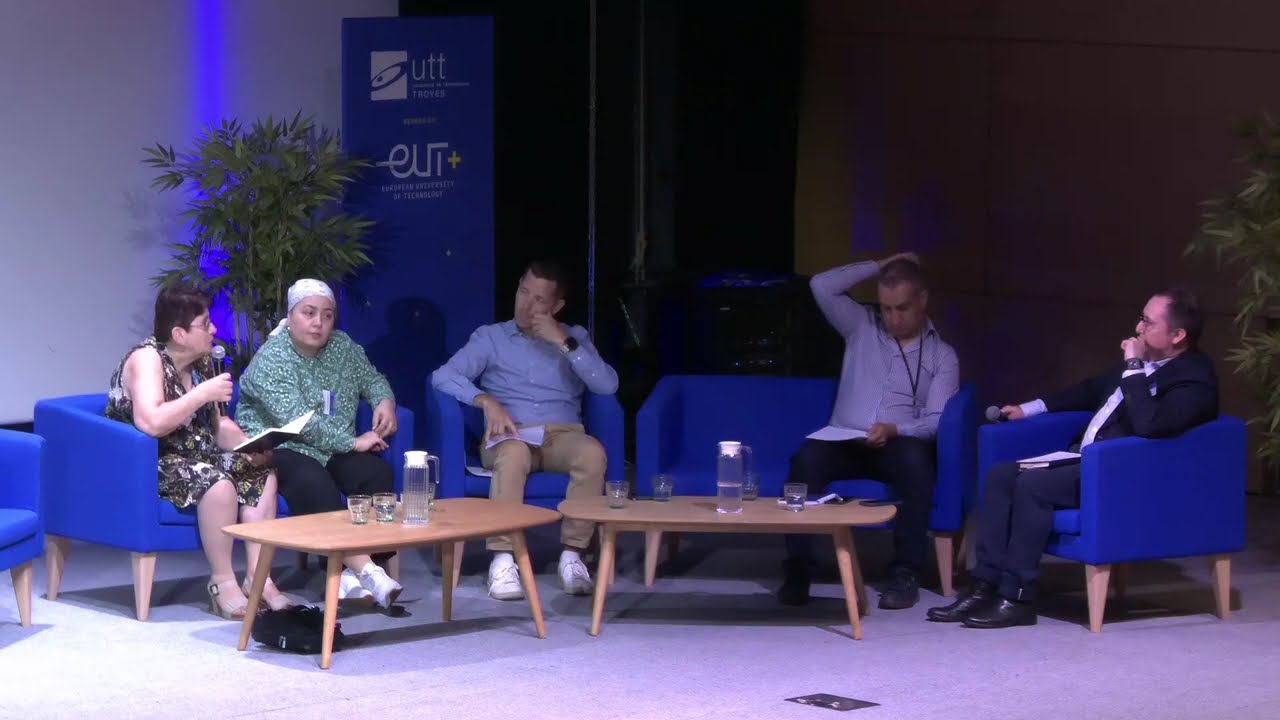
Révolution IA générative au cœur de l’université de Technologie de Troyes
Generative AI revolution at the heart of the University of Technology of Troyes
Keywords
Summary
225 words
Critical Evaluation
Value of the Information & Strength of the Argument
The discussion provides valuable firsthand insights from university faculty and administrators, complemented by survey data on AI usage among students, PhD candidates, and teachers. The arguments are balanced, acknowledging both benefits (time savings, improved brainstorming) and risks (passive learning, digital divide). However, the claims are largely qualitative and based on convenience samples, lacking rigorous statistical analysis or longitudinal data. The panelists demonstrate a nuanced understanding of the issues, but the argumentation relies more on anecdotal evidence and shared experience than on strong empirical proof.
Scientific Rigor, Source Quality, Title Accuracy
The video references an internal survey (623 student responses, 130 teacher responses) but does not provide the survey instrument or raw data. No external research papers are cited, and the only source link in the description points to a symposium page on the UTT website, which is not a peer-reviewed source. The title matches the content faithfully, describing the generative AI revolution at UTT. The discussion is thematically coherent, but the lack of verifiable sources limits its scientific rigor. The panelists are credible experts, yet their statements are not backed by published literature, making it more of an experiential outlook than a systematic review.
203 words
Title / Content Match
The title accurately reflects the content, which focuses on the integration of generative AI into university teaching, learning, and research practices.
Quality & Reliability
7/10
The video is a roundtable discussion featuring university experts and survey data, but it relies on self-reported usage patterns and lacks external verification or peer-reviewed sources.
Key Moments
Markers derived by PSI from the transcript: the creator did not define chapters.
- Mohamed Gebri presents the three main student use cases: reformulating concepts, generating examples, and structuring materials, with ChatGPT and Gemini dominating.
- Michel Noblau discusses the survey results, noting a lack of institutional AI framework and student demand for clearer rules.
- Leila Merghem and Nada Mata describe PhD student usages, including code generation and article evaluation, and teacher perspectives regarding time savings and skepticism.
- Panelists address the digital divide risk, highlighting how proficient users benefit more while others may fall behind.
- Discussion on skill atrophication, particularly coding abilities, and the need for educational programs to mitigate this risk.
- Experts propose institutional measures: regulated AI use, mandatory training for students and staff, and evolving assessment methods like oral exams.
Cited Sources
- Symposium sur l'IA générative au cœur des universités — Linked in the description as the official page for the symposium, providing background on the event and its objectives.
Contribution & Novelties
The video contributes to the debate on generative AI in higher education by offering survey-based evidence and practitioner perspectives from a specific institutional context. It highlights a surprising preference for Gemini among students, which contrasts with global trends, and underscores the need for tailored guidelines and training. The discussion on the ’two-speed’ learning profiles and the potential atrophy of coding skills adds a fresh angle to the conversation.
Pour aller plus loin :
- Prompt engineering — Key to effective AI use, central to the training needs mentioned by the panel.
- Artificial intelligence in education — Broad overview of AI’s role in education, contextualizing the video’s findings.
- Generative artificial intelligence — Technical background on the models discussed, useful for understanding the capabilities and limits.
123 words
Radar Profile
The radar profile shows a balanced intake of information, with high scores for quantity of information and overall reliability, but lower technical depth. This reflects the video's pragmatic, discussion-based approach, prioritizing practical insight over deep algorithmic detail.