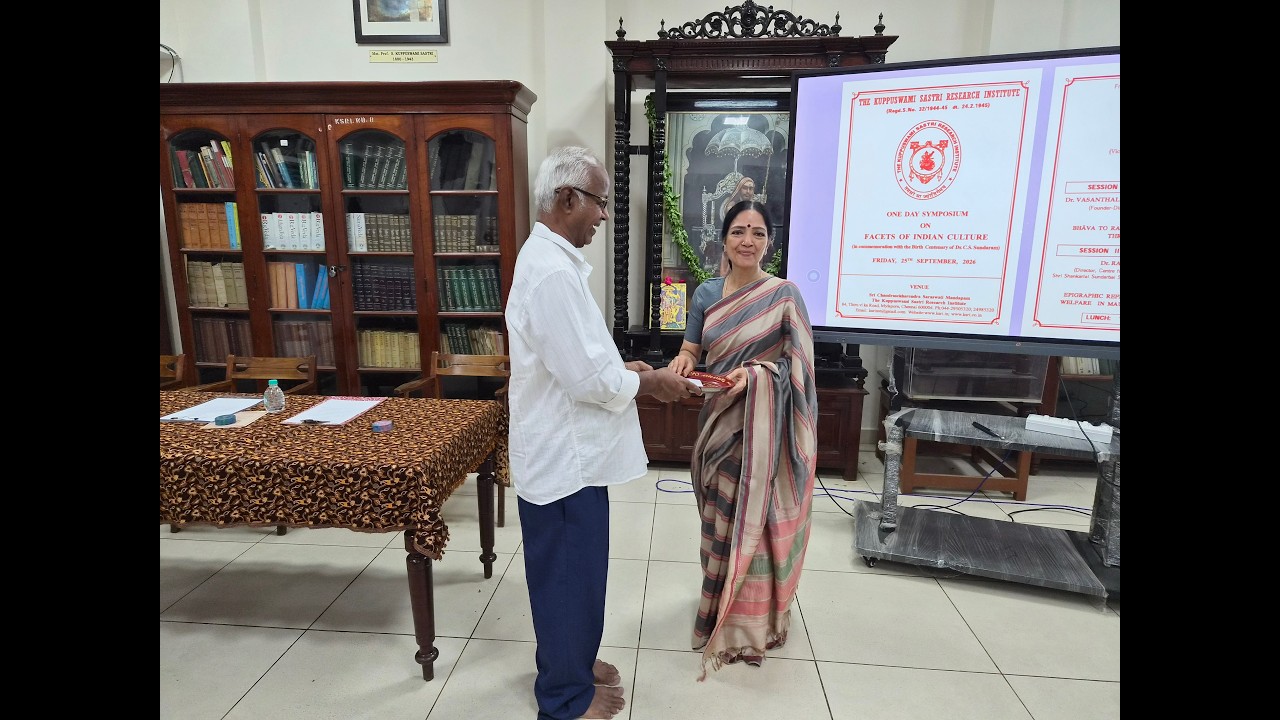
SESSION 1 of One-Day Symposium on “Facets of Indian Culture”
Keywords
Summary
164 words
Critical Evaluation
Value of the Information & Strength of the Argument
The talk offers substantial insight into the practical application of classical Indian aesthetic theory. The speaker’s argument is built on authoritative references like the Natyashastra, Abhinavagupta, and Anandavardhana, and she strengthens her points by showing real performances and explaining the creative process. The demonstrations are not only illustrative but also serve as evidence for key theoretical claims, such as how bhava is transformed into rasa through abhinaya. The reasoning is coherent and well-supported, though the reliance on personal experience and performance footage may limit the generalizability of specific interpretations. Still, the lecture provides a rich, first-hand perspective on the art form.
Scientific Rigor, Source Quality, Title Accuracy
The sources are classical texts and the speaker’s own documented productions. The lecture is rigorously grounded in established aesthetic frameworks, and the speaker demonstrates a mastery of the tradition. The video clips serve as primary sources, and she explains their relevance clearly. The title matches the content precisely: it is a session on Indian culture, specifically focusing on the aesthetic journey through abhinaya. No external sources are cited beyond the video itself, but the internal consistency and the authoritative status of the speaker uphold the scientific credibility. The absence of citations to contemporary scholarship or external references is a minor limitation, but it does not undermine the intrinsic value of the presentation.
228 words
Title / Content Match
The title accurately reflects the session's subject, which is a specific facet of Indian culture—the theory and practice of bhava and rasa in classical dance.
Quality & Reliability
8/10
The speaker is a distinguished scholar with extensive credentials and awards. The lecture draws on classic texts like Natyashastra and Abhinavagupta's work, and the demonstrations are coherent and instructive. Some claims are presented with authority, but the overall scholarly rigor is high.
Key Moments
Markers derived by PSI from the transcript: the creator did not define chapters.
- Host introduces Dr. Vasanthalakshmi Narasimhachari and her achievements.
- Speaker begins with a Sanskrit invocation and explains the importance of pronunciation in abhinaya.
- Discussion on the relationship between bhava and rasa, quoting Bharata and Anandavardhana.
- Video demonstration from Natyaveda, showing the 11 aspects and the Ananda Tandava of Shiva and Parvati.
- Presentation of the dance-drama Meghaduta, explaining choreographic choices like personifying the cloud and using pindi bandhas.
- Discussion of the war poem Kalingat Parani and how abhinaya transforms the stage into a battlefield.
- Concluding segment on Krishna and the rasalila, ending with a reflection on the purpose of natya.
Contribution & Novelties
The lecture provides a rare integration of theoretical exposition and practical demonstration, drawing on the speaker’s own decades-long career to illustrate key concepts. It offers an insider’s view of how classical texts are interpreted creatively in modern productions, bridging ancient dramaturgy and contemporary choreography.
Pour aller plus loin :
- Natyashastra — Foundational treatise on Indian performing arts, crucial for the concepts discussed.
- Rasa (aesthetics) — Explains the theory of aesthetic experience as elaborated by Bharata and Abhinavagupta.
- Abhinavagupta — Philosopher whose commentary on Natyashastra is central to understanding rasa.
- Meghaduta — Kalidasa’s lyrical poem that inspired the dance-drama presented in the lecture.
102 words
Radar Profile
The radar profile shows high scores in information quantity and quality, reflecting the dense content and authoritative delivery. The technical level is moderately high, suitable for an educated but not specialized audience. Overall fiabilite is strong due to the speaker's credentials and clear referencing of classical texts.