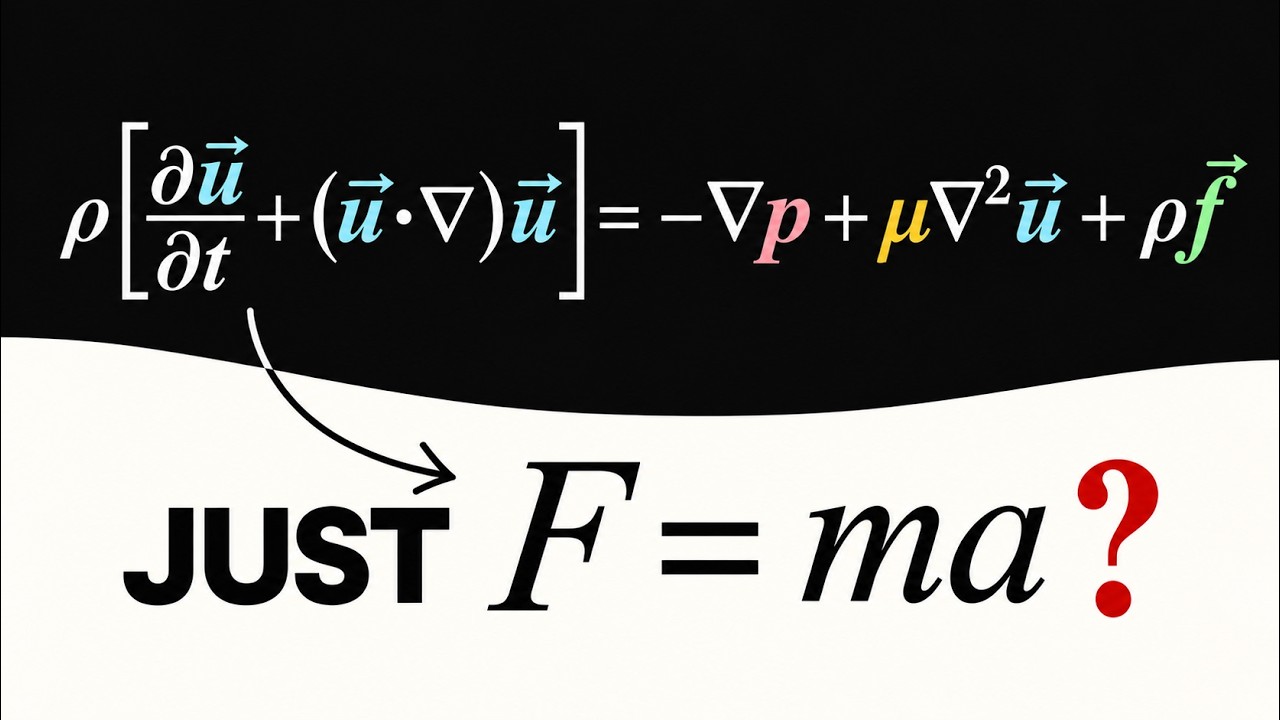
You Already Understand the Navier–Stokes Equation
Keywords
Summary
207 words
Critical Evaluation
Value of the Information & Strength of the Argument
The value of this video lies in its pedagogical clarity. By starting from Newton’s second law and building up each term, it demystifies a complex equation. The argumentation is solid: the presenter carefully defines each quantity, uses intuitive examples (e.g., river flow, layers of fluid), and justifies each assumption (incompressibility, Newtonian fluid). The step-by-step derivation is logical and easy to follow. The video does not merely present the equation but explains the physical intuition behind each term, which is of great educational value.
Scientific Rigor, Source Quality, Title Accuracy
The video is scientifically rigorous: the derivation is standard and correct, and the presenter uses appropriate terminology. No external sources are cited, which is typical for an explanatory video; however, the content is consistent with established fluid dynamics textbooks. The title accurately reflects the content, as the video successfully shows that the Navier–Stokes equation is, at its core, Newton’s second law applied to fluids. The video includes a sponsorship segment for an AI course (approximately 3 minutes) which is not relevant to the scientific content.
183 words
Title / Content Match
The title accurately reflects the content; the video demonstrates that the Navier–Stokes equation is essentially Newton's second law applied to fluids, making it approachable.
Quality & Reliability
9/10
The video provides a clear, step-by-step derivation of the Navier–Stokes equation, correctly linking it to Newton's second law. No scientific errors were detected in the explanations.
Key Moments
Markers derived by PSI from the transcript: the creator did not define chapters.
- Introduction and importance of the Navier–Stokes equation.
- Derivation of acceleration from the velocity field, introducing the material derivative.
- Viscous force derivation: shear stress and the second derivative term.
- Pressure force derivation: pressure gradient contributes to force.
- Assembling all terms and generalization to 3D.
- Conclusion and summary.
Concurring Sources
- Navier–Stokes equations — This Wikipedia article corroborates the derivation and meaning of the equation presented in the video.
Contribution & Novelties
The video provides a valuable contribution by making the Navier–Stokes equation accessible through a clean, step-by-step derivation that emphasizes physical intuition. It clarifies the meaning of each term and shows how they arise from Newton’s second law. The presentation is unique in its clarity and incremental approach, which is rare in many explanations that jump directly to the final equation.
Pour aller plus loin :
- Navier–Stokes equations - Comprehensive overview and history on Wikipedia.
- Material derivative - The concept used to describe acceleration in fluid flow.
- Viscous stress tensor - Generalization of the viscous force term.
- Millennium Prize Problem on Navier–Stokes - Official statement of the Clay Mathematics Institute problem.
110 words
Radar Profile
The video scores very high on quality and reliability, reflecting its accurate and clear explanations. Its slightly lower score on quantity of information (8) is due to its focus on the equation's meaning rather than covering the full mathematical theory or existence proofs. The technical level is high (8), suitable for an audience with some physics background.