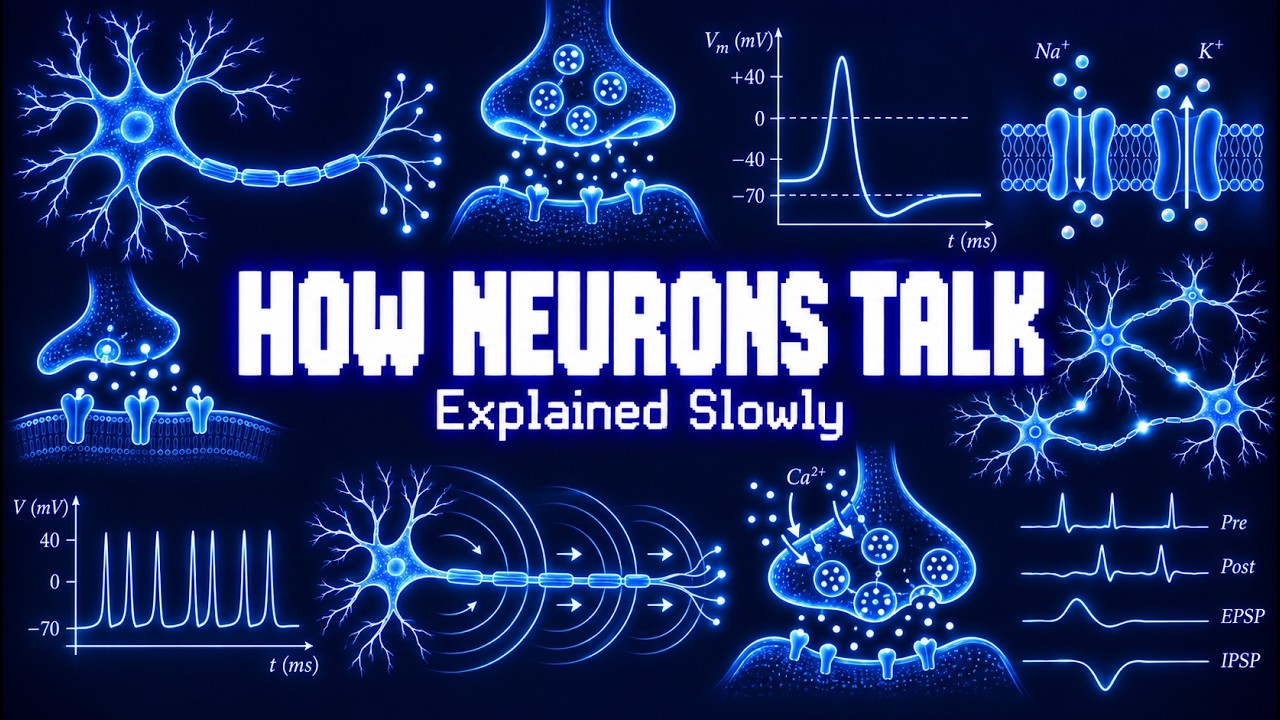
Everything About How Neurons Talk To Each Other Explained Slowly (For Sleep)
Keywords
Summary
98 words
Critical Evaluation
Value of the Information & Strength of the Argument
The video offers exceptional educational value by weaving together historical context and modern neuroscience, making the topic engaging and memorable. The argumentation is rigorous: it relies on documented experiments, logical deductions, and chronological progression. It honestly presents the debate between electrical and chemical transmission, showing how evidence accumulated and how controversies were resolved. The narrative is well-constructed, building from fundamental questions to detailed mechanisms, and correctly distinguishes between established facts and hypotheses, such as the unresolved aspects of synaptic plasticity.
Scientific Rigor, Source Quality, Title Accuracy
The scientific rigor is high, with the video referencing seminal experiments and primary sources. The description provides credible resources including NCBI Bookshelf chapters and Nobel Prize lectures, which directly support the content. The title matches the content precisely: it covers all aspects of how neurons communicate and is explicitly designed for slow, sleep-oriented presentation. There are no evident errors or misleading claims; the presentation stays true to the scientific consensus, and the historical figures and their contributions are accurately depicted.
175 words
Title / Content Match
The title accurately reflects the content: the video comprehensively covers how neurons communicate, from historical discoveries to modern mechanisms, and is indeed slow-paced and calming, suitable for sleep.
Quality & Reliability
9/10
The video presents a historically accurate account of the discovery of neural communication, referencing key primary sources and Nobel laureates. The explanations are consistent with established neuroscience.
Key Moments
Markers derived by PSI from the transcript: the creator did not define chapters.
- Introduction to the topic and the mystery of neural communication
- Ancient views on the brain and Aristotle's heart-centered theory
- Galvani's animal electricity experiments and Volta's counter-argument
- Helmholtz measures the speed of nerve impulses
- Golgi's staining method and Cajal's neuron doctrine
- Sherrington coins the term 'synapse' and the delay at junctions
- Otto Loewi's dream experiment proving chemical transmission
Cited Sources
- NCBI Bookshelf — Synaptic Transmission — Reference for synaptic transmission mechanisms
- Nobel Prize — Otto Loewi and the Chemical Transmission of Nerve Action — Loewi's Nobel lecture describing his experiment
- NCBI Bookshelf — Molecular Mechanisms Underlying Long-Term Potentiation — Reference for synaptic plasticity and LTP
- Nobel Prize — Discoveries of Machinery Regulating Vesicle Traffic — Nobel prize for vesicle trafficking, relevant to neurotransmitter release
Concurring Sources
- NCBI Bookshelf — Synaptic Transmission — Supports the explanation of synaptic transmission
- Nobel Prize — Otto Loewi and the Chemical Transmission of Nerve Action — Confirms Loewi's experiment as described
- NCBI Bookshelf — Molecular Mechanisms Underlying Long-Term Potentiation — Confirms the role of NMDA receptors and LTP in learning
- Nobel Prize — Discoveries of Machinery Regulating Vesicle Traffic — Supports the description of vesicle release in synaptic transmission
External References
Contribution & Novelties
The video contributes a unique synthesis of neuroscience history and modern understanding, making it a valuable educational resource. It highlights the human side of scientific discovery, such as the rivalry between Golgi and Cajal and Loewi’s dream, which enhances engagement. While not presenting new research, it effectively consolidates well-established knowledge, which is beneficial for learners.
Pour aller plus loin :
- Neuron — Basic unit of the nervous system, central to the video’s content.
- Chemical synapse — The specific type of synapse focused on in the video.
- Action potential — The electrical signal described in the video.
- Synaptic plasticity — The process strengthening/weakening connections, discussed near the end.
107 words
Radar Profile
The scores profile indicates a very high-quality video: it excels in the quantity of information (10), with strong qualitative accuracy (9), a technical level suitable for a broad audience (7), and high reliability (9). This balanced profile suggests an excellent educational resource.