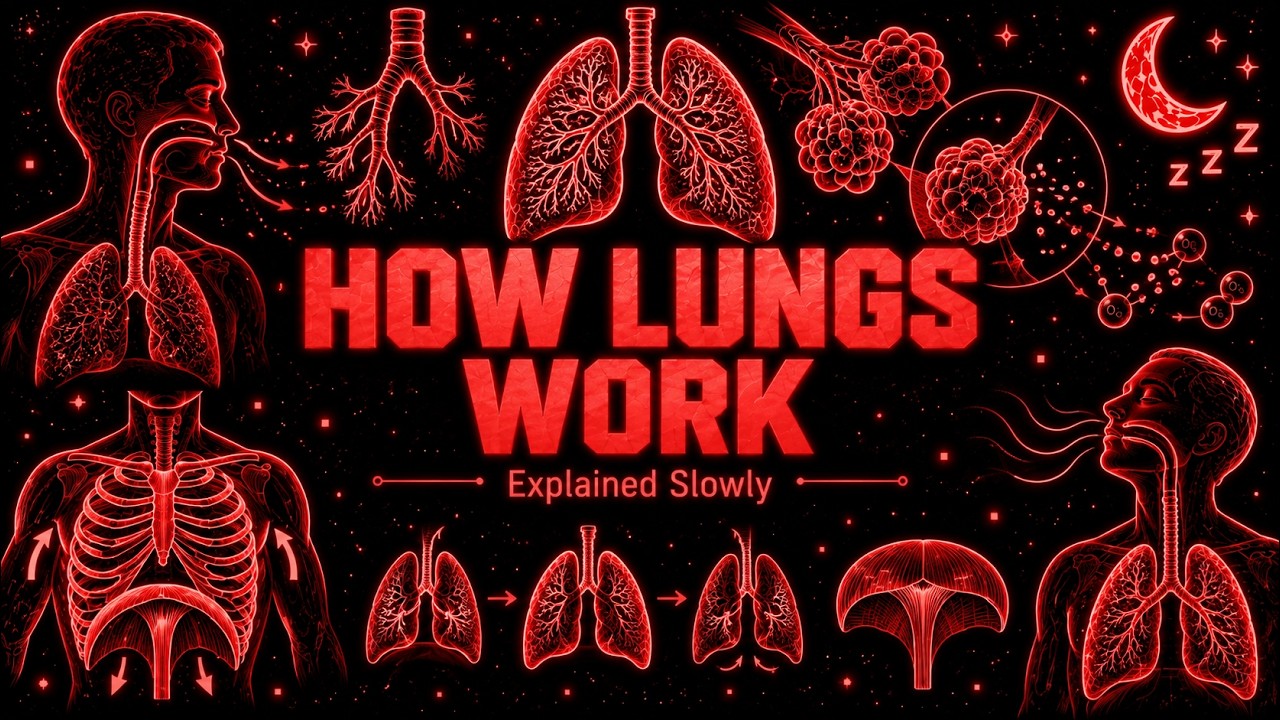
Literally Everything About How The Lungs Work Explained Slowly (For Sleep)
Keywords
Summary
159 words
Critical Evaluation
Value of the Information & Strength of the Argument
The video provides exceptional educational value by interweaving historical narrative with physiological detail, making complex topics like surface tension and cooperative binding accessible. The argumentation is solid, building each concept from fundamental principles (e.g., diffusion, Laplace’s law) and reinforcing them with concrete examples (e.g., neonatal respiratory distress syndrome). The slow, deliberate pacing enhances comprehension, and the logical flow from ancient misconceptions to modern understanding demonstrates a coherent thread. The inclusion of the Bohr effect and hemoglobin saturation curves adds depth, while references to real medical history (e.g., Patrick Kennedy’s case) humanize the science. The video successfully argues that lung function is both elegantly simple and intricately complex, and it leaves the listener with a clear mental model.
Scientific Rigor, Source Quality, Title Accuracy
The scientific rigor is high: the video accurately represents physiological processes, and the described mechanisms align with established medical knowledge. The sources listed in the description—NHLBI, NCBI Bookshelf, and OpenStax—are authoritative and directly relevant to the content. The title is appropriate and descriptive, promising a comprehensive and relaxed explanation, which is exactly what is delivered. The historical anecdotes are factually grounded, though some details (e.g., Empedocles throwing himself into a volcano) are presented with appropriate skepticism. Overall, the content adheres to scientific consensus and is presented transparently, with no evident bias or misinformation. The title-to-content match is strong, ensuring viewers get exactly what they expect.
237 words
Title / Content Match
The title promises a complete and slow explanation of lung function, and the content fully delivers, covering anatomy, gas exchange, surfactant, hemoglobin, and historical figures, while maintaining a calming pace suitable for sleep.
Quality & Reliability
9/10
The video presents a thorough and accurate account of lung physiology, supported by historical context and modern scientific principles. It cites reputable sources (NHLBI, NCBI, OpenStax) and demonstrates a deep understanding of the subject. The narrative is logically structured and technically sound throughout.
Key Moments
Markers derived by PSI from the transcript: the creator did not define chapters.
- Introduction: the miracle of breathing and the question 'What is breathing for?' sets the stage.
- Ancient theories: Empedocles' four elements and Aristotle's idea of lungs as a cooling system.
- Galen's three spirits and the long-reigned erroneous belief in invisible pores in the heart's septum.
- Ibn al-Nafis and the correct description of pulmonary circulation; later rediscovery by Vesalius, Servetus, and Colombo.
- Lung anatomy: asymmetry, cardiac notch, trachea, main bronchi, and branching bronchial tree.
- Alveoli: 300 million tiny sacs, surface area of half a tennis court, and the thin blood-air barrier.
- Gas exchange by diffusion: oxygen and carbon dioxide movement governed by concentration gradients.
- Pulmonary surfactant: production by type II pneumocytes, the law of Laplace, and treatment of neonatal respiratory distress.
- Hemoglobin and cooperative binding, the oxygen-hemoglobin dissociation curve, and the Bohr effect.
Cited Sources
- How the Lungs Work - NHLBI — Listed in video description as a resource for understanding respiratory system fundamentals.
- Pulmonary Ventilation and Perfusion - NCBI Bookshelf — Listed in video description for in-depth details on ventilation-perfusion matching.
- Physiology, Lung - NCBI Bookshelf — Listed in video description as a general physiological reference on lung function.
- Gas Exchange - OpenStax Anatomy and Physiology — Listed in video description, providing educational material on gas exchange mechanisms.
Concurring Sources
- How the Lungs Work - NHLBI — Provides authoritative information consistent with the video's explanation of lung anatomy and gas exchange.
- Pulmonary Ventilation and Perfusion - NCBI Bookshelf — Supports the video's discussion of ventilation-perfusion matching and gas exchange physiology.
- Physiology, Lung - NCBI Bookshelf — Offers detailed physiological data that align with the video's descriptions of lung function.
- Gas Exchange - OpenStax Anatomy and Physiology — Educational content matching the video's coverage of oxygen and carbon dioxide diffusion.
Contribution & Novelties
The video distinguishes itself by weaving a rich historical narrative into a meticulous physiological explanation, offering a unique perspective that enhances understanding. It connects ancient misconceptions to modern discoveries, making the science feel alive and deeply rooted. The detailed treatment of surfactant and the hemoglobin dissociation curve provides value beyond typical introductory material, while the calm, slow presentation makes it accessible for sleep-focused learning.
Pour aller plus loin :
- Pulmonary surfactant — Overview of the substance and its clinical importance in respiration.
- Bohr effect — Explains how pH and CO2 influence hemoglobin’s oxygen affinity.
- Law of Laplace — Physical principle relevant to alveolar stability and surfactant function.
107 words
Radar Profile
The radar profile shows high quantity and quality of information (9 and 8), a moderate technical level (7) suitable for a broad audience, and strong reliability (8). This balance indicates a well-researched educational video that is both informative and trustworthy, while remaining accessible to non-specialists.