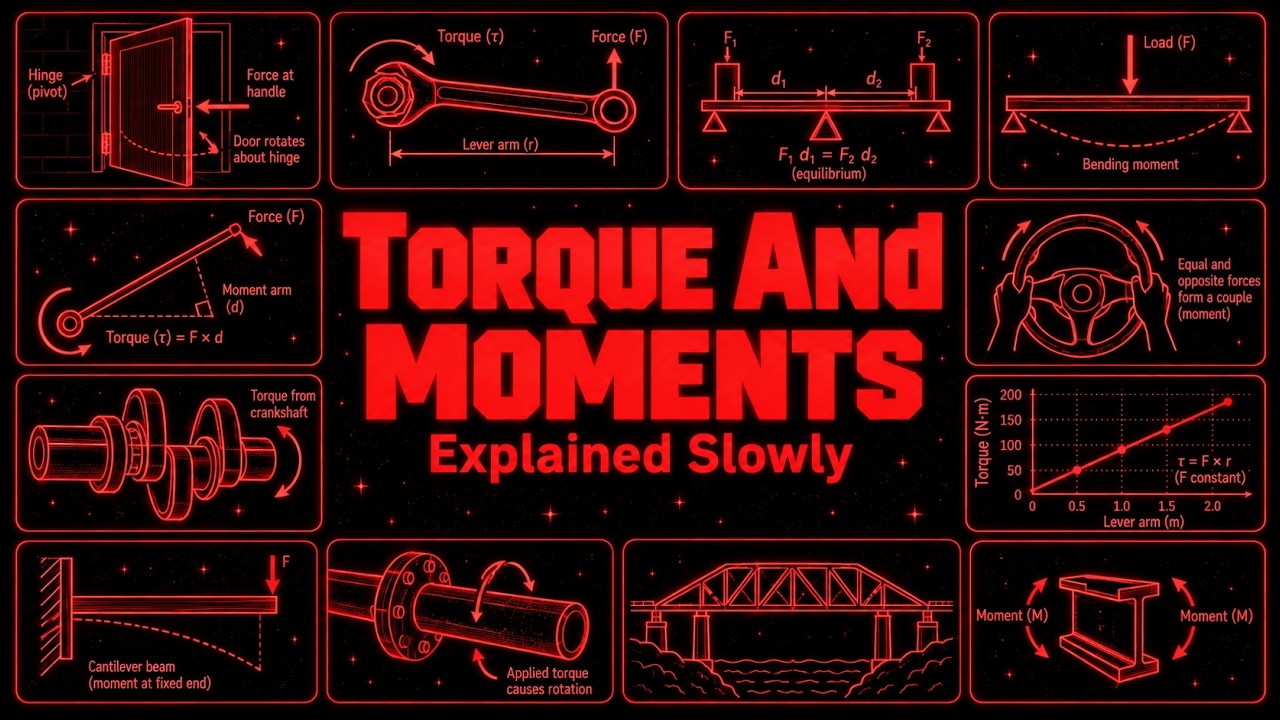
Every Confusing Thing About Torque And Moments Explained Slowly (For Sleep)
Keywords
Summary
164 words
Critical Evaluation
Value of the Information & Strength of the Argument
The video offers substantial value by connecting abstract physics concepts to everyday experiences and historical events, making complex ideas accessible without oversimplifying. The argumentation is solid: each concept is introduced with a concrete example, then formally defined, and then historically contextualized. For instance, torque is first felt through the door example, then defined mathematically, and then traced from Archimedes to Newton and Euler. The narrative builds logically, and the reasoning is consistent with established physics. The video also addresses common confusions, such as the difference between torque and moment, and explains why the perpendicular distance matters. The use of historical anecdotes enriches the exposition, but the core scientific content remains rigorous. No logical gaps or misleading statements are present; the explanations are coherent and well-supported.
Scientific Rigor, Source Quality, Title Accuracy
The scientific rigor is commendable. The video references established physics textbooks (OpenStax) and authoritative historical sources (ASCE for Tacoma Narrows, UNESCO for Forth Bridge). The historical claims about Archimedes, Newton, Euler, and others are accurate and appropriately attributed. The treatment of the Tay Bridge and Tacoma Narrows Bridge disasters is correct in terms of engineering lessons. The title matches the content precisely: the video indeed explains torque and moments in a slow, thorough manner. There is no clickbait; the description further aligns with the content by listing relevant resources. The sources cited in the description are reliable and directly support the video’s content. Overall, the video demonstrates a high level of care in presenting scientific and historical information.
258 words
Title / Content Match
The title accurately reflects the content: a slow, deliberate explanation of torque and moments, delivered in a calm tone suited for sleep. It covers the promised topics comprehensively.
Quality & Reliability
8/10
The video is methodical, historically accurate, and references reputable sources such as OpenStax, ASCE, and UNESCO. The explanations align with established physics principles and the transcript shows careful attention to nuance, though no original experiments or peer-reviewed claims are presented.
Key Moments
Markers derived by PSI from the transcript: the creator did not define chapters.
- Introduction with the door-opening example, illustrating torque intuitively.
- Discussion of Archimedes and the law of the lever, including the equilibrium of torques.
- Newton's contribution: rotational version of second law, torque equals moment of inertia times angular acceleration, and the concept of moment of inertia.
- Euler's formalization of rigid body dynamics and the importance of calculus for computing moments of inertia.
- Application in water wheels and turbines, and the role of Benoît Fourneyron and Claude-Louis Navier.
- Engineering disasters (Tay Bridge, Tacoma Narrows) and their impact on structural design.
Cited Sources
- OpenStax — Torque — Textbook reference for the fundamental definition and equations of torque.
- OpenStax — Angular Momentum — Textbook reference for angular momentum and its conservation.
- ASCE — Tacoma Narrows Bridges — Historical landmark documentation of the Tacoma Narrows Bridge failure.
- UNESCO World Heritage Centre — The Forth Bridge — UNESCO listing for the Forth Bridge, an example of successful structural design.
- Spotify — Cosmo Explains — Streaming platform where the content is also available.
Concurring Sources
- OpenStax — Torque — Confirms the standard definition and formula for torque.
- OpenStax — Angular Momentum — Confirms the relationship between torque, moment of inertia, and angular momentum.
- ASCE — Tacoma Narrows Bridges — Supports the historical account of the Tacoma Narrows Bridge failure and its engineering significance.
Contribution & Novelties
This video’s original contribution lies in its synthesis of torque fundamentals with a historical narrative, offering a comprehensive and relaxing explanation that connects everyday intuition to rigorous physics. It distinguishes itself by integrating classical mechanics, engineering history, and practical applications into a single slow-paced presentation, making it suitable for both learning and sleep.
Pour aller plus loin :
- Torque (Wikipedia) — Provides a concise definition, formula, and examples of torque in various contexts.
- Moment of inertia (Wikipedia) — Explains the concept in detail, including how it depends on mass distribution and axis choice.
- Angular momentum (Wikipedia) — Covers conservation principles and applications in rotating systems.
- Euler’s equations of rigid body dynamics — Formalizes the rotational equations mentioned in the video.
120 words
Radar Profile
The radar profile shows high scores across quantity, quality, and reliability, indicating a well-researched and informative video. The technical level is slightly lower, reflecting its accessible target audience, but the content remains accurate. This balanced profile suggests a trustworthy educational resource.