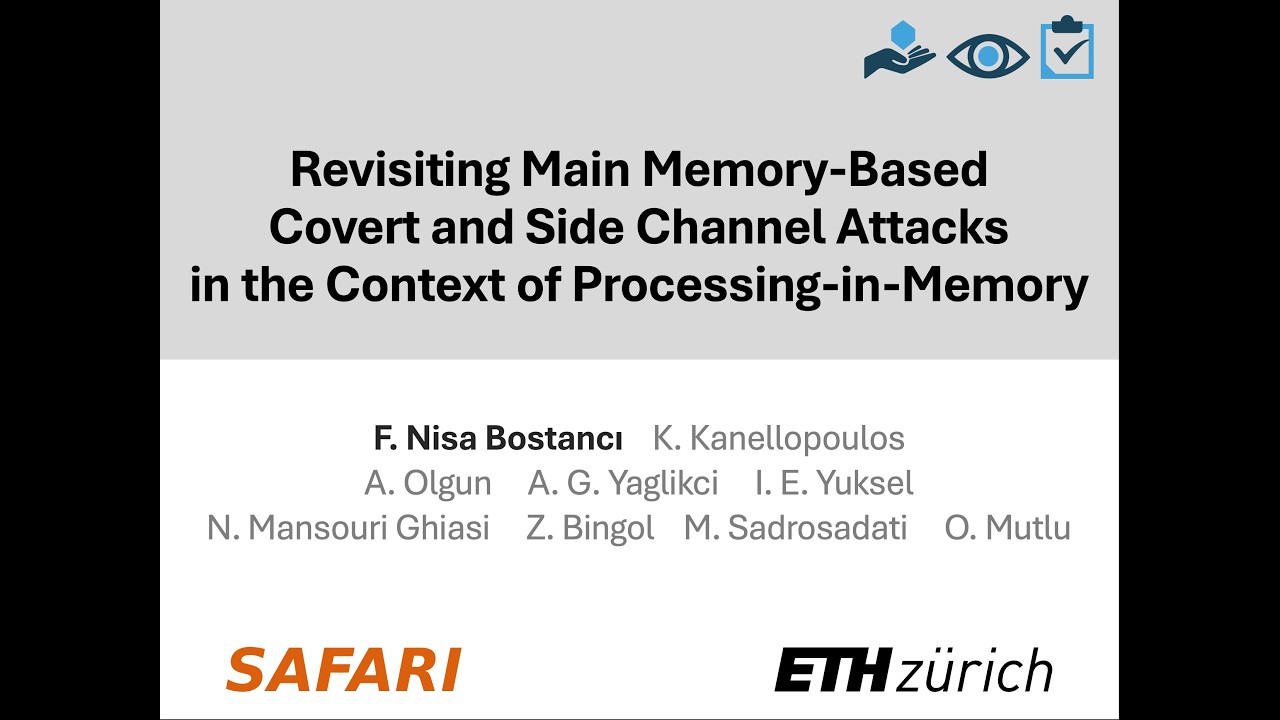
Revisiting Main Memory-Based Timing Attacks in the Context of PIM - DSN'25 Talk by Nisa Bostanci
Keywords
Summary
171 words
Critical Evaluation
Value of the Information & Strength of the Argument
The talk provides significant value by exposing a previously unexamined security vulnerability in emerging PIM architectures. The argumentation is well-structured: it starts with the motivation of PIM, identifies the root cause of vulnerability (direct memory access), and systematically develops attacks and mitigations. The use of simulations and comparisons with existing attacks strengthens the credibility of the claims. The inclusion of multiple case studies (covert channels and genomics) demonstrates the practical reach of the attacks. The discussion of mitigations is balanced, acknowledging their overheads and limitations.
Scientific Rigor, Source Quality, Title Accuracy
The scientific rigor is high, as the work builds on established research (e.g., RowHammer, prior timing attacks) and is presented at a top-tier conference (DSN). The slides and related papers are referenced in the description, providing transparent sources. The title accurately reflects the content, focusing on revisited timing attacks in the context of PIM. The talk is well-organized and the claims are backed by simulated evaluations. The open-source availability of data and code enhances reproducibility.
175 words
Title / Content Match
The title accurately reflects the content: the talk revisits main memory-based timing attacks in the context of processing-in-memory (PIM) architectures, presenting novel attacks and mitigations.
Quality & Reliability
8/10
The talk is presented at a reputable conference (DSN'25) by a researcher affiliated with ETH Zurich, with slides and related papers openly available. The content is technically detailed, based on simulations and comparisons with state-of-the-art attacks, and has been peer-reviewed as part of the conference. The findings are plausible and clearly explained, with open-source artifacts mentioned. However, since it is a talk, a full paper would provide more rigorous detail.
Key Moments
Markers derived by PSI from the transcript: the creator did not define chapters.
- Introduction to processing-in-memory (PIM) and the energy cost of data movement.
- Key observation: PIM architectures provide direct main memory access, enabling high-throughput timing attacks.
- Simulation results show that direct memory access maintains leakage throughput regardless of LLC size, unlike cache-bypassing attacks.
- First covert channel attack based on processing-near-memory (PNM) with PIM instructions.
- Second covert channel attack based on processing-using-memory (PUM) using row clone operations.
- Comparison of leakage throughput: IMPACT attacks achieve 8.2 and 14.8 Mbps, outperforming all prior attacks.
- Side-channel attack on a genomics application (DNA read mapping) leaking private information with low error rate.
- Evaluation of mitigations, including adaptive constant-time latencies, showing high performance overheads.
- Conclusion: PIM architectures create severe security challenges; low-cost mitigations are urgently needed.
Cited Sources
- IMPACT dsn25 talk slides (pptx) — Slides of the presented talk.
- IMPACT dsn25 talk slides (pdf) — PDF version of the slides.
- A Modern Primer on Processing in Memory — Comprehensive overview of PIM technologies, recommended reading.
- Memory-Centric Computing: Solving Computing's Memory Problem — Recent paper on memory-centric computing, recommended reading.
- Memory-Centric Computing: Recent Advances in Processing-in-DRAM — Survey of recent advances in processing-in-DRAM.
- RowHammer: A Retrospective — Reference on RowHammer, a well-known DRAM vulnerability.
- Fundamentally Understanding and Solving RowHammer — In-depth analysis of RowHammer and its mitigation.
- Accelerating Genome Analysis via Algorithm-Architecture Co-Design — Paper on accelerating genomics, relevant to the side-channel case study.
- From Molecules to Genomic Variations: Accelerating Genome Analysis via Intelligent Algorithms and Architectures — Paper on intelligent architectures for genomics.
Concurring Sources
- A Modern Primer on Processing in Memory — Provides foundational knowledge on PIM, aligning with the talk's assumptions.
- RowHammer: A Retrospective — Relevant as a prior work on main memory attacks, supporting the context.
Dissenting Sources
- — No discordant sources found in the provided material.
External References
Contribution & Novelties
This work is the first to systematically analyze and evaluate the security of PIM architectures against timing attacks. It introduces IMPACT, a set of high-throughput attacks that exploit direct memory access provided by PIM, achieving leakage throughputs of 8.2-14.8 Mbps, significantly higher than prior state-of-the-art. The attacks are demonstrated on both processing-near-memory and processing-using-memory architectures, and also a side-channel attack on a real-world genomics application is shown. The work also evaluates mitigations, concluding that existing defenses are either costly or inapplicable to PIM. This highlights a critical security gap in emerging memory-centric systems.
Pour aller plus loin :
- Processing-in-memory — Overview of PIM architectures and their motivations.
- Timing attack — General concept of timing side-channels exploited in this work.
- Covert channel — Definition and examples of covert communication channels.
- Row hammer — Related DRAM vulnerability that shares similar attack vectors.
140 words
Radar Profile
The radar profile shows very high scores in technical depth and quality of information, indicating a highly specialized and rigorous presentation. The quantity of information is also substantial, but slightly lower due to the time constraints of a talk. Overall, the talk is a strong research presentation with excellent technical merit.