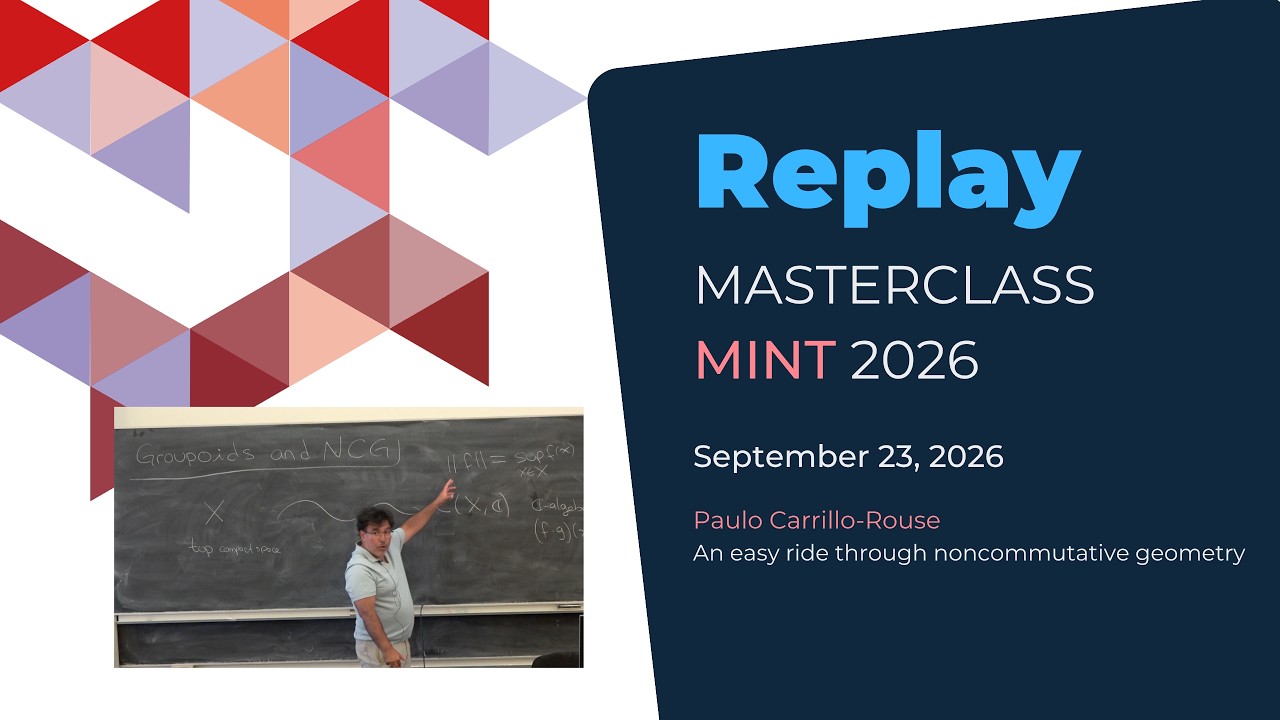
MASTERCLASS MINT 2026 | Paulo Carrillo-Rouse | September 23, 2026
Keywords
Summary
217 words
Critical Evaluation
Value of the Information & Strength of the Argument
The value of the information lies in its clear and structured presentation of the foundations of noncommutative geometry. The speaker builds a logical progression from the commutative Gelfand-Naimark theorem to noncommutative examples, using matrices and convolution algebras to illustrate the transition. The argumentation is solid: each step is motivated by the desire to extend geometric intuition to noncommutative settings. The use of groupoids as a unifying concept is well-justified, though the lecture stops short of fully developing the groupoid definition due to time constraints. The examples are concrete and help anchor abstract ideas. The speaker’s expertise is evident, and the mathematical content is accurate and up-to-date. However, the lecture assumes a fairly high level of mathematical maturity, which may limit its accessibility to a broader audience. The argumentation is not speculative; it relies on established theorems and standard constructions. The value is primarily educational, offering a coherent overview of a complex field.
Scientific Rigor, Source Quality, Title Accuracy
The scientific rigor is high: the speaker cites the Gelfand-Naimark theorem, a cornerstone of functional analysis, and refers to Laurent Schwartz and distribution theory. The mathematical statements are precise and correct. However, the lecture lacks explicit citations to specific papers or textbooks, which would enhance verifiability. The description provides no links to references, only the abstract. The title accurately reflects the content, as it is a masterclass on noncommutative geometry, though the specific focus on groupoids is not mentioned in the title. The title is adequate but could be more descriptive. No comments were provided, so no analysis of public trends is included.
270 words
Title / Content Match
The title announces a masterclass on noncommutative geometry, and the content delivers an introduction to that field, with a focus on groupoids and their algebras. The title is adequate, though it does not mention the specific emphasis on groupoids.
Quality & Reliability
8/10
The content is a mathematical lecture by a specialist, based on established theorems (Gelfand-Naimark) and standard constructions (C*-algebras, groupoids, convolution algebras). The reasoning is rigorous and the examples are correct. The only weakness is the absence of explicit bibliographic references or URLs in the description, which limits verifiability.
Key Moments
Markers derived by PSI from the transcript: the creator did not define chapters.
- Introduction and overview of the talk.
- Explanation of the commutative world: compact spaces and commutative C*-algebras.
- Statement of the Gelfand-Naimark theorem as an equivalence of categories.
- First noncommutative example: matrices as a C*-algebra.
- Matrices as functions on a set with a non-pointwise product.
- Second example: convolution algebra of functions on R.
- Representation of the convolution algebra on L2(R) and operator norm.
- Mention of Laurent Schwartz and distribution theory.
- Transition to groupoids: the hidden structure in the examples.
Contribution & Novelties
The lecture provides a fresh and accessible introduction to noncommutative geometry, emphasizing the role of groupoids as a unifying framework. It connects classical results like the Gelfand-Naimark theorem to modern developments, showing how noncommutative algebras arise naturally from groupoids. The speaker’s approach of using familiar examples (matrices, convolution algebras) to motivate abstract concepts is pedagogically valuable. The talk does not present new research results but offers a coherent synthesis that could benefit students and researchers entering the field.
Pour aller plus loin :
- Noncommutative geometry — Wikipedia article providing an overview of the field.
- Groupoid — Wikipedia article on groupoids, their definition and examples.
- Gelfand–Naimark theorem — Wikipedia article on the theorem that bridges commutative C*-algebras and topological spaces.
- C*-algebra — Wikipedia article on C*-algebras, essential for understanding the algebraic framework.
- Alain Connes, Noncommutative Geometry (Academic Press, 1994) — The foundational book on the subject, though no URL is provided to avoid uncertainty.
153 words
Radar Profile
The radar profile shows high technical level and good information quality, with moderate quantity due to the introductory nature of the talk. Reliability is strong, reflecting the speaker's expertise and the use of established theorems. The overall shape indicates a specialized, rigorous lecture suitable for an advanced audience.