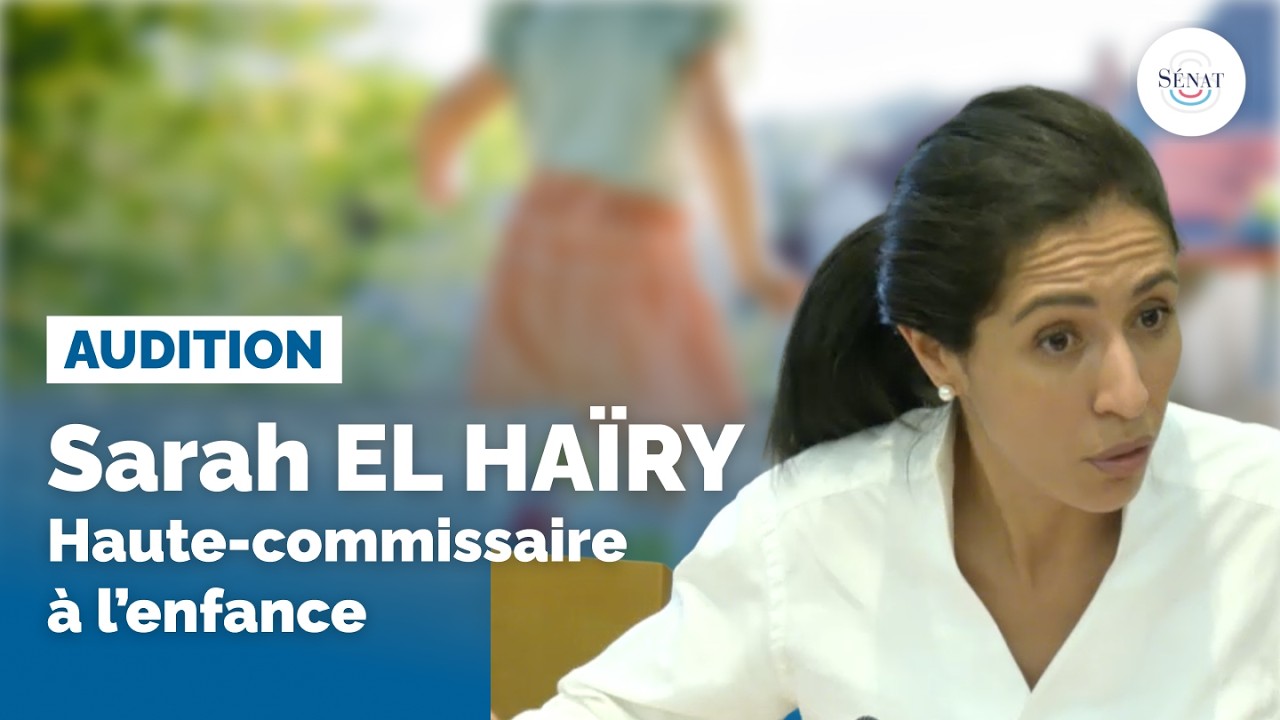
Violences dans le périscolaire : audition de Sarah El Haïry
Violence in extracurricular settings: hearing of Sarah El Haïry
Keywords
Summary
162 words
Critical Evaluation
Value of the Information & Strength of the Argument
The primary value lies in the authoritative institutional perspective of a sitting High Commissioner, who translates a broad policy vision into concrete and actionable proposals (e.g., single interministerial service for background checks, mandatory family notification). The argumentation is logically structured around four distinct pillars, demonstrating a coherent overarching philosophy of breaking down administrative silos. El Haïry consistently anchors her claims in recent institutional data (e.g., 7,358 people excluded via SI honorabilité) and recognized institutional weaknesses, although the argumentation relies more on accumulated professional experience and policy advocacy than on controlled scientific studies or empirical trials. The rapporteur’s parallel questions reinforce the argument’s relevance by underscoring operational hurdles such as the impact of judicial delays on child testimony.
Scientific Rigor, Source Quality, Title Accuracy
The scientific rigor is constrained by the format of a parliamentary hearing, which is inherently an exercise in political communication and expert opinion rather than a peer-reviewed publication. The speaker cites institutional references (SI honorabilité, BAFA) and organizations (SOS périscolaires) but does not provide formal bibliographic citations. The institutional provenance (French Senate) guarantees a high level of factual accuracy regarding the policy context, yet the claims concerning the effectiveness of proposed measures remain unsupported by granular evidence. The title precisely reflects the content, as the entire video documents the specific hearing of Sarah El Haïry on the topic of violences in the périscolaire.
235 words
Title / Content Match
The title perfectly matches the content, as the entire video documents the specific hearing of Sarah El Haïry on the topic of violences in périscolaire under oath before the Senate.
Quality & Reliability
7/10
Official sworn testimony before a Senate commission by a public official (High Commissioner for Children). High institutional authority and factual anchoring (e.g., SI honorabilité figures, number of departments). However, the arguments are mostly policy positions and advocacy, with limited presentation of formal scientific evidence or methodological detail.
Key Moments
Markers derived by PSI from the transcript: the creator did not define chapters.
- Introduction and swearing-in of the High Commissioner before the Senate commission.
- Opening remarks highlighting widespread distrust and the systemic nature of violence across all institutions.
- El Haïry presents the four structural pillars: prevention, protection, removal, and penal response.
- Details on the SI honorabilité system (7,358 exclusions) and the proposal for a unique interministerial service for background checks.
- Advocacy for child-friendly judicial procedures, filmed interviews, and training to prevent secondary traumatism.
- Defense of a national protocol to inform families about alleged abusers and enforce the precautionary principle.
- Rapporteur questions the practical control of honorability during recruitment and the issue of judicial delays.
Cited Sources
- SI honorabilité (Système d'information d'honorabilité) — Mentioned as a system which has excluded 7,358 individuals from contact with children in the context of child protection.
- SOS périscolaires (Collective) — Mentioned as a partner organization working with the High Commissioner to address shortcomings in the périscolaire sector.
- Rapport du Haut-commissaire à l'enfance (20 mesures prioritaires) — Public report submitted to the Prime Minister before the summer, containing 20 priority measures on child protection.
- Audition du Garde des Sceaux (Gérald Darmanin) — Referenced as having been heard by the commission the previous day regarding judicial delays and procedures.
Contribution & Novelties
The novelty of this content is the direct articulation of a high-level policy framework to address a severely under-regulated area of child protection. It introduces the concept of a single interministerial clearinghouse for judicial background checks and explicitly advocates for the legal right of parents to know the identity of adults interacting with their children in the périscolaire. This perspective formalizes a shift from post-incident reaction to preemptive verification and transparency.
For further reading:
- Protection of children in France (French Wikipedia) — Contextualizes the French child protection system discussed in the hearing.
- Activité périscolaire (French Wikipedia) — Describes the specific institutional sector under scrutiny.
- Traumatisme psychique (French Wikipedia) — Relevant to the discussion on psychotrauma and the memory of child testimony.
121 words
Radar Profile
The radar profile indicates a high concentration of institutional information (quantity 8, reliability 7) against a moderate technical depth (5). This reflects the dual nature of the content as a normative policy hearing rather than a scientific exposition, balancing strong factual grounding with a lack of technical or methodological innovation.