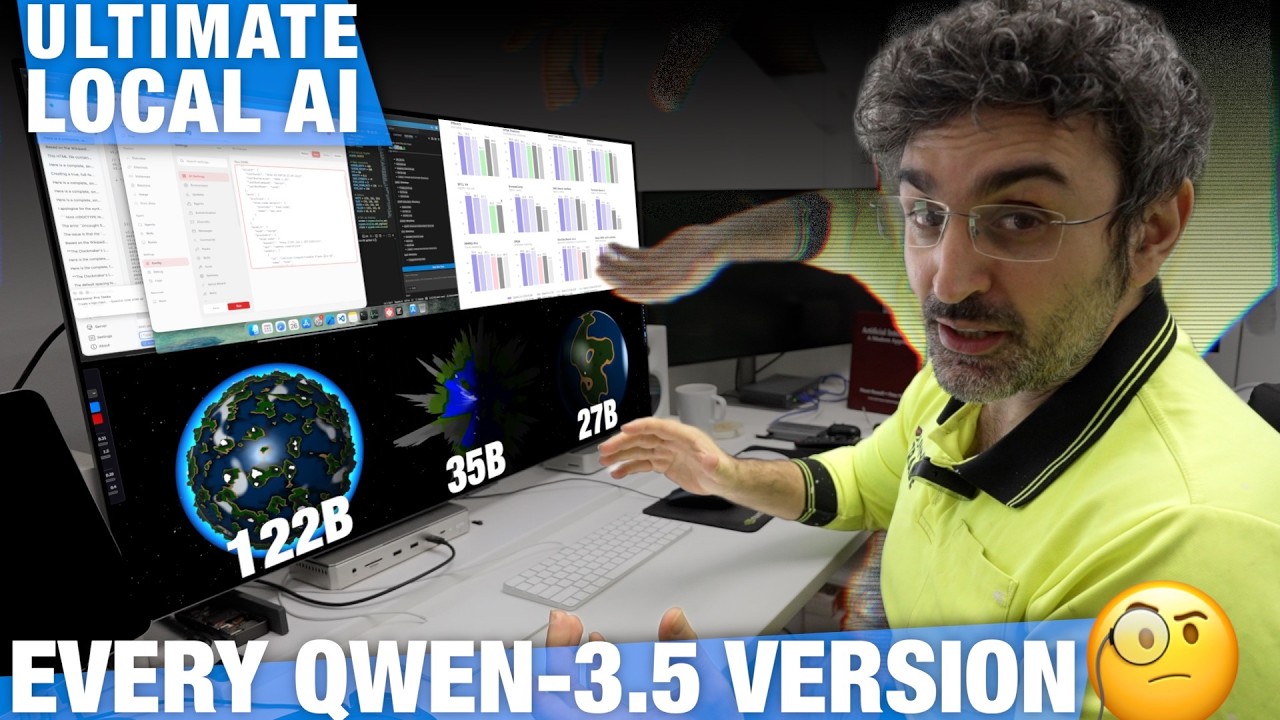
Is Bigger Better? EVERY Qwen 3.5 Local AI Compared - 397B vs 122B vs 35B vs 27B 🧐
Keywords
Summary
181 words
Critical Evaluation
Value of the Information & Strength of the Argument
The video provides valuable practical insights into running large language models locally, offering concrete performance data on token generation speeds, memory usage, and output quality across multiple model sizes. The argumentation is based on direct testing and emphasizes reproducibility, as the host shares specific model versions and quantizations. However, the reasoning is largely observational and lacks a rigorous experimental design, with occasional reliance on anecdotal comparisons and personal opinions. The discussion of benchmarks from external sources adds some credibility, but the host himself notes inconsistencies in the aggregated rankings. Overall, the content is informative for enthusiasts and practitioners seeking guidance on selecting a model for local deployment.
Scientific Rigor, Source Quality, Title Accuracy
The scientific rigor is moderate: while the host conducts real-world tests and references external benchmarks, the methodology is not fully documented and the tests are not repeated under controlled conditions. The sources cited include the Inferencer app, Hugging Face model repository, and companion videos, which provide context but no formal references. The title accurately matches the content, as the video explicitly compares the four model sizes. The description includes affiliate links and a sponsorship, which is disclosed but does not interfere with the technical evaluation. The audience comments are overwhelmingly positive, praising the depth and clarity of the review, with a few suggesting additional tests for smaller models.
230 words
Title / Content Match
The title accurately reflects the content, which systematically compares four different parameter sizes of the Qwen 3.5 family in a local deployment context.
Quality & Reliability
7/10
The video provides a comprehensive hands-on comparison of Qwen 3.5 models with detailed real-world tests on a Mac Studio, but the methodology is informal, relying on anecdotal observations and limited benchmarks rather than a systematic or peer-reviewed approach.
Key Moments
Markers derived by PSI from the transcript: the creator did not define chapters.
- Introduction of the Qwen 3.5 model family and benchmark charts.
- Testing the 397B model with Q9 quantization on a complex world-generation prompt.
- Evaluation of the 122B model (Q9) including tool calling and coding agents.
- Testing the 35B model (Q9) and its 3B active parameters; highlighting speed and reasoning.
- Comparison with the 27B model, which outperforms in benchmarks; final thoughts.
Cited Sources
- Inferencer App — The application used for running and benchmarking the models.
- Hugging Face Model Repository — Where the quantized model files are hosted.
- Parallels Virtual Machine — Mentioned as a tool for running virtual machines, though not directly used in the tests.
- Qwen3.5 397B companion video — A dedicated review of the largest model.
- Kimi K2.5 Local Cluster video — Comparison with another local AI cluster.
- Kimi K2.5 with OpenClaw video — Shows integration with OpenClaw, an agent framework.
- FLUX 2 Klein video — Related to another model.
Concurring Sources
- Qwen official blog — Official model release notes and benchmark details.
External References
Contribution & Novelties
The video contributes a practical, hands-on comparison of the Qwen 3.5 model family, demonstrating that smaller models like the 27B can rival or exceed larger ones in specific tasks, while also highlighting memory constraints. The introduction of a memory filter in the Inferencer app adds practical value for users selecting models. The original contribution lies in the direct benchmarking of multiple quantizations and the emphasis on real-world usability.
Pour aller plus loin :
- Large language model — Background on LLMs and their architecture.
- Mixture of experts — Relevant to the sparse activation in models like Qwen 3.5.
- Quantization (machine learning) — Concept of reducing model precision; note that the exact page may focus on signal processing, but the principle applies.
120 words
Radar Profile
The radar profile shows a balanced performance with slightly higher scores in quantity of information and technical detail, but lower in rigor and reliability, reflecting the informal nature of the tests. The strengths lie in practical insights and breadth, while weaknesses are in methodology and formal validation.
💬 Sur les 30 commentaires analysés, le climat est très positif, les téléspectateurs exprimant leur enthousiasme et leur gratitude pour les tests détaillés, avec quelques demandes de couverture de modèles plus petits et des questions techniques.