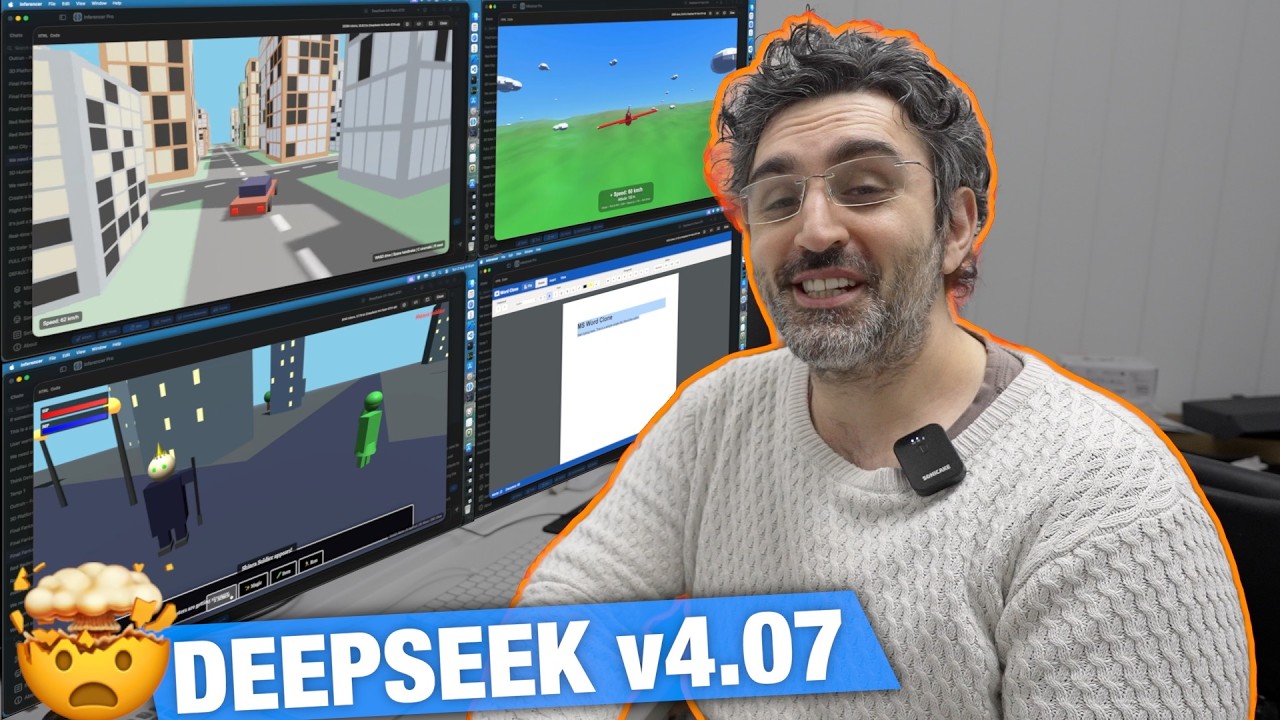
DeepSeek V4.07 - The NEW Ultimate LOCAL AI? Better than GLM & Claude?
Keywords
Summary
185 words
Critical Evaluation
Value of the Information & Strength of the Argument
The video provides practical, hands-on value for users interested in running large language models locally. The creator’s tests are diverse and reveal real behavioral nuances, such as the counterintuitive temperature effects and reasoning loop management. The argumentation is mainly observational, based on personal tests rather than controlled experiments. While this limits scientific rigor, the insights are actionable for practitioners. The comparison to GLM 5.2 is relevant given the benchmark claims, and the creator clearly distinguishes between benchmark results and real-world performance. The discussion of quantization trade-offs and the introduction of features like expanded thinking detection add original value.
Scientific Rigor, Source Quality, Title Accuracy
The video relies on the creator’s own testing and a direct link to the Hugging Face model page, which is a reliable source. No external papers or official benchmarks are cited. The description includes affiliate product links, but these are not part of the content and do not influence the evaluation. The title is somewhat sensationalist, implying superiority over Claude, which is not specifically addressed in the video. The content focuses on DeepSeek vs GLM, with only brief mentions of other models. Despite the lack of rigorous methodology, the video is transparent about its approach and limitations.
210 words
Title / Content Match
The title accurately reflects the content: a local AI model test comparing it to GLM and Claude, though Claude is not explicitly mentioned in the video. The focus is on DeepSeek V4 Flash's local viability and benchmark comparisons.
Quality & Reliability
7/10
The video presents hands-on tests of DeepSeek V4 Flash, with detailed observations on performance, temperature sensitivity, and reasoning. However, the evaluation is subjective and lacks standardized benchmarks, relying on anecdotal game and logic tests. The creator acknowledges limitations and provides practical insights, but the methodology is not reproducible or statistically robust.
Chapters
Cited Sources
- DeepSeek-V4-Flash-0731-MLX on Hugging Face — Official model page for the MLX-converted DeepSeek V4 Flash used in the local testing.
- Inferencer App — The inference application used to run the model locally and on the cloud.
- Kimi K3 Companion Video — Related video reviewing Kimi K3, mentioned as a comparison point.
- GLM 5.2 Companion Video — Related video reviewing GLM 5.2, the main comparison model in this video.
- Nemotron Ultra Companion Video — Related video reviewing Nemotron Ultra, another comparison model.
External References
Contribution & Novelties
The video contributes original hands-on testing of a newly released model, highlighting practical issues such as temperature sensitivity and reasoning loop mitigation. It also introduces the concept of ‘context attention’ and ’expanded thinking detection’ as features in the inferencer app to improve long-context performance and stabilize outputs. The comparison between benchmark claims and real-world behavior provides a valuable caveat for users.
Pour aller plus loin :
- DeepSeek (company) — Background on the company and its models.
- Large language model — Foundational concepts for understanding LLM capabilities and limitations.
- Quantization (signal processing) — Explains the trade-offs in model compression and quantization.
- Temperature (machine learning) — Impact of temperature on token sampling and output variability.
- Recurrent neural network — Not directly related but gives context on older architectures.
126 words
Radar Profile
The radar profile shows strong scores in information quantity and technical level, but lower scores in reliability due to subjective testing. The balance reflects a practical, hands-on review rather than a rigorous scientific evaluation.