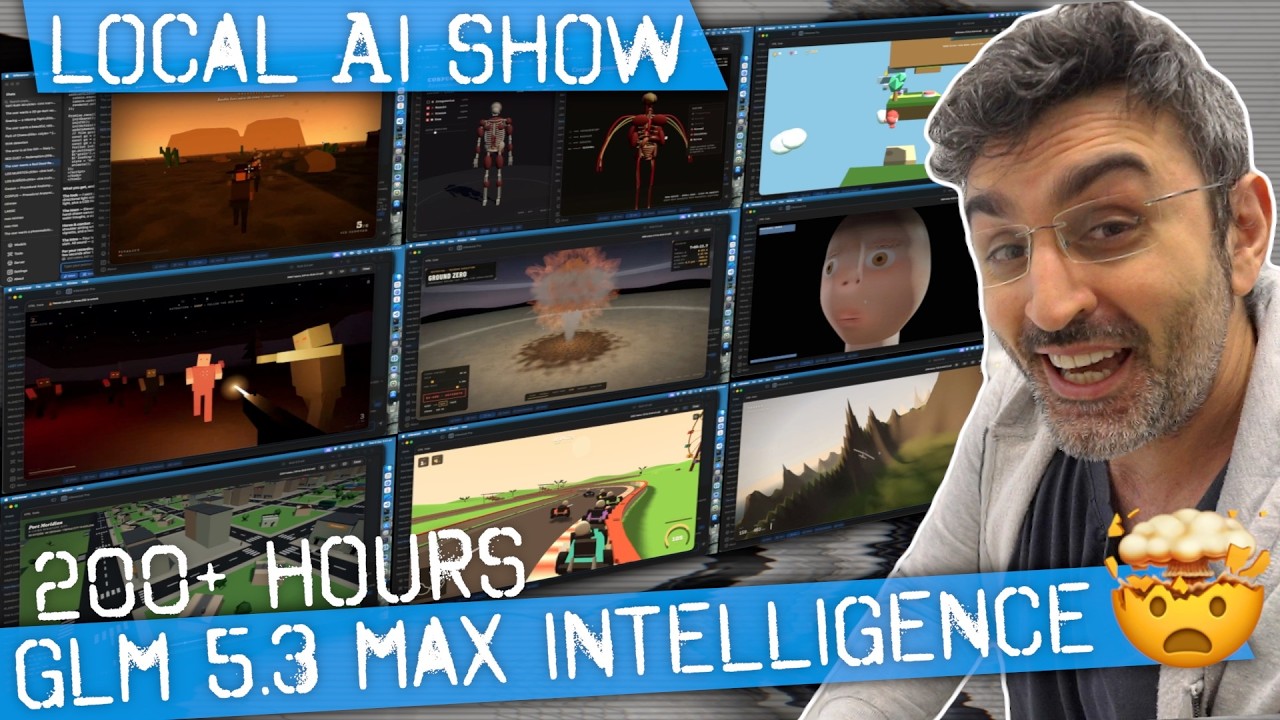
I Ran GLM 5.3 at MAX Locally for 200+ Hours... Forget GPT-6 & Fable 🤯
Keywords
Summary
156 words
Critical Evaluation
Value of the Information & Strength of the Argument
The video offers valuable empirical data on token usage and output quality across different thinking modes, which is useful for practitioners running large models locally. The argumentation is convincing: the creator systematically compares scenarios, provides exact token counts, and includes side-by-side demonstrations. The MinMax concept is well-illustrated with concrete examples, and the discussion of reasoning leakage is insightful. However, the evaluation is subjective, relying on visual inspection rather than quantitative metrics. The creator also notes that some differences are marginal, and results vary by task. The argument that MinMax saves tokens without sacrificing much quality is supported by several examples, but the lack of statistical rigor and controlled conditions weakens the overall strength of the claims.
Scientific Rigor, Source Quality, Title Accuracy
The video is based on original testing rather than citing external sources, which is appropriate for a hands-on review. The description includes links to the model (HuggingFace), the inference app (Inferencer), and companion videos, but no scientific references. The methodology is not strictly controlled—only one run per mode is shown, and quantisation may influence results. The title is catchy and partially sensational, but it accurately reflects the extensive testing undertaken. The content aligns with the title: the creator did run GLM 5.3 at max for many hours and explored thinking modes. However, the title’s reference to ‘Forget GPT-6 & Fable’ is not substantiated in the video, making it somewhat misleading.
241 words
Title / Content Match
The title is engaging and accurately reflects the video's focus on exhaustive local testing of GLM 5.3, though the mention of GPT-6 and Fable is sensational.
Quality & Reliability
7/10
Hands-on empirical testing with detailed token counts and qualitative comparisons, but lacks rigorous methodology and may be affected by quantization artifacts and uncontrolled variables.
Chapters
- Intro & The GLM 5.3 Thinking Problem
- Introducing MinMax Thinking Mode
- 3D Solar System (Low vs High vs Max vs MinMax)
- WinRT C++ & Math Logic Verification
- 3D Nuclear Bomb Explosion Simulation
- Controllable Spacecraft & Gravity Physics
- Modifying Existing Code
- Procedural Face (6-Hour Reasoning Loop)
- Understanding Reasoning Leakage & Thinking Limits
- Interactive 3D Human Anatomy Model
- GTA Open-World City Clone
- Red Dead Redemption Western Simulation
- Theme Park Simulator
- Tokenizer Sampling Deep Dive
- Procedural 3D Flight Simulator
- Go-Kart Track Racing Game
- Motorcycle Highway Racing Game
- 3D Platformer & Double-Jump Game
- Interactive 3D Planet Generator
- Dynamic Weather and Interactive City
- 3D Zombie FPS Survival Game
- Final Verdict: Is Local GLM 5.3 Usable?
Cited Sources
- GLM-5.3-MLX-Q4i on Hugging Face — Quantized version of GLM 5.3 used by the creator for local testing.
- Inferencer App — Inference app used to run the models and configure thinking modes.
- Companion Video: GLM 5.3 Flash — Related video on GLM 5.3 Flash.
- Companion Video: Qwen 4 EXP — Related video covering Qwen 4 EXP.
- Companion Video: Kimi K3 — Related video on Kimi K3.
External References
Contribution & Novelties
The video introduces and demonstrates a ‘MinMax thinking mode’ for local LLMs, which aims to reduce token usage while preserving high intelligence. This is a practical contribution for users of large open-weight models on consumer hardware, as it addresses the common problem of excessive reasoning overhead. The creator also explores threshold-based thinking limits and discusses reasoning leakage, offering strategies to control model behavior. The empirical comparisons across multiple complex prompts provide valuable insights into token-quality trade-offs.
Pour aller plus loin :
- GLM-5.3-MLX-Q4i on Hugging Face — The exact model quantisation used, relevant for reproduction.
- Reasoning Leakage — Concept discussed in the video; no reliable URL available, but related to controlling chain-of-thought generation in LLMs.
- Quantization (MLX) — The technique used to reduce model size; see Apple MLX documentation (no direct URL provided).
132 words
Radar Profile
The profile shows strong performance in information quantity and technical depth, with slightly lower scores in reliability and information quality. This suggests the video is rich in hands-on data but lacks formal scientific rigor, making it a useful practical guide rather than a peer-reviewed analysis.