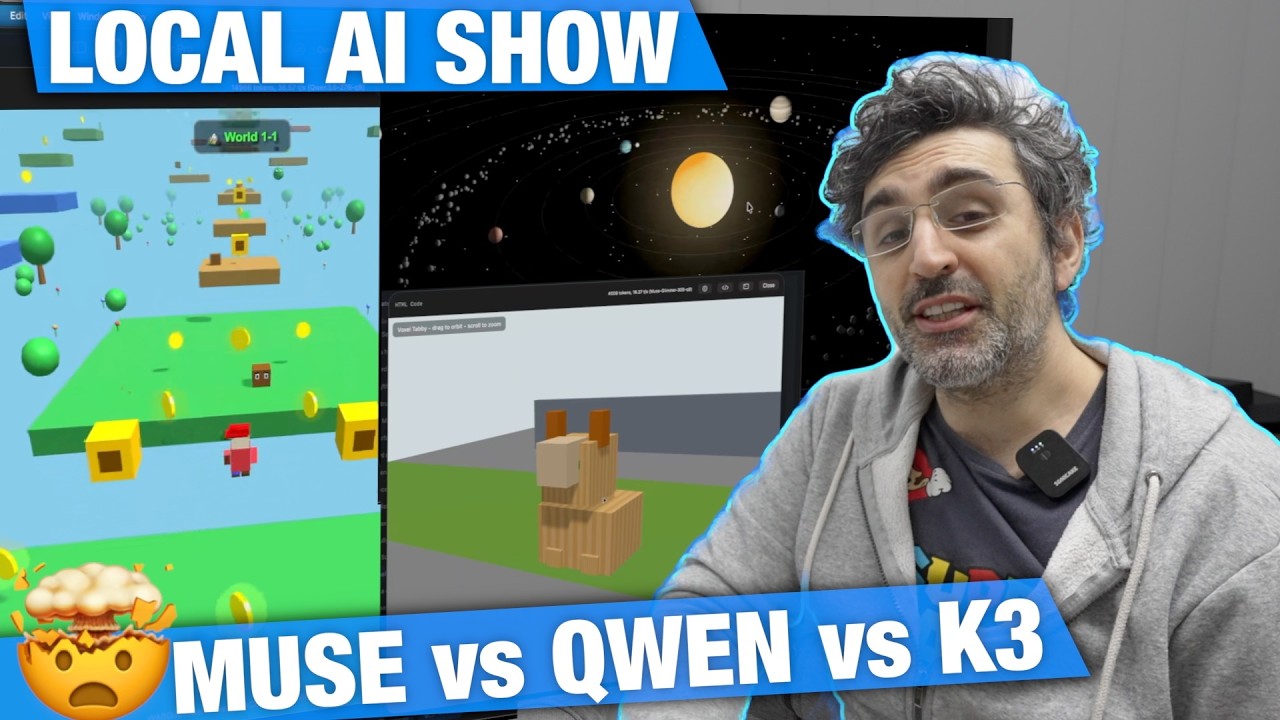
Can 30B Beat 2.8T Local AI? Muse Glimmer vs Qwen vs Kimi K3 🤯
Keywords
Summary
161 words
Critical Evaluation
Value of the Information & Strength of the Argument
The video provides practical value by demonstrating what users can expect from these models in real-world local inference scenarios. The argumentation is built on direct observation and side-by-side comparisons, which is compelling for a casual user. However, the lack of controlled testing, multiple runs, and quantitative metrics weakens the scientific validity. The host acknowledges limitations and even humorously notes the ’extra high thinking’ token counts are far below what the term suggests. The comparison is useful for someone deciding which local model to adopt, but it should not be taken as a definitive performance benchmark.
Scientific Rigor, Source Quality, Title Accuracy
The title is accurate and sets the right expectations. The video cites its primary sources through the description, linking to the Hugging Face model cards for Muse Glimmer and Qwen 3.6, as well as the Kimi K3 page (coming soon). These are reliable references for the models themselves. However, the video’s scientific rigor is limited: it does not cite any peer-reviewed papers or official benchmark methodology, and the host’s own testing is informal. There is also noticeable affiliate marketing and product placement, though it does not detract from the core content. Overall, the sources are appropriate for the purpose of a review, but the depth of analysis is shallow.
219 words
Title / Content Match
The title accurately reflects the content: a direct comparison of Muse Glimmer (30B) against Qwen 3.6 and the massive Kimi K3 (2.8T) for local AI performance.
Quality & Reliability
6/10
The video offers a hands-on, subjective comparison of three local AI models. While it showcases practical strengths and weaknesses, the methodology is not rigorous—no controlled benchmarks, repeated trials, or statistical analysis. The conclusions rely on anecdotal observations and a few one-shot tests, limiting the reliability of the comparisons.
Key Moments
Markers derived by PSI from the transcript: the creator did not define chapters.
- Introduction and announcement of Muse Glimmer, a new 30B model from Meta.
- First test: generating a 3D voxel cat. Muse Glimmer wins against Qwen 3.6.
- 3D solar system test. Kimi K3 produces the best visuals, Qwen is second, Glimmer fails.
- Procedural photorealistic face test. Glimmer's output is creative but flawed; Qwen fails.
- Flight simulator and ancient ballista tests. Qwen wins on ballista, Glimmer runs a basic flight sim.
- GTA-style game test. Qwen impresses with a functional open-world prototype, Glimmer is rudimentary.
- Conclusion: Kimi K3 delivers the best quality, Qwen is solid but error-prone, Glimmer shows promise for its size.
Cited Sources
- Muse Glimmer 30B MLX Q9 - Hugging Face — Model card for the Muse Glimmer 30B quantized version reviewed in the video.
- Qwen 3.6 27B MLX Q9 - Hugging Face — Model card for the Qwen 3.6 27B quantized version used in the tests.
- Kimi K3 (Coming Soon) - Hugging Face — Page listing upcoming Kimi K3 model; the video tests a locally running version.
- Inferencer App — The tool used to run the local models during the benchmarks.
- Companion Video: Kimi K3 — Earlier video on Kimi K3, referenced for context.
External References
Contribution & Novelties
The video contributes original, hands-on testing of three emerging local AI models, particularly being among the first to run Kimi K3 (2.8T parameters) locally and compare it against 30B and 27B models. Its main novelty lies in the practical observation that size massively impacts generation quality for creative tasks, but that lighter models like Muse Glimmer can still win on simpler tasks and have a place in constrained environments.
Pour aller plus loin :
- Muse Glimmer 30B model card — This page provides technical details on the model, including architecture, training, and quantization.
- Qwen 3.6 27B model card — Documentation on Qwen 3.6, including its multimodal capabilities and benchmark comparisons.
- Moonshot AI (maker of Kimi K3) — Official site of the company, though the URL is not verified; alternative: search for ‘Moonshot AI’ on Wikipedia.
- Quantization in large language models — A key technique for running models locally with reduced memory; consider the Wikipedia article on Quantization (signal processing) as a starting point, though not specific to LLMs.
- Spectral decoding — A method to speed up inference mentioned in the video; more information may be available from Unsloth AI or research papers, but no reliable URL is confirmed.
198 words
Radar Profile
The radar profile shows a balanced but moderate performance across all dimensions, with higher scores in information quantity and technical level, but lower in reliability. This suggests a video that is informative and technically competent for a general audience, yet lacks the rigor of a formal benchmark. The low reliability score reflects the informal testing methodology and reliance on single runs.