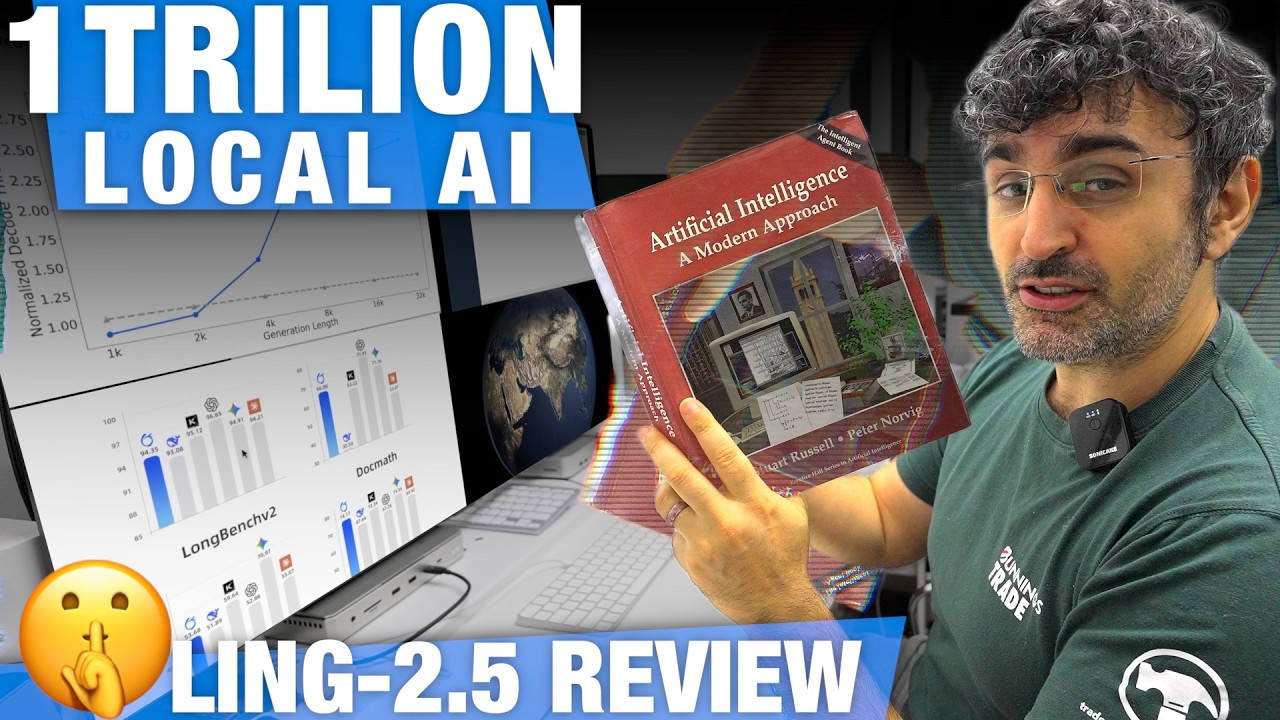
Let's Run Ling-2.5 - TRILLION Param Local AI (Sibling of Kimi K2.5 & Qwen 3.5)
Keywords
Summary
193 words
Critical Evaluation
Value of the Information & Strength of the Argument
The video’s main value lies in its real-world demonstration of a very large model running locally, providing specific metrics like token generation speed and memory footprint. The argumentation is based on empirical tests, though the sample size is small and the tests are somewhat ad hoc. The presenter’s enthusiasm and transparency about the quantization process add credibility. However, the benchmarks cited (e.g., beating DeepSeek) are from the model’s own documentation and not independently verified, weakening the argument for superiority. The logical reasoning tests reveal inconsistencies, which are honestly reported. Overall, the information is useful for practitioners interested in running large models locally, but the conclusions are preliminary and subjective.
Scientific Rigor, Source Quality, Title Accuracy
The video cites the HuggingFace repository for the quantized model and the Inferencer app as tools, but does not provide external references for the claimed benchmarks. The sources in the description include product links (clearly marked as affiliate) and companion videos, which are not authoritative. The title accurately matches the content and does not overstate the scope. The presenter does not engage with peer-reviewed literature or independent benchmarks, relying instead on his own tests. There is a clear distinction between the model’s official claims and the presenter’s hands-on assessment, which is a positive sign of critical engagement. The sponsor segment is kept brief and does not influence the technical evaluation.
234 words
Title / Content Match
The title accurately reflects the video's content: running Ling-2.5, a trillion-parameter model, locally on a Mac Studio. It appropriately highlights the model's scale and its relationship to Kimi K2.5 and Qwen 3.5.
Quality & Reliability
7/10
The video provides hands-on testing of a newly released 1T parameter model, including quantitative metrics (tokens/sec, memory usage) and qualitative assessments of coding and logic tasks. The presenter is clearly knowledgeable, but the evaluation is subjective and limited to a few examples, and the benchmarks cited are from the model's own claims without independent verification.
Key Moments
Markers derived by PSI from the transcript: the creator did not define chapters.
- Introduction of Ling-2.5: 1T parameters, 63B active, comparison to Kimi K2.5 and Qwen 3.5.
- Discussion of Ant Group history, Alibaba relationship, and Jack Ma's controversial speech.
- Performance metrics on Mac Studio: 15 tokens/sec, 436GB memory usage, comparison with Qwen 3.5.
- Coding test: regex problem successfully solved; newline issue identified and fixed.
- Further coding demos: 3D solar system, Earth visualization, Flappy Bird; noting quant limitations.
- Logic tests: car wash (failed), surgeon riddle (correct), trolley problem (evasive).
- Personality test and Wikipedia grounding demonstration; model retrieves and uses external content.
- Conclusion and sponsor mention for an intelligent agent cookbook.
Cited Sources
- Ling-2.5-1T-MLX-3.7bit (HuggingFace) — Quantized model uploaded by the presenter, the first available online.
- Inferencer App — Application used to run the model with various settings.
- Qwen 3.5 Companion Video — Referenced as a companion video for comparison with Qwen 3.5.
- Kimi K2.5 with OpenClaw Companion Video — Referenced as a companion video for comparison with Kimi K2.5.
- GLM-5 Companion Video — Referenced as a companion video for comparison with GLM-5.
- FLUX 2 Klein Companion Video — Referenced as a companion video for comparison with FLUX 2 Klein.
Contribution & Novelties
This video provides an early hands-on evaluation of Ling-2.5, a newly released 1T parameter model, and is notable for being the first to offer a quantized version (3.7-bit) that runs on consumer-grade hardware. The presenter tests its capabilities on coding and logic tasks, offering insights into the model’s real-world performance beyond official benchmarks. The quantized model is made publicly available, which is a significant contribution for the local AI community.
Pour aller plus loin :
- Mixture of experts — The architecture of Ling-2.5 incorporates MoE, which is relevant to understanding its parameter efficiency.
- Ant Group — The company behind Ling-2.5, providing context on the corporate origins and financial scale.
- Large language model — General background on the evolution and characteristics of LLMs, including parameter counts and quantization considerations.
128 words
Radar Profile
The radar profile shows high scores for technical level and information quantity, reflecting the hands-on nature and detailed metrics. Quality and reliability are slightly lower due to the subjective testing methodology and reliance on the presenter's own quantized build, while the overall score is balanced by the novelty and practical value.