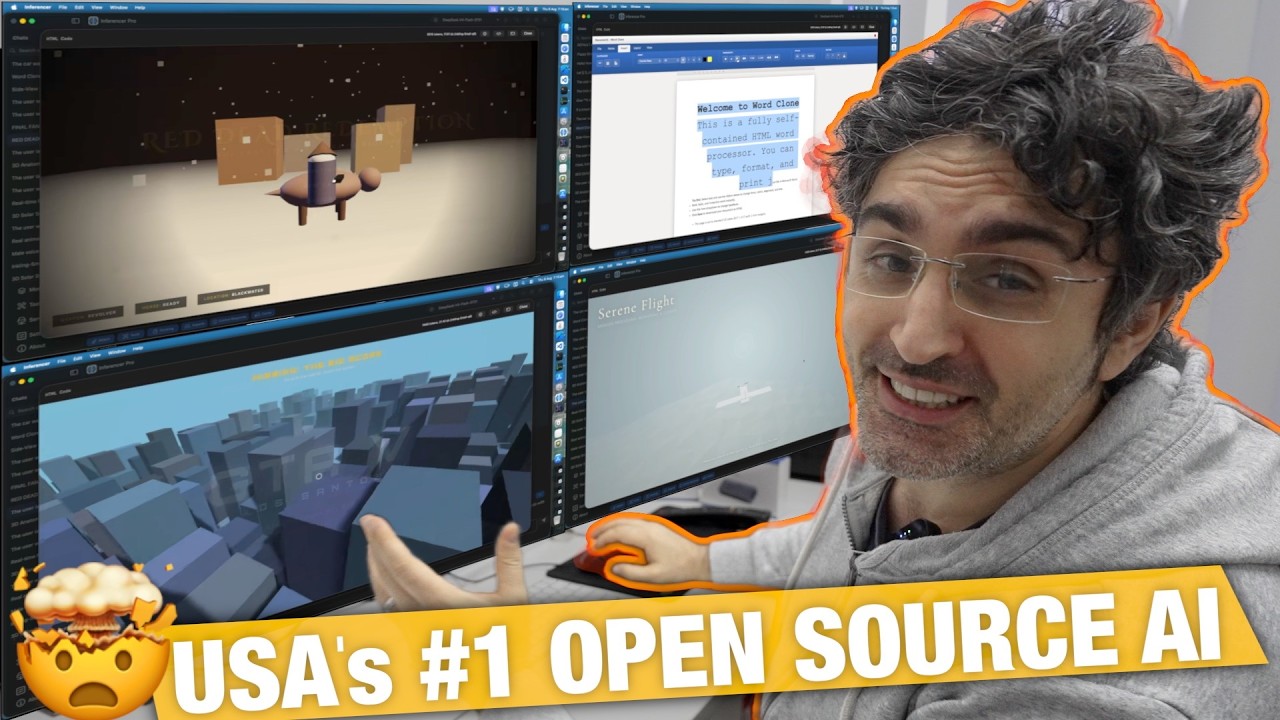
USA's NEW #1 OPEN SOURCE Local AI - Better than Qwen? | Inkling-Small
Keywords
Summary
110 words
Critical Evaluation
Value of the Information & Strength of the Argument
The video provides considerable value through real-world testing across diverse tasks, offering insight into the model’s capabilities and limitations. The argumentation relies on direct demonstrations and personal observation, but is not systematic—there is no controlled comparison against all competitors, and successes/failures are described anecdotally. The creator acknowledges trade-offs, such as occasional logic errors and structural glitches, which strengthens credibility. However, the selection of benchmarks and prompts is somewhat arbitrary, and the lack of rigorous metrics limits the strength of the conclusions.
Scientific Rigor, Source Quality, Title Accuracy
The video references official benchmark claims and provides links to the HuggingFace model page and companion videos for context. The creator does not independently verify the official numbers but supplements with own tests. The title accurately reflects the content, as the video does address whether the model is better than Qwen based on benchmarks and hands-on experience. The methodology is informal, typical for tech review videos, but the inclusion of specific test cases and outcomes gives a reasonable basis for the assessments. The description includes affiliate links, but these do not affect the scientific content.
191 words
Title / Content Match
The video directly answers the title's question by comparing Inkling-Small against Qwen through benchmarks and practical tests, confirming the claim with mixed results.
Quality & Reliability
6/10
The video offers hands-on testing of the model with specific prompts, but the evaluation is subjective and relies heavily on official benchmarks without independent verification.
Key Moments
Markers derived by PSI from the transcript: the creator did not define chapters.
- Introduction and benchmark claims
- Audio inference test with cow sounds
- Vision inference test - 3D voxel cat
- 3D solar system generation
- Procedural terrain flight simulator test
- GTA 5 clone attempt
- Final Fantasy VII inspired scene
- Microsoft Word clone functionality test
- Logic and safety test with oranges and knife
Cited Sources
- Inkling-Small-MLX-Q9 on HuggingFace — Model card and download for the tested quantized version
- Inferencer App — Web interface used for testing the model
- Kimi K3 Companion Video — Reference to comparison with another model
- GLM 5.2 Companion Video — Reference to comparison with another model
- Nemotron Ultra Companion Video — Reference to comparison with another model
External References
Contribution & Novelties
This video provides an early practical assessment of Inkling-Small, an open-weight model, showcasing its strengths in multimodal inference and its limitations in logic and mechanical faithfulness. It contributes anecdotal evidence of the model’s ability to generate complex 3D scenes without runtime errors, a notable improvement over some contemporaries. The creator also highlights the importance of quantization and thinking modes for performance.
Pour aller plus loin :
- Mixture of Experts (MoE) — The model likely uses a Mixture-of-Experts architecture, relevant to understanding its parameter efficiency and performance trade-offs.
- Quantization in AI — The video discusses quantizing the model to Q9, a technique for reducing memory footprint; this article explains the general principle.
- Thinking Machines Lab — The company behind the model; checking their official site can provide more details on the architecture and benchmarks (note: URL uncertain, but likely valid).
- Open weights vs. closed weights — Discussion of open-weight models and their implications, relevant to the video’s focus on local AI.
160 words
Radar Profile
The scores reflect a balanced profile: information quantity and technical level are moderate, while reliability is slightly lower due to subjective testing. The model's performance is presented with both positive and negative aspects, but the lack of rigorous methodology keeps the reliability score at 5.