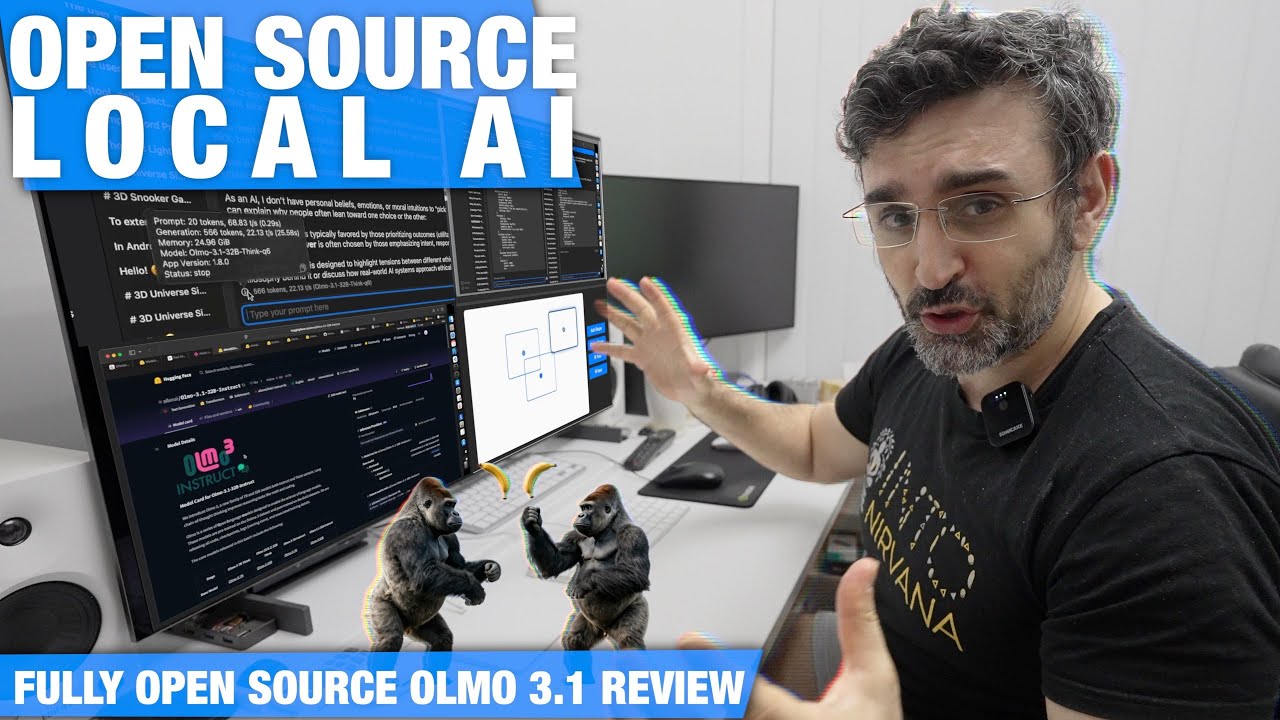
100% OPEN SOURCE Olmo 3.1 Local AI - 32B Instruct & Think Developer REVIEW
Keywords
Summary
193 words
Critical Evaluation
Value of the Information & Strength of the Argument
The video provides substantial hands-on information about OLMo 3.1’s real-world performance, including benchmark comparisons, local hardware requirements (~24 GB VRAM, 22 tokens/s on a Mac Studio), and detailed tests of tool calling, reasoning, creative writing, and coding. The argumentation is primarily empirical, showing actual prompt-response examples and runtime logs. However, the evaluation is anecdotal and the reasoning tests are single-instance, which may not be representative. The reviewer’s opinions are clear but sometimes subjective (e.g., judging story quality). The backing for claims relies on official benchmarks from Ai2, which are credible but not independently assessed in the video.
Scientific Rigor, Source Quality, Title Accuracy
The video cites official benchmarks and supplies Hugging Face links for the exact MLX quantized models used. It also mentions the Inferencer application used for testing. The title accurately reflects the content: a review of OLMo 3.1’s Instruct and Think versions running locally. The sources are directly relevant and verifiable, though the reviewer does not provide external academic references. The video’s conclusion to download the model is a call to action rather than a measured critique, but overall the sourcing is adequate for a practical review.
198 words
Title / Content Match
The title accurately describes the content: a practical review of OLMo 3.1 Instruct and Think models running locally.
Quality & Reliability
7/10
The video presents official benchmarks and practical tests, but the analysis is subjective and lacks independent verification.
Key Moments
Markers derived by PSI from the transcript: the creator did not define chapters.
- Introduction to Ai2 and Paul Allen's background
- Benchmark comparison with Gemma models
- Tool calling test with Inferencer website
- Logic puzzle (surgeon riddle) on instruct model
- Trolley dilemma test on thinking model
- Creative writing and token inspector demonstration
- Coding test: Gorilla game clone in HTML
- Batching test with two simultaneous inferences
- Word processor and MS Draw clone results
- Conclusion and Elmo segment
Cited Sources
- Olmo-3.1-32B-Instruct MLX 6.5bit — Hugging Face model card for the Instruct version used in testing.
- Olmo-3.1-32B-Think MLX 6.5bit — Hugging Face model card for the Think (reasoning) version used.
- Inferencer App — The application used to run and test the model locally.
External References
Contribution & Novelties
This video adds hands-on evidence of OLMo 3.1’s practical capabilities and limitations, particularly for local execution. It demonstrates that a fully open-source model can outperform major closed alternatives on certain benchmarks and handles tool calling and creative tasks, while highlighting issues like refusal on ethical dilemmas and generic story titles. The discussion of fine-tuning from open checkpoints is a valuable resource for developers.
Pour aller plus loin :
- Allen Institute for AI (AI2) — The organization behind OLMo, providing open-source models and datasets.
- Large language model — Background on LLM architectures and training.
- Hugging Face — Platform hosting the MLX quantized versions and other open models.
- Fine-tuning concept — The video suggests using OLMo’s checkpoints for custom fine-tuning; see Hugging Face’s fine-tuning guides for practical methods.
126 words
Radar Profile
The radar chart shows a balanced profile with strength in information quantity (8) and moderate scores in quality, technique, and reliability (7,6,7). This reflects a video that packs a lot of practical detail but with some analytical depth and credibility trade-offs.