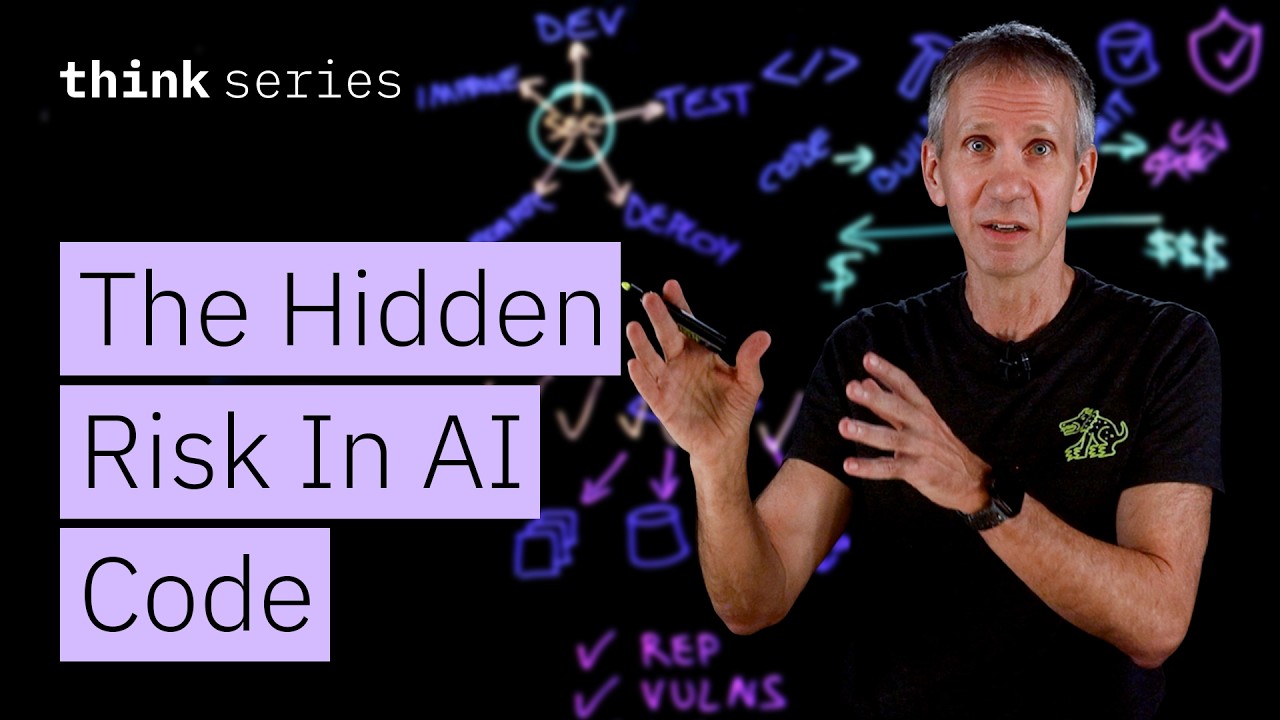
How Developers Secure AI-Generated Code: 5 Security Best Practices
Keywords
Summary
121 words
Critical Evaluation
Value of the Information & Strength of the Argument
The video provides a valuable overview of practical security considerations for AI-assisted development. It argues convincingly that traditional security practices are insufficient when code is generated at machine speed, and it offers actionable principles. The argumentation is logically structured, using examples like a service that correctly retrieves data but over-exposes it, and the King Midas analogy to illustrate intent problems. The emphasis on continuous validation and dependency management is well supported, though the lack of specific case studies or empirical data slightly weakens the depth. Overall, the value lies in its clear, applicable guidance for developers and security professionals.
Scientific Rigor, Source Quality, Title Accuracy
The rigor is moderate: the presenter relies on general knowledge and anecdotal evidence rather than citing specific studies or standards. He mentions a zero-day vulnerability found by an AI model but does not provide details or a reference. The description includes a link to a shift-left testing resource, which is relevant and provides additional credibility. The title matches the content exactly, presenting five principles as promised. No official sources are cited beyond the channel’s own link, and the video does not engage with academic literature. Consequently, while the content is coherent and aligns with industry best practices, it could benefit from explicit references to frameworks or research.
221 words
Title / Content Match
Title accurately reflects the content: the video systematically outlines five distinct security best practices for developers working with AI-generated code.
Quality & Reliability
8/10
The video presents clear, coherent security principles for AI-generated code from an IBM expert, using practical examples and analogy. While it lacks detailed external citations, the content aligns with established DevSecOps practices.
Key Moments
Markers derived by PSI from the transcript: the creator did not define chapters.
- Introduction: AI changes software development, but security must adapt.
- Principle 1: Trust the outcome, not just the generation; validate permissions, data leaks, and failure handling.
- Principle 2: Security starts during development; shift-left with static analysis, DAST, and compliance checks.
- Principle 3: Validate dependencies; review package reputation, vulnerabilities, and source integrity.
- Principle 4: Validate intent; ensure the AI solved the right problem, considering business rules and data protection.
- Principle 5: Security as a continuous practice; monitor, patch, and verify even after release.
- Conclusion: Agentic AI requires guardrails and human oversight; trust is the ultimate goal.
Cited Sources
- Shift-Left Testing — Referenced in the video description as a resource for shift-left testing practices.
External References
Contribution & Novelties
This video synthesizes well-known security principles (shift-left, dependency management, continuous validation) and adapts them specifically to the challenges of AI-generated code. It emphasizes that outcomes, not just code, must be verified, and that intent validation is critical when AI interprets ambiguous requirements. The discussion of agentic workflows and the need for guardrails adds a forward-looking perspective.
Pour aller plus loin :
- Shift-left testing — Explains the general shift-left approach in software testing, relevant to the core concept.
- Software supply chain — Provides background on supply chain risks that AI-generated dependencies introduce.
- Zero-day vulnerability — Gives context on the 27-year-old vulnerability example mentioned in the video.
105 words
Radar Profile
The radar profile shows balanced moderate-to-high scores, with quality and reliability slightly above quantity. This indicates a concise yet substantive tutorial that prioritizes clear, trustworthy advice over exhaustive detail. The technical level is appropriate for a professional audience, and the overall profile suggests a solid but not extraordinary contribution.