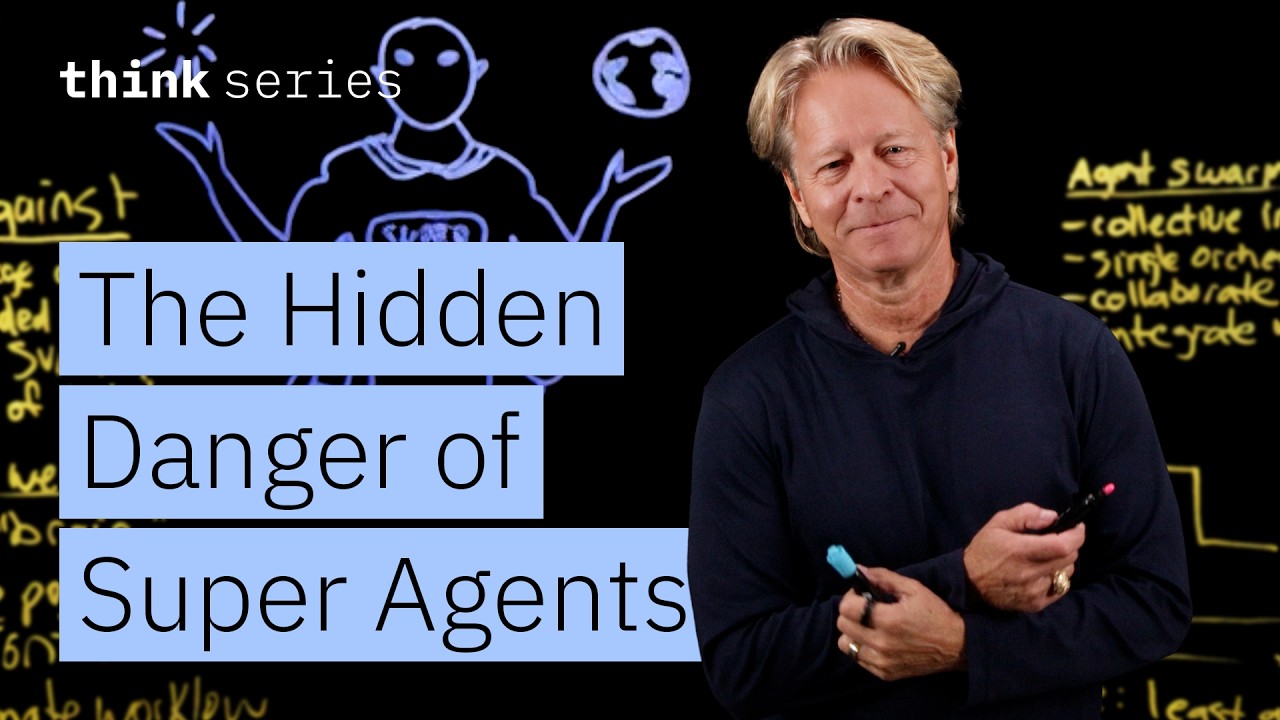
When Should AI Systems Use Super Agents?
Keywords
Summary
151 words
Critical Evaluation
Value of the Information & Strength of the Argument
The video provides a valuable conceptual framework for when to use super agents, distinguishing between the high-level orchestrator and the low-level agents interacting with critical resources. The argumentation is coherent, logical, and practical, building from historical precedents to contemporary challenges. It effectively balances the benefits of centralized intelligence with the security risks, offering a step-by-step design approach. The use of a graph to visualize the agency-risk trade-off is particularly insightful, though it remains somewhat abstract without concrete implementations.
Scientific Rigor, Source Quality, Title Accuracy
The video is an expert opinion from IBM Technology without external citations or references to specific research, but it reflects industry-standard concepts like least privilege and observability. The title perfectly matches the content, and the description includes links to IBM’s Agentic AI resources, which are referenced in the sources section. No comments are available for analysis.
149 words
Title / Content Match
The title directly matches the content, which asks when super agents should be used and explains the conditions and safeguards.
Quality & Reliability
8/10
The video provides a well-structured, reasoned expert opinion from an IBM engineer, with clear security principles and practical guidance. It lacks empirical data or citations but is logically coherent and aligns with industry best practices.
Key Moments
Markers derived by PSI from the transcript: the creator did not define chapters.
- Introduction to the concept of super agents, referencing historical precedents like master control programs.
- Discussion of concerns: privilege abuse, expanded attack surface, and lack of isolation.
- Benefits of super agents: the 'brain' for organization-wide understanding, single point of contact, and workflow coordination.
- Introduction of agent swarms as a secure model, with a single orchestrator and collective intelligence.
- Presentation of the agency vs. risk graph, explaining the step function for low agency at high risk.
- Key principles: least agency, tool isolation, and observability, plus the importance of human oversight.
- Conclusion: super agents are acceptable with proper safeguards like least agency and observability.
Cited Sources
- Learn more about Agentic AI — Referenced in the video description as a resource for learning more about agentic AI.
- Sign up for a monthly newsletter for AI updates from IBM — Recommended in the video description for staying updated on AI news.
Contribution & Novelties
The video contributes a practical yet expert perspective on a debated topic, offering a clear decision framework based on agency and risk, and emphasizing the importance of agent swarms and orchestration. It adds value by synthesizing common security principles into a specific agentic AI context, making it accessible to practitioners.
Pour aller plus loin :
- Multi-agent system — Relevant to understanding agent swarms and collective intelligence.
- Principle of least privilege — Directly ties to the concept of least agency discussed in the video.
- Observability — Fundamental for monitoring and auditing agent behavior as highlighted in the video.
97 words
Radar Profile
The radar profile shows balanced scores across information quantity, quality, technical level, and reliability, with a slight strength in quality and reliability, indicating a solid expert overview without deep technical details.