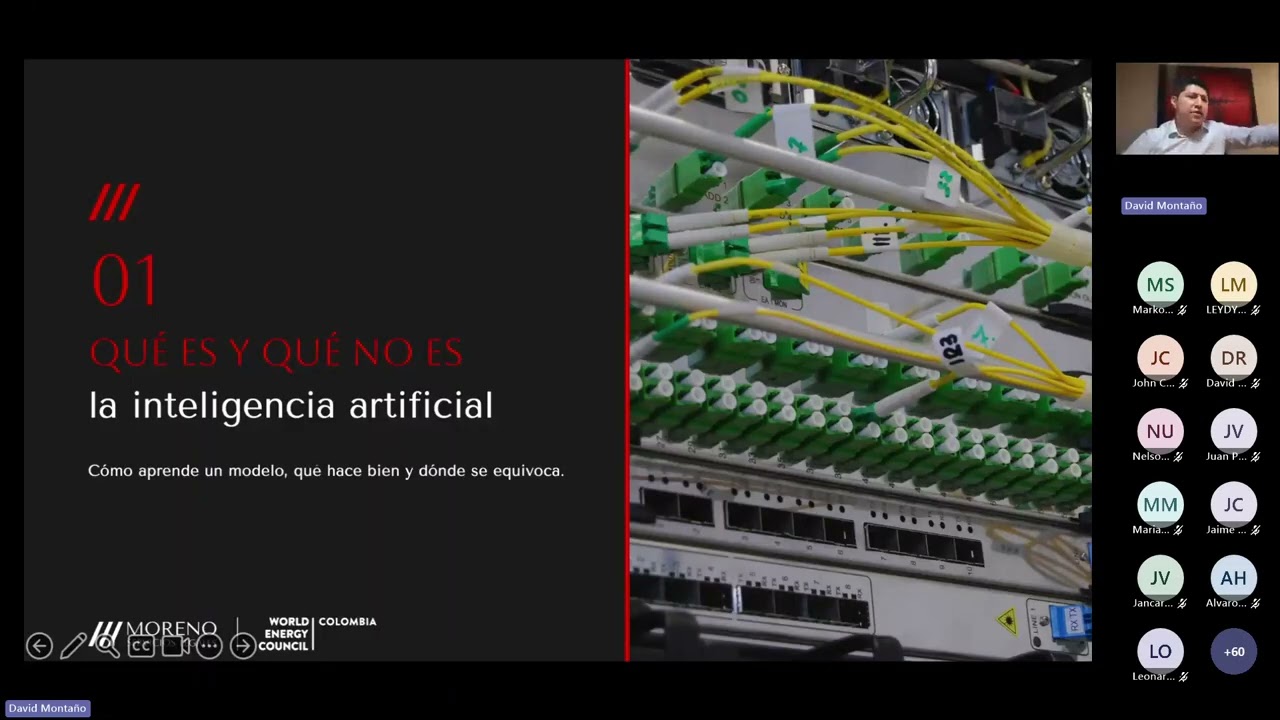
Webinar IA y Energía Que es y qué no es la IA
Webinar AI and Energy What AI is and what it is not
Keywords
Summary
182 words
Critical Evaluation
Value of the Information & Strength of the Argument
The value of the information lies in its practical orientation, bridging technical AI concepts with energy sector realities, especially for Latin America. The speaker uses a relatable anecdote (fraud detection model misclassifying a vacant house) to illustrate potential failures, which strengthens the argument about the need for careful implementation. The argumentation is coherent, moving from definitions to applications and then to risks and governance. The inclusion of IEA data adds credibility, though the speaker could have provided more direct citations. The distinction between AI as a tool and AI as a client (data centers) is insightful and highlights a growing trend.
Scientific Rigor, Source Quality, Title Accuracy
Scientific rigor is moderate: the speaker cites the International Energy Agency and a Chilean case, but other claims are based on anecdotal experience. The title matches the content well, addressing both the definition of AI and its energy implications. The webinar is more of an expert opinion than a systematic review, so sources are illustrative rather than exhaustive. The lack of visible presentation slides or references in the description reduces verifiability, but the speaker’s professional background lends some authority. The provided transcript does not include comments, so no public feedback was analyzed.
208 words
Title / Content Match
The title accurately reflects the content: a webinar addressing what AI is and isn't, with a focus on energy sector implications.
Quality & Reliability
7/10
The content is an expert webinar with clear explanations, practical examples, and references to IEA data. While not peer-reviewed, it provides a solid overview and includes specific case studies. Minor limitations: some claims lack direct citations, and the legal perspective is emphasized.
Key Moments
Markers derived by PSI from the transcript: the creator did not define chapters.
- Introduction by Marco, welcoming attendees and introducing David Montaño López.
- David starts explaining the agenda and the importance of AI in energy.
- Definition of AI: 'learns patterns from past data to predict what comes next', explained with a diagram.
- Discussion on the learning process and the assumption of continuity; AI cannot say 'I don't know'.
- Common misconceptions: AI is not always accurate, explanations must be designed, cloud is physical infrastructure, and existing regulations apply.
- AI applications in generation, grid, and non-technical losses; mention of IEA data on transmission capacity (115-177 GW).
- Case study: Chilean grid coordinator reduces simulation times by 86% using AI.
- Transition to AI as a client: data centers requiring constant 24/7 power supply.
- Legal and governance issues: data ownership, vendor responsibility, and the need for contractual safeguards.
- Recommendations: transactional considerations and data governance for energy companies adopting AI.
- Closing remarks and invitation to next sessions.
Cited Sources
- International Energy Agency (IEA) reports on transmission capacity and AI applications — Mentioned when discussing potential grid efficiency gains (115-177 GW) and building efficiency.
- Chilean system coordinator (Coordinator Eléctrico Nacional) — Example of AI reducing simulation times by 86% in grid expansion planning.
Concurring Sources
- IEA report on digitalization and energy — Supports claims about AI improving grid efficiency and demand forecasting.
- World Economic Forum on AI and energy — Provides additional context on AI's role in energy transition; not directly cited but aligns with the webinar's themes.
Dissenting Sources
Contribution & Novelties
This webinar provides a comprehensive overview of AI in the energy sector with a focus on Latin America, integrating legal and business perspectives often missing in technical discussions. It clarifies common misconceptions and highlights concrete use cases, such as non-technical loss detection and grid optimization. The emphasis on AI infrastructure as a growing energy client is particularly timely.
Pour aller plus loin :
- Artificial intelligence — General background on AI definitions and types.
- Data center — Infrastructure details and energy consumption patterns.
- Smart grid — How AI integrates with grid operations.
- International Energy Agency — Primary source for energy data and AI-related reports.
- National Electric Coordinator (Chile) — Official site for the case study mentioned.
115 words
Radar Profile
The profile shows strong scores in information quantity and quality, reflecting rich content and practical insights. Technical level is moderate, indicating accessibility for non-specialists while still offering substance. Reliability is fair, with reliance on authoritative sources like the IEA but limited direct citations. This creates a balanced profile suitable for an introductory-to-intermediate audience.