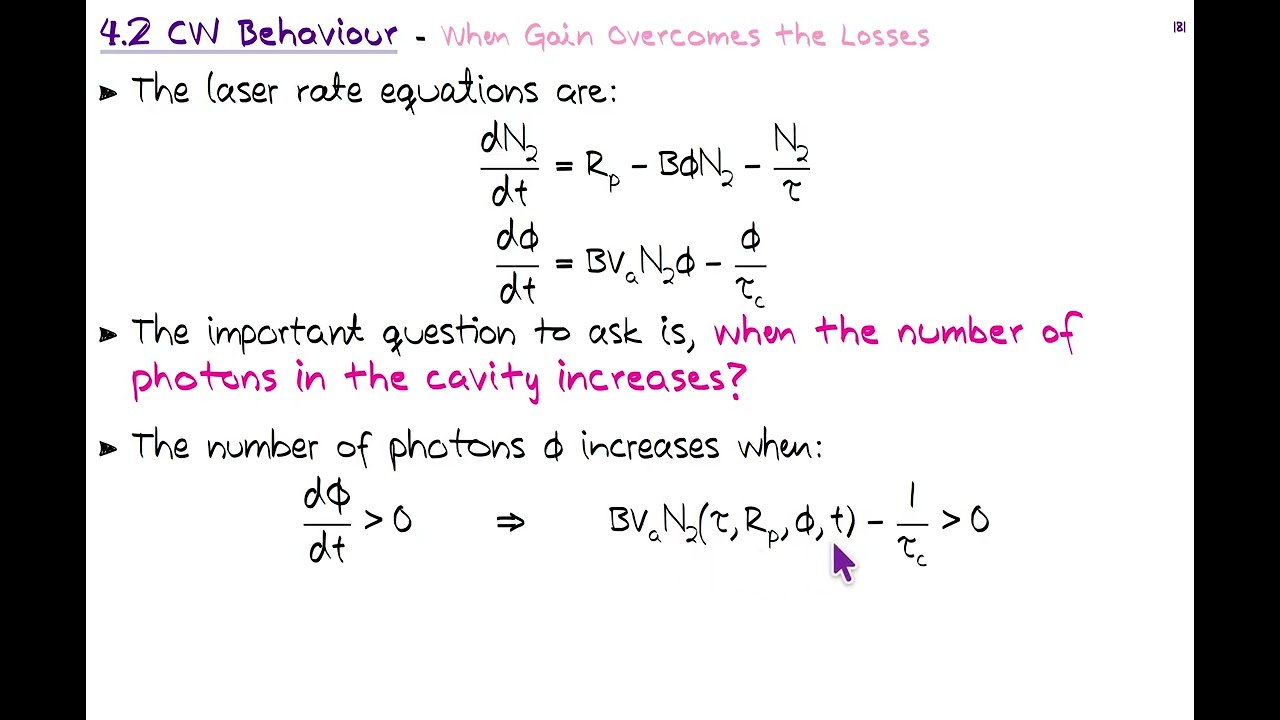
FYS.510 Laser physics 4.2 CW Behaviour, part I
Keywords
Summary
173 words
Critical Evaluation
Value of the Information & Strength of the Argument
The value of this lecture lies in its systematic derivation of laser threshold and steady-state behavior from fundamental rate equations, offering clear physical insights into factors controlling laser efficiency. The argumentation is solid: the instructor carefully defines variables, states assumptions, and derives inequalities step by step, linking each mathematical result to practical engineering considerations such as minimizing cavity losses or extending gain length. The explanation of why an extra photon term is necessary is particularly insightful, connecting classical and quantum perspectives. The logic is consistent and the presentation progresses logically from threshold to post-threshold behavior.
Scientific Rigor, Source Quality, Title Accuracy
The scientific rigor appears high: the lecture follows standard textbook methods (e.g., Siegman’s ‘Lasers’), and the derivations match conventional laser physics treatments. However, no explicit sources or references are cited within the video or description, so external verification is limited. The title accurately reflects the content: it is a focused lesson on continuous-wave behavior, part I, covering threshold and steady-state analysis. There is no mismatch between title and content.
179 words
Title / Content Match
The title precisely matches the content: a laser physics course lecture on continuous-wave behavior, part I.
Quality & Reliability
8/10
Coherent, university-level lecture deriving laser CW behavior from rate equations; standard methodology without cited references.
Key Moments
Markers derived by PSI from the transcript: the creator did not define chapters.
Contribution & Novelties
This video provides a pedagogical treatment that clarifies the mathematical foundation of CW laser operation, especially the role of the spontaneous emission seeding term. It offers a clear connection between the differential equations and practical laser design parameters. The ‘single photon’ inclusion is explained convincingly, demystifying why even a zero-photon initial condition can lead to lasing.
Pour aller plus loin :
- Laser - Overview of laser physics.
- Rate equation - Mathematical basis for population and photon dynamics.
- Stimulated emission - Process underlying gain.
- Population inversion - Condition for amplification.
89 words
Radar Profile
The radar profile shows high scores across quantity, quality, technical level, and reliability, indicating a dense, accurate, and advanced lecture suitable for advanced students. The balance between information density and clarity is strong, with slightly lower quality score than quantity, reflecting that some derivations are presented quickly.