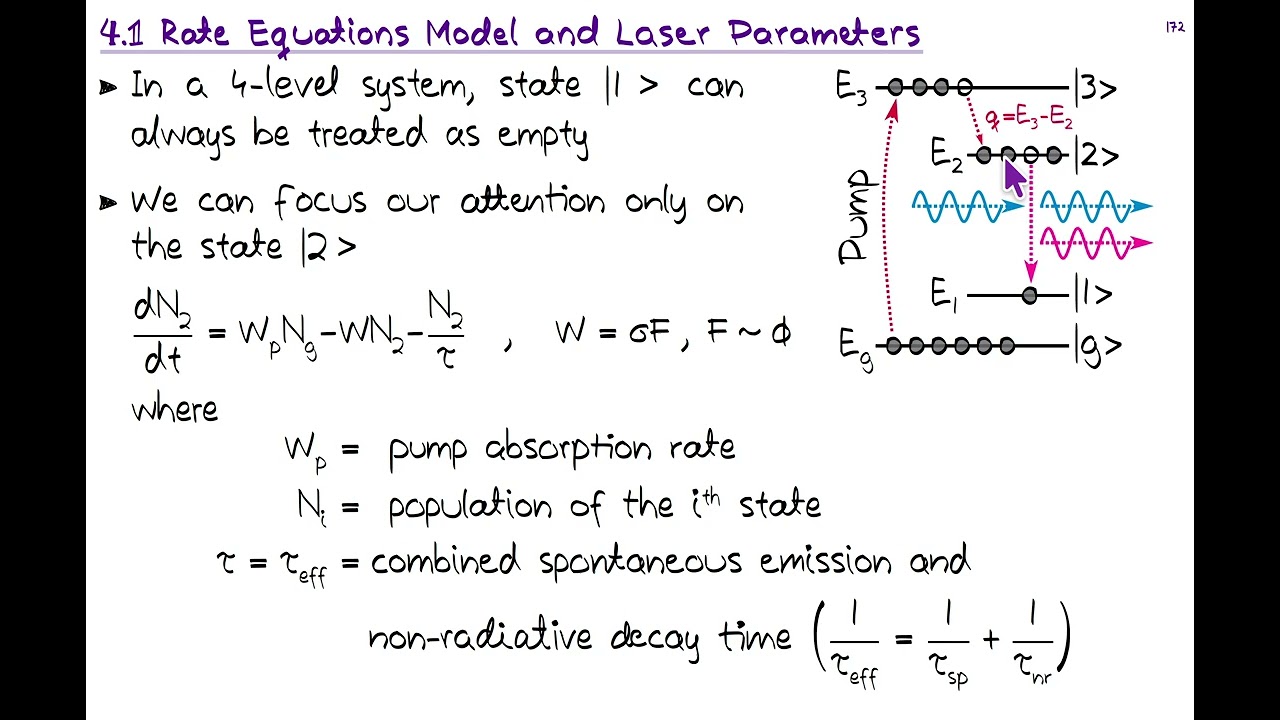
FYS.510 Laser physics 4.1 Rate Equations Model and Laser Parameters
Keywords
Summary
155 words
Critical Evaluation
Value of the Information & Strength of the Argument
The lecture provides a clear and systematic exposition of the rate equation model, which is central to understanding laser dynamics. The argumentation is solid: each step is motivated by physical reasoning, and the mathematical derivations are transparent. The lecturer emphasizes the physical meaning of each term, which enhances comprehension. The value lies in bridging microscopic interactions (stimulated emission, spontaneous emission) with macroscopic cavity parameters (losses, lifetime), offering a usable model for practical laser analysis.
Scientific Rigor, Source Quality, Title Accuracy
The scientific rigor is high for an introductory lecture. The approximations are clearly stated and justified (e.g., small losses, linearization). The derivation correctly follows standard textbook treatments. No external sources are cited, but the content is consistent with established laser physics. The title matches the content precisely. The lecture does not rely on dubious claims and presents the material in a coherent, error-free manner.
153 words
Title / Content Match
The title accurately reflects the content: it focuses on the rate equations model and laser parameters as part of a laser physics course.
Quality & Reliability
8/10
The lecture presents a rigorous derivation of the rate equations for a four-level laser system, with clear assumptions and mathematical steps. The content is consistent with standard laser physics textbooks and includes proper physical interpretations. No external sources are cited, but the educational nature and logical structure support high reliability.
Key Moments
Markers derived by PSI from the transcript: the creator did not define chapters.
- Introduction and overview of the chapter on continuous wave laser behavior.
- Recap of previous chapters and outline of topics to be covered.
- Distinction between pulsed and continuous wave lasers, and introduction to ultra-short pulse terminology.
- Assumptions for the space-independent model: four-level system, single longitudinal mode, constant transverse profile, homogeneous broadening.
- Formulation of the population rate equation for the upper laser level and the photon number equation.
- Physical interpretation of each term in the rate equations.
- Derivation of the B coefficient and photon lifetime from cavity parameters using round-trip analysis.
- Introduction of logarithmic losses and linearization of the exponential gain term.
- Final expression for the rate equations with explicit definitions of all parameters.
- Summary and discussion of how the model can be extended to pulsed lasers.
Contribution & Novelties
This lecture offers a pedagogical derivation of the laser rate equations, making the connection between microscopic processes and macroscopic cavity parameters explicit. It serves as a foundational model for understanding CW laser operation.
Pour aller plus loin :
- Rate equation model for lasers — This article provides a broad overview of rate equations in laser physics, useful for background.
- Four-level laser — A detailed description of the four-level system assumed in the derivation.
- Photon lifetime — Explains the concept of photon lifetime in optical cavities, central to the model.
- Laser cavity losses — Discusses cavity losses and their influence on laser performance.
102 words
Radar Profile
The radar profile shows high scores in technical level and reliability, with slightly lower scores in information quantity due to the focused scope. The balance indicates a solid, in-depth tutorial that is both trustworthy and technically competent.